Monday, November 14, 2016

Stats Geeks, Bent Coppers and Proper Football Men (By Paul Tomkins)

https://tomkinstimes.com/2016/11/stats-geeks-bent-coppers-and-proper-football-men/

AKA ‘Good Old-Fashioned Policing’ Needed Science Too
A lot has been spoken about football analytics in the past year, ever since Brendan Rodgers was sacked and a few media outlets blamed a man with a laptop and a nickname; a man who has subsequently become Liverpool’s Sporting Director, in part based on the improvements at the club in the past 12 months.
Some suggest that there is no common ground between those who think football needs to be seen to be believed and those who value data, although it’s fair to say that I’m not aware of anyone in the latter category who writes off the importance of the former. Few analytics people, if any, think the numbers tell you everything; although some may value their ideas too highly, as we can all fall in love with our own creations and fail to see them objectively.
And let’s face it, few data ‘nerds’ are willing to put a 6’5” centre-back up against the dressing-room wall at half-time before trying to insert a cup of boiling tea into his rectum, if such tactics are still required in 2016.
Equally, there are some ‘proper’ football people who also like what data can add, although it is the traditionalist – the Proper Football Man – who seems to feel most threatened by the way the sport is moving.
As we’re seeing all over the western world right now, when someone’s way of life is threatened they can become angry and react with passion and hatred – lashing out in the process – rather than trying to take an objective stance and studying the true factors behind it. Blaming the immigrant is what happened in Germany in the 1930s, and we all know what that led to. Blaming the data-guys-and-girls must be tempting if results aren’t going your way, and you were brought up to buy players via traditional methods.
When mulling over the clash between analytics and the old ways, it struck me that there was a parallel: the fight between good old-fashioned police work and the modern technology (and science) used to catch criminals. The police often resist new science – certainly in the more rural, backwards areas – but in time it has come to play a key part.
Unlike football, this stuff really is life and death. And we put our trust in science because it makes sense; it gets results. However, none of this is done without the investigative skills that have been around since the mid-19th century. In other words, none of it is done without good old-fashioned police work.
It’s a partnership. On their own, neither approach will work. A complex genetic code is of no use without someone to analyse it; and a Sweeney-style copper beating the crap out of someone in the interrogation room (with no tape recorder or video feed) because he knows the guy did it, even though there’s no evidence, would be a return to the dark ages. Turns out that knowing something – gut instinct – isn’t always to be trusted. Yes, sometimes it may be right, but it can just as easily be wrong. Science often helps us to discover what is counterintuitive.
While evidence in football isn’t as clear cut as it can be with crimes – a one-in-quadrillion chance that the DNA profile belongs to someone other than you is impossible to dispute; whereas an expected goals model isn’t going to prove anything definitively – there is still the need to interpret it, and to add context. It may inarguably be your DNA, but there could be myriad innocent ways it could have ended up at the scene. (I once saw a programme about a case where there were seventy semen deposits from different men found on a hotel bedspread, upon which a dead woman had been found. The science here tells us that … we probably need to take our own sheets when travelling around, or to sleep on the floor.)
Lab-work will confirm it’s your DNA; police-work will determine why it’s there.
A big part of the problem with eyes-only scouting is that we can’t always trust what we see. We all have our biases, and we can be misled by these different types of bias.
In Soccernomics, Kuper and Szymanski described how traditional scouts tended to favour blonde-haired players because they stood out. And part of Moneyball (the book, not the misunderstood theory) related to how Billy Beane, as a young man, was the perfect-looking batter – big, strong, lovely smooth technique – but he himself admitted he was too tense when at the plate, with the book detailing how a less-talented peer made a much better career as a player because he had a carefree attitude (and therefore didn’t choke).
The theory of moneyball relates to finding skills that aren’t instantly obvious, where the eye-test can be deceiving. We don’t need stats to tell us Lionel Messi is absolutely outstanding, for example, because we can see for ourselves; but they can still help quantity just how good he is, compared to the competition. (For example, his creativity for others dwarfs that of Cristiano Ronaldo, and so, with similar goalscoring records, puts him ahead as a player.) And even then, it cannot be reduced to an equation that defines all of Messi’s subtle skills and complexities.
But finding value can be about discovering what other people can’t, because outside of the world’s elite, plenty of players look vaguely the same. And our eyes – our perceptions – can let us down, because of all those biases. (Note to young, aspiring footballers: take a headband smeared in realistic fake blood to any professional trials you attend. It will make you stand out, and bring to mind the commitment of Terry Butcher.)
Indeed, for the past few decades – ever since the science was first used in 1987 in what became my home town (Leicester) – the factual certainty of DNA fingerprinting has been used to undo countless wrongful convictions that were usually based on the massively flawed concepts of eye-witness testimony and coerced confessions, both of which are due to biases within the mind.
Geographical profiling
To me, geographical profiling is one of the areas where there is some clear overlap between football and criminal detection. The idea was developed to show that offenders tend to work in locations where they feel most comfortable – where they grew up or where they live (and also where they work), given that knowing an area is helpful in determining what escape routes are available. Then there’s the simple fact that people are more likely to offend where their everyday life occurs (including the many unplanned crimes of opportunity); few people from Bradford or Glasgow are going to take a holiday to China just to murder someone. They will know the country lanes and the dimly lit alleys of their hometowns, and lurk there.
Habits of movement, and locations of shots, tie into this. You can identify a player’s traits from his behaviour; and so a heat-map, or a matrix of shot locations, pieces together the evidence in a way that we may not notice when using our eyes in realtime. (On this subject, I wrote a month or two ago that, against Leicester, Gini Wijnaldum impressed me with his deep-lying interceptions and deceptively simple passes, which were reminiscent of John Barnes in the mid-‘90s. However, upon re-watching the game I noticed how many forward runs he made, without getting the ball. This would have shown up in the tracking data that the club has access to – the kind of big-data the clubs monitor with the latest technology – but not in a simple touch-based heat-map. And it only became apparent to me once I’d had the luxury of watching it again, without the anxiety – and ball-following – that comes with viewing a game live. In real life, eye-witness testimony is flawed due to what we fail to notice, and what we chooseto see.)
The older I get, the more interested I am in analysis, detection, and the way we assess things in general, rather than just saying who played well and who did not, and raging about which player the club hasn’t yet signed. For the past decade and a half I’ve watched a ton of crime documentaries, mostly because I like the way problems are solved; but equally, many of these films and TV series also highlight the flaws in the processes over the past few decades (although in big metropolitan areas it has significantly improved). As such, the mistakes are just as interesting to learn from. Perhaps we can say the same about Damien Comolli’s interest in crosses?
The more I watch football – and I still love the pure elements of the sport, beyond the numbers; especially when a team operates as thrillingly as this current Liverpool side – the more I’m bothered by ignorant views. Not least because my love of football brings me into contact with such people, mostly via Twitter.
Indeed, it seems that the internet has allowed us to forego the knowledge built up through centuries of research and academia, as well as the views of an impartial quality press, insightful authors and journalists, and trusted broadcasters; even if we didn’t always agree with them, we could still learn from them. Certain hate-filled publications were very much underground, niche concerns, limited to small mailing lists that the police monitored. (And the BBC wouldn’t regularly give airtime to fascists.)
The internet has put an incalculable amount of extra good information out there – but it has allowed the propagation of an equal, if not far greater, amount of misinformation. I don’t know if we’ve ever been more exposed to ignorance, based on how easy it is to muddy the waters with bullshit, with hit-chasing tabloids and cable news shows shamelessly profiting from hate-mongering, and with no sense of shame in the lies they tell. For every scientific fact you can find an unqualified counterargument (often funded by big business and their lobbyists), shared within increasingly loud echo chambers, that once would have been limited to those small mailing lists.
While experts make mistakes, the truth is that we need genuine experts more than ever in our lives, whilst shysters thrive on denouncing them (and we lurch backwards in our thinking). At times it’s hard to worry about the quality of our football pundits when the rest of our lives are being overridden by knowingly deceitful people.
We are entering the post-truth age, where anything goes, and that’s scary. Example: in 1989 Donald Trump took out full-page ads in the US press stating that the ‘Central Park 5’ should face the death penalty for bludgeoning and raping a 28-year-old woman, given that they had confessed – but also, where no evidence was found, and where police intimidation was claimed (and the victim had no memory). As CNN put it recently, “In 2002, another man, a convicted rapist and murderer, confessed to the assault, and his DNA did match semen that was found on the victim. No DNA evidence has been found to tie any of the Central Park 5 to the crime.”
The reason for sharing this comment from CNN? With remarkable cognitive dissonance, Trump still insists that the five are guilty. (Still, at least that loser is nowhere important these days, eh? Phew!)
In his book Black Box Thinking, Matthew Syed talks about how the aviation industry reports on all its mistakes, with detailed investigations into every accident, which are then made public, and come with strong recommendations to all airlines based on the results. Syed talks about how, for example, the health industry often treated deaths on the operating table during minor procedures as “just one of those things” – without ever noting that the same things were happening time and again, all throughout the world; where junior members of staff could see the problem but were too scared to tell the surgeons, who were in denial. Treated as isolated incidents, no data was ever built up in order to find a pattern.
Syed also talks about crime, and false confessions, and offers his own examples. And yet in just the past fortnight I have watched three unrelated documentaries involving false confessions that led to wrongful convictions, and have seen and read about many more beforehand. They usually rely on confirmation bias – the detective, rather than looking objectively at the facts, is trying to get the suspect to fit into his own idea of what happened (and a conviction can often be the goal for police and prosecutors who are blinded to the facts; they can still “win” despite getting it wrong. But here society loses not once but twice: the innocent are jailed and the guilty are free to offend again).
This is known in the police world as tunnel vision – ignoring clues in the investigation that don’t tally with the preferred theory, with the blinkers narrowing the field of view. Thankfully they’re much more aware of it now, although perhaps not in Manitowoc County.
The Ryan Ferguson case is one of the most interesting I’ve come across, as his friend – Chuck Erickson – confessed in 2003 to killing sportswriter Kent Heitholt two years after the event, even though he couldn’t actually remember doing it, as he had blacked out after heavy drinking and drug usage. He just had this vague sense – almost a dream – and upon confessing said Ferguson was with him. Both boys were just 17 years old at the time of the crime, and Ferguson was nowhere near the incident. Ericsson’s story was beyond patchy, but the police wanted to believe it.
When Erickson was asked to detail how events unfolded, he said he hit the man just once with a blunt instrument; the interrogator said that actually there was evidence of multiple blows. So Erickson said that Ferguson hit him the other times. When asked how the victim was then strangled, Erickson said it was Ferguson, using a rolled up shirt. Erickson was told that this didn’t fit the evidence, so Erickson changed it to a rope.
When he was told it wasn’t a rope either (at which point, as an observer of the recorded interview, you find yourself screaming WTF!?), the suspect was asked if he remembers Ferguson removing the victim’s belt to strangle him with it, and yes! – that was it! Of course!
Before this part of the interrogation, Erickson had been told that Ferguson was confessing and blaming it all on him (a blatant but not illegal lie), and that, as he was banged to rights, if he wanted a better deal he had to get in first. Ferguson was later told by the police that of course he was guilty – how would Erickson have got all the facts given that they weren’t released to the media? (It also later transpired that the police also ignored the testimony of the only eye-witness because she said it definitely wasn’t Ferguson. All the witnesses involved complained of bullying by the prosecutor, who is now … a judge.)
When Ferguson was first arrested he was told that Erickson had confessed and implicated him too, with the officer saying it therefore must be true, as he’d never heard of someone confessing to something they hadn’t done. And yet I was already aware of many, many examples.
People have trouble believing that anyone would confess to something they didn’t do, but the truth – as gathered from large sample sizes – is that they do, all the time. These provide examples of how our thinking can be so skewed by beliefs.
There was Michael Crowe, a 14-year-old boy, whose 16-year-old sister was raped killed by a homeless man who, in 1998, broke into their California house – but which was determined by DNA only months after Crowe had been in custody for the crime. Crowe liked playing video games, and after countless hours of interrogation he cracked and confessed to a crime he did not commit.
Like almost everyone else, he was either young or vulnerable –or both; and not aware of the need for a lawyer. He confessed just to escape the torment of the third degree, assuming that the mess could later be undone once the angry men had stopped shouting in his face. Luckily for him it was, but only after months on remand; others were not so fortunate.
west_memphis_three_mugshotThere was the West Memphis threeconvicted with no evidence, but where one of the youngsters (the one with a low-IQ, Jessie Misskelley), confessed, which put all three teens – who dressed in black and liked heavy metal music – behind bars for almost twenty years. Even the parents of the victims – three nine-year-old boys – ended up protesting their innocence (apart from one of the parents – a step-dad who is still suspected of the crime, and whose DNA was found at the scene).
Amanda Knox confessed in Italy to killing Meredith Kercher when out of her depth, speaking in a non-native tongue, and intimidated by the police. Like so many others, she was convicted for looking or behaving slightly oddly, with no actual evidence to back up the police story. Like so many other cases, it was only once it escaped the provincial court system and was viewed by a more powerful, metropolitan court that the joke of an investigation was exposed.
(Note: never discover a dead body. Also, never be the last person to see someone who later turns up dead. But if you do, be sure to react or grieve appropriately. Don’t get hysterical, as you will be suspected of acting, or of being emotionally unbalanced enough to commit murder. Oh, but don’t be quiet, and seem like you’re in shock, as that will show that you’re a heartless murdering bastard. You must master the perfect level of sadness and grief. Finally, get a solicitor/lawyer, although the police will take ‘lawyering up’ as a sign of your guilt.)
skiszkopIn 1975, Yorkshire-based 23-year-old ‘oddball’ Stefan Kiszko, of foreign descent and possessed of little or no social skills (a “mummy’s boy” whose testicles had only recently descended upon medical intervention), admitted to killing young Lesley Molseed after three days of intense questioning without the presence of a solicitor. He confessed, thinking he could go home and everything would duly be sorted. Except it wasn’t; even though the semen found on the victim had sperm heads, and due to his medical condition he was incapable of producing such spermatozoa. He was released as an innocent man17 years later, but after all that time spent locked up, being beaten up and abused for being a child-killer and rapist, he only lived another year before succumbing to a heart attack.
The true offender in that case – Ronald Castree – had been found guilty of abducting a 9-year-old girl around the same time as the Molseed murder, driving this victim to an abandoned property, sexually assaulting her, before ejaculating over her, at which point she luckily escaped. He was given … a £25 fine. (Who says the law is an ass?)
Castree was never considered a suspect because the data wasn’t all linked together, in the way that it is now, in the age of powerful computers; back then, the police files were comprised of millions of index cards, which made it hard for decent policemen and women up and down the country to tie crimes together. Of course, in this case the police still chose to ignore powerful evidence (that the sperm could not have been Kiszko’s) that contradicted their case.
Perhaps most interesting to me is the case of Richard Buckland, the 17-year-old with learning difficulties who confessed to the murder of Dawn Ashworth, the second such crime of the mid-1980s in the part of Leicester I first moved to over a decade later (honestly – I can prove it). The two crimes – three years apart – were clearly linked, but Buckland only confessed to the latter, given that the police could put him in the vicinity.
So the investigators went to Alec Jeffreys at the University of Leicester, to see if the new analysis they were doing could link Buckland to both crimes. And so was born DNA fingerprinting, with the undeniable conclusion that Buckland committed … neither. He was entirely innocent, even though he’d confessed. (Donald Trump probably still thinks he’s guilty, mind.)
Thousands of men were then sampled across the area, with the true culprit, Colin Pitchfork, captured after he’d got a co-worker to take the test for him; another co-worker informing the police of this suspicious evasion. (Pitchfork recently failed in his attempt at parole but did get moved to an open prison.)
08-brendan-dassey-interrogation-w536-h357-2xThe most recently highlighted – and perhaps famous – example is the confession of the low-IQ youngster Brendan Dassey, via the compelling Making A Murderer, which made waves almost a year ago, a decade on from the clearly coerced confession. (I even appeared on an Anfield Index podcast about the show at the time.) The whole original process, including the behaviour of Dassey’s own defence lawyer, was simply to confirm his guilt, not to investigate the facts or discover the truth. Like others, he was ready to go home after his initial confession, thinking he had done what was asked of him. It took him over a decade to get home; much like Ryan Ferguson, whose lawyer (Kathleen Zellner) also set Dassey free.
And there’s that aforementioned tunnel vision, or confirmation bias. In 2000, Brenton Butler (the subject of the brilliant “Murder on a Sunday Morning”), was a diligent 15-year-old African American kid walking back from getting an application form for a job at Blockbuster video. Two hours earlier an elderly white woman had been robbed and shot in the face at point-blank range whilst leaving a hotel with her husband. An APB went out for the murderer, a 6ft black male in his mid-twenties. Butler, at 15 and 5’8”, only matched the description due to his skin colour and gender.
Police saw Butler walking along minding his own business, and for no reason other than he was the only black person they could see at the time (in the area, two hours after the crime), put him in the back of the squad car, and promptly got the distressed husband to look at him; and, presumably thinking that as the boy was ‘in custody’ he’d done it, and doubtless still confused and shaken, he said that it was (even though the clothes also didn’t not match). Butler’s family gave the boy an alibi – he was home at the time – but it was ignored. In the middle of the night the police took Butler to where they mistakenly thought the stolen purse was dumped – the woods – and beat him up when he wouldn’t tell them where it was. To his credit, Butler still refused to confess, despite such incredible intimidation.
The purse was found by a citizen eleven miles away, at the same time in the morning that the police had stopped Butler, making for a 22-mile round trip in two hours for a kid on foot, if him dumping it there is to be believed (but they ignored the testimony of the guy who found the purse). No one else was investigated. Butler’s side of the story was never investigated; none of his neighbours were canvassed to see if they saw him.
Somehow this went to trial, but thankfully was thrown out, and the main police officers involved were all soon demoted. Years later the DNA of the true culprit was found on the purse, when it was finallyforensically tested, and the murderer went to jail. The eye witness – the victim’s husband – had got it horribly wrong, albeit if not maliciously. (People in such situations often focus on the gun rather than the person holding it, and it often all happens so quickly. Plus, people are not as good at differentiating people of a different race.)
Also, two years ago, when broaching the subject of ‘trusting what we see’ in a piece for TTT subscribers, I wrote the following paragraphs:
Let me take you back to North Carolina in the mid-’80s. Jennifer Thompson was a 22-year-old student when someone broke into her apartment, put a knife to her throat and raped her. Days later she assertively picked the assailant from a photo lineup, then, shortly after, identified him again from the physical lineup.
“I was absolutely, positively, without-a-doubt certain he was the man who raped me when I got on that witness stand and testified against him. And nobody was going to tell me any different.”
The only problem was that the accused, Ronald Cotton, was not the man who raped her. Like a lot of wrongful convictions in America (particularly in previous decades) he was a black male – although people of all races have been dubiously convicted on eyewitness testimony.
When, two years after the conviction of the man Thompson swore attacked her, another man, Bobby Poole, made a jailhouse confession, Cotton was allowed a retrial; unfortunately Poole recanted his confession in court, and Thompson insisted she’d never seen Poole before in her life. Years later DNA proved that Poole was indeed behind the attack[2016 edit: Thompson and Cotton are now friends, and Thompson does work to enlighten people to the flaws of eye-witness testimony.]
Another case is even more startling. After emerging from a coma, one woman testified that her husband was the man who raped and beat her to within an inch of her life. In this instance she couldn’t remember her husband leaving the house to get some takeaway – which he did – or the other man sneaking in through the unlocked front door. By the time the husband got back with the food she was bloodied and unconscious, and all trace of the attacker was gone. There was however one incriminating piece of evidence, in the form of the rapist’s semen. But this was before DNA testing. The husband, who was convicted on the strength of his wife’s testimony, was not going to be granted a retrial when she had sworn blind it was him, and given that there was no sign of an intruder. It took over two decades for the conviction to be overturned. (Even after the DNA evidence, the victim, who suffered some brain damage, still maintained it was her husband, despite the fact that the DNA found inside her body was from a subsequently convicted rapist and housebreaker.)
If you can mistake someone committing the most intimate (and ‘unforgettable’) of assaults, it’s fair to say that your mind can be tricked over almost anything. In the latter case the woman obviously couldn’t remember anything, but was locked into a narrative that she didn’t want to let go of, in the face of overwhelming evidence.
What has this got to do with football?
If this has little to do with football, it has everything to do with how we process information and the conclusions we reach. If we cannot analyse anything properly then we cannot truly understand football. We can just expel hot air; with some pundits making a living because their air is the hottest: super-heated bluster.
We’ve had to go through some bad science to the good science; which is often how science works, with it essentially being an example of the best of our knowledge at this point in time, and subject to change, while new ideas are poked and prodded before being taken as worthy.
For example, phrenology was the science of thinking that the shape of your head defined your character; and that criminals had different shaped-heads to the rest of us, with bumps that marked them out as deviants. Thankfully it didn’t last too long before being shown up as nonsense (…he says, nervously rubbing the strange lump on the back of his bald head.)
There’s also the polygraph – the lie detector – which is not admissible in court, because of it’s ropey results. (Sociopaths don’t tend to get nervous, so don’t trigger the sensors, while other people can be nervous about the whole process, or have guilty secrets that don’t relate to the case but which ping all the same. Also, you can learn how to beat the machine by making yourself nervous about every question, so the easy control questions – such as “what’s your name?” – get flunked too.) What I find interesting in bungled cases is how much value the police used to put into a polygraph when the suspect failed – itconfirmed everything – and how they noted the unreliability when he or she passed.
So maybe we’ve been here with football analytics too, with the Charles Reep notion – as the first person to try and collect detailed data – that most goals are scored after just a few passes, and therefore the aim should be to get the ball into the box as directly as possible, with the fewest possible interactions. And so long-ball football was born.
In more recent times, for a long while possession became the key stat, but then that too got questioned after the even more recent (but outlier) success of low-possession teams.
But then there are different types of possession – keeping the ball to score a goal by patiently moving it around until the optimal moment; playing back and forth in front of a packed defence and never taking a shot because possession has become the be-all and end-all; or knocking it about between the back four to waste time.
You can also have dynamic possession, where you only give the ball away by having a shot or trying the killer pass, after five or ten passes, and then you quickly win it back again – so it’s broken up by the opposition, but only briefly. (Arguably this is the Jürgen Klopp way, with Liverpool’s surprisingly high possession statistics, given he was painted as purely a counterattacking manager.)
It can be hard to know what data to look for, and what to trust, given the amount that’s now out there. But the job of interpreting the information is still vital in both fields: with DNA, for example, someone has to investigate what its presence means, and make sure, for example, that the suspect doesn’t have an identical twin who shares the same genetic fingerprint (and who walks around with a bloody axe).
And confessions and eye-witness testimony remain important – but confessions have to match the facts, and eye-witness testimony is very different in terms of someone saying “yes, that’s the man” when they barely got a look at a stranger fleeing in the dark compared with if they knew the person well to start with, got a clear look, and can categorically say it was that individual. The quality of the data remains vital.
But in football this evidence will probably always remain a little vague, because finding some game-changing secret is difficult, not least because of the complexity of the sport, but also because everyone else is out there looking, too. Anything that is discovered can quickly be picked up by other teams, and lose its unique value.
For example, picking better areas to shoot from, based on xG, is probably now in the thinking of most big clubs, but how its implemented will vary: lots of shots from decent areas, or keeping the ball those extra passes (which increase the likelihood of giving it away, given that most final-third passes are in an area where you will be outnumbered), in the hope of carving out that clear-cut chance. So, fewer shots overall, but more shots from close-in. Some will tell players never to shoot from 30-yards, but goals are still scored from that distance.
Conclusion: we’ve come a long way
It’s now eleven years since I first defended zonal marking on the official Liverpool FC website. Just a year earlier I’d been confused by it, and indeed, against it. Why? Well, I’m not sure. I think it’s because Andy Gray used to rant about it, and I’d only ever played a man-marking system. Then a guy called Bill Urban took me to task on RAWK, and explained what the point was, and how it actually worked – something lacking in Gray’s assessment, which was narrow-minded and almost bigoted. I went away, collected data on corners, and over the coming years was able to show how successful it was for Liverpool.
Had I stayed listening to Gray – and not seen him to be a hoary dinosaur (although actual dinosaurs adapted to change, and some had quite large brains), I could have been stuck with archaic biases and mistrust of the new and the foreign. (Does this ring any bells in wider society?)
I didn’t know what confirmation bias was back then, but I could still spot it; noting in my first book, written during 2004/05, that Norwich vs Boro had ended 4-4 with five goals due to man-marking, and not a peep about it was heard. If Liverpool conceded just one goal to zonal marking there was almost a fanfare of “I told you so”s, and that Rafa Benítez was keeping Proper Football Men like Alan Curbishley and Steve Bruce out of the top jobs.
In everyday life the media seems increasingly set-up to confirm to us what we already think we know, and the fact that Donald Trump could make so many blatant lies in the US election – not even political white lies that Democrats and Republicans have always tended to make, but blatant holy-cow whoppers – and yet still prevail is because of this lack of critical thinking. The internet, and social media, is splitting us up into those who want to learn and those who know it all and are going to impose it on the rest of us. Knowledge and intelligence is being overlooked for passion and patriotism; analysis is being replaced by brash, confident lies, stated loudly.
But in football, as in life, we should learn to understand our own biases, and know that they potentially make us wrong. We should be prepared to embrace information, not eschew it because it’s complicated and threatening. Data enables us to join the mass of dots, even if we might occasionally draw the wrong conclusions or spot an incorrect pattern.
And what we know about football – or think we know – can be carried over from what we discover about life, if we keep looking and learning. We need the beat bobbies, and we need the wily old investigators – but we also need those who can look at the bigger picture and go beyond believing that just because the guy confessed he must have done it.

Monday, October 31, 2016

Flashbacks To Vietnam and Bad LSD, Via Selhurst Park by Paul Tomkins


In By Paul TomkinsFree


https://tomkinstimes.com/2016/10/flashbacks-to-vietnam-and-bad-lsd-via-selhurst-park/


The first half of Liverpool’s latest stirring victory was like a bad acid trip I took after returning from Vietnam in 1969, two years before I was even born. Everything went fuzzy and there was some Doors music playing, possibly at half-speed. Every time Palace went forward it was like someone else’s life – indeed, the lives of lots of people – flashed before my eyes, all amidst vague shouts of “Tomkins, you fucked up there! You lost your man…”.
By the 30-minute mark I’d given up the usual hopes taken into a game – clean sheet, and almost any hope of winning – based on the fact that Palace were able to score two goals having created just one chance.
It was 2013/14 all over again – a vivid, technicolour flashback to that awful day when Liverpool, upon realising that they could go top if they racked up double-figures, let a three-goal lead slip late-on with trauma-inducing ineptness.
This was also starting to feel like something of a return to the harum-scarum football of Rodgers’ middle season, although Klopp’s side have rarely given away more than a goal in a game since Alberto Moreno was benched after the first game of the season.
Here Moreno was back in the side, and although he attacked very well, and didn’t do an awful lot wrong defensively – and retains his own 100% win rate this season – he seems like a conjurer of chaos. He’s batshit crazy – el fucking loco – and while part of me loves him for it, the other part of me wants recompense for the five years he’s taking off the end of my life.
My personal, staid, mid-life opinion is that you only bring attention to yourself with your appearance when things are going well. Robbie Fowler was entitled to die his hair blonde in 1995, and Lionel Messi, also recently dabbling with the peroxide, could have a giant cock tattooed on his forehead and still avoid derision; nice cock, we’d all say.
What Moreno did with the bleach is a bit like Wayne Rooney deciding that now would be a good time to grow a ponytail – assuming that the scraggy remnant of Muppet fabric atop his head actually has the ability to increase in length.
The fact that Moreno chose to go blonde when things weren’t going well for him suggests something of a loose cannon, and although it’s hard to fault his performance (other than not getting closer to Zaha on the second goal, albeit in itself a danger), I’ve never missed the boring, level-headedness of James Milner quite so much. Milner is Mr Anti-Chaos. Milner would never die his hair blonde, and right now I’m thankful for that dullness.
Of course, Milner was a bit of a loose cannon at Palace last season – a rare moment of recklessness – at a ground where nothing feels simple anymore. That occasion ended up proving a landmark under Klopp, coming back from a goal and a man down to win, against all odds. So maybe Selhurst Park can be struck off the list of bogey grounds – albeit itself a bit of a strange phenomenon if most of these players weren’t even at the club in 2013/14. There’s no such thing as a curse, unless you believe you’re cursed, and act accordingly.
Of course, Liverpool have a rather large 27-year curse to eradicate – which is obviously not an actualcurse, but which brings its own mental demons. Fortunately, Arsenal – another of the early pacesetters – have a prolonged wait of their own to overcome, in a way that Manchester City and Chelsea do not (and which would not affect Spurs quite so much, seeing as no one expects too much of them most years, aside from in the FA Cup every decade or so; even if this is their best side in years).
The secret to winning the title will be handling the pressure, and Arsenal, as well as Liverpool, have historical weights that won’t work in their favour. We want it bad; almost too much. We are desperate, all of us.
That said, Liverpool look as good as anyone this season – and possibly better than anyone else going forward – and remain joint-top of the table (we can ignore goal difference for now) despite 60% of the Reds’ league games being away.
The goal difference is obviously adversely affected by the difficulty of playing away more often, as well as the fact that Liverpool have already faced Arsenal, Chelsea, Spurs, Man United and Leicester. And of course, everyone who has already played Sunderland will soon have to forfeit the points, once the league declares them to be a League Two team playing in the top flight by deceit.
And while it won’t make Liverpool better, not being in Europe is one less thing to potentially make the Reds worse. Chelsea also have that ‘luxury’, but of course, it also made it harder to scout A-list players this summer, and to retain the best talents already on the books. It’s not as if teams out of Europe often win the Premier League title, is it? It hardly makes life easy.
Another bonus with Klopp is that he doesn’t want superstars anyway – his training methods, tactical approach and inspirational style miraculously end up making everyone look better. The brilliant Daniel Sturridge is struggling to get a game, because he’s not quite as much of a team player as Roberto Firmino; and while Sturridge will hopefully stay until at least next summer (because he’s a big talent and an elite finisher), it’s hard to argue when the team wins without you.
The work-rate of the centre-forward/s sets the tone for the team as a whole, and Leicester’s surprise success last season was built upon two of those. Sturridge is not lazy, and his sublime talent helps the Reds to win games; but when Firmino plays the team seems to further exceed the sum of its parts. This is Klopp’s way.
And yet, as I pondered in depth in midweek, the depth of Liverpool’s squad is astonishing – especially when considering the profit made in the summer. You can be an excellent player and not even make the bench these days – it’s that tough.
Even at the time the lack of massive spending struck me as Klopp’s wish – I’m fairly sure that was more money was there, if he wanted it. But he didn’t. More churn would mean a greater loss of understanding, both on the pitch and in terms of group togetherness. Big fees would possibly mean big egos too.
Big spending is often the shortcut to success – there’s no getting around that – but a lot of the best players who change hands on the transfer market have been coached to high levels in the first place. Upon moving they have to adjust to new surroundings, new tactics, new relationships, new pecking orders, new expectations, and new homes within new cities, maybe even new countries; as well as often playing under the burden of a hefty price tag.
Really elite coaching can elevate players to new standards, and that’s what Klopp and his trusty lieutenants are doing. It didn’t happen overnight, but equally, it’s not taken him and his staff too long either. It helps that they arrived with a strong vision, and set about implementing it, with the transfer committee’s help (rather than working against it).
It’s also about finding the right types of character – talented, but with a good mentality, and who will work their knackers off for the cause. Put those together in the same team (after some supreme fitness training), with a manager whose own style makes it hard for anyone to coast, and sparks will fizz and fly.

Tuesday, October 18, 2016

Hate. Hate. Hate. Hate. Hate! By Paul Tomkins

https://tomkinstimes.com/2016/10/hate-hate-hate-hate-hate/


In By Paul TomkinsFreeSubscribers Only

PART ONE
We hate Nottingham Forest. We hate Everton too. We hate Man United… (and Chelsea, Arsenal, City, Spurs, … et al.)
Of course, hating something is often as a result of it being a threat – to your own personal health, to your happiness or to your way of life. Right now, plenty of teams are out to sabotage our happiness as Liverpool fans.
Part of the must-win mania surrounding modern football is just how there seems to be a grudge wherever you look. Indeed, modern society seems to be about divisiveness, and the pitting of different groups against one another; as if, despite some progress, there’s also been a regression in recent years.
These days football almost feels as much about wanting another club – or indeed, clubs – to lose as your own club to win; schadenfreude being its own kind of ‘success’ in the banterverse. Social media obviously heightens this, as does the media coverage and the way everything now has to be about confrontation – with the internet providing lots of relatively new ways to argue with the ill-informed, and be wound up by keyboard warriors. In the past you’d rarely run into fans of certain clubs; now they can contact you (or pop up on your Twitter and Facebook feeds) at will. The more we celebrate our own uniqueness – and big-up our differences to others – the more we demean everyone else.
As I’ve posited before, the way games are spread out over an increasingly long weekend only adds to the angst. By the time Liverpool face Man United at Anfield I’ve already sat through (or checked scores for) several other games, in the hope that rivals slip up. I have a healthy respect for what Spurs and their manager are doing, but when they are losing in the 88th minute in the game against West Brom it feels almost like three points for Liverpool; then, when they equalise a minute later, it feels like Liverpool have dropped two points, when all that happened was Spurs gained one, and Liverpool weren’t even in action. When Arsenal hold on with ten men to beat Swansea it feels like another defeat, as does Chelsea thrashing Leicester. And when Pep Guardiola’s exiting Man City side can only draw with Everton it feels like Liverpool have gained two points, although Everton also getting a point feels like another point lost. All this and Liverpool haven’t even played yet.
In the old days there was nothing beyond the half-time and full-time announcements of the other results at Anfield (unless you took a radio to the game, which was reserved for end-of-season deciders). If you weren’t at the game you could follow it at home on the radio, but all the action across the country still took place within the same 90 minutes (and then, after a while, one game on Sunday afternoons). That 90 minutes could be agonising, but it was just one part of your weekend. Now, football impinges on yourentire weekend. And then it continues most days of the week, with no respite from the news, views and banter.
Whilst immersed in the action at the game there was never any time to think about, analyse and fret over how everyone else was doing – you found out seconds after the final whistle, and whatever had happened happened. You might hear that a rival won 4-2, but without knowledge of how that game unfolded there could be no investment in hope during the part when they were actually 2-0 behind.
Now it’s a kind of water torture, drawn out for days on end. It means we can find ourselves on edge on a Friday night, a Saturday lunchtime, a Saturday afternoon, a Saturday evening, a Sunday lunchtime and a Sunday afternoon, with all that emotional energy spent before our team even gets to play, on the Monday night.
The fact that every game seems must-win makes a rival’s defeat feel all the better, but only makes you more on edge if your game is up last and everyone else has won. Every single week it feels like the whole world is riding on the result, and that’s not healthy. A must-win game used to describe an end of season encounter when, with one game left, you needed three points to secure the title, qualify for Europe or escape relegation. Now it’s used every week. We used to joke that losing a game was a crisis, but these days it often is portrayed that way.
Early season clashes are almost billed as title-deciders, with nowhere else to go for the hyperbole; Sky TV’s advert for “Red Monday” playing into the hype of today’s clash. And while any result – particularly a clash between two supposed challengers and/or title rivals – can be very meaningful, there is still an incredible amount of time left for things to change.
After three games we were in awe of Manchester City and Manchester United, with their perfect records; their new managers had come in and sorted them out, with no need to faff about with excuses about needing time (when of course, many managers actually do need time; instant good results obscuring that fact).
Then United slipped up on a few occasions and looked distinctly mediocre, as if the shine of Mourinho, Pogba and Ibrahimovic had worn off after less than a handful of games. Man City won their first ten games in all competitions, and looked invincible; and yet they’ve now failed to win any of the past three – which is hardly a disaster, but shows that they are human after all. Last season no one could see anyone but City winning the title after they won the first five league games and yet they fell away badly. Leicester and Spurs only belatedly hit the front. Various teams had spells at the top.
So this encounter tonight won’t settle anything; and a United win certainly wouldn’t make them clearly superior when all it would do is draw the teams level on points. Equally, a Liverpool win would be an obvious (but still small) addition to the weight of evidence that this is a very strong, exciting team, but it wouldn’t seal anything; and a defeat would not mean that the previous results were some kind of charade. This is a must-win game purely for the context of bragging rights, plus the fact that it could perhaps have some small psychological impact either way. But it’s not in any way decisive.
Ultimately, a defeat would still leave Liverpool on 16 points after eight games; a very healthy ratio of two points per match, especially when those matches would have included Arsenal (a), Spurs (a), Leicester (h), Chelsea (a) and Man United at home. Obviously Leicester aren’t as strong this season, but the signs are that Arsenal (doing well against anyone but Liverpool), Spurs (started this season better than last, and recently outplayed City), Chelsea (not struggling in the bottom half like last year) and United (no longer mind-numbingly dull) are all stronger. The Premier League hasn’t imported many peak-years superstars, but the massive spending has probably improved a whole host of clubs (and slowed the small flood of elite talent to Spain).
Whatever happens in a one-off game can still be fairly random (there’s always the possibility to play well and lose), but the added anxiety surrounding this game is that it feels like this could really be a special Liverpool side going places, and this defeat would feel like a sharp detour on that journey; a failed test.
But you can’t pass every test that comes your way; Leicester certainly didn’t last season – losing at Liverpool, for a start. They simply passed enough tests. During Liverpool’s halcyon years the Reds often lost to clearly inferior United sides, and during the period of United domination there were spells, particularly around the mid-to-latter parts of the Evans, Houllier and Benítez tenures, when Liverpool got the better of a side that still went on to win the title. Whoever won the battle often didn’t win the war.
The difference now is that both clubs appear to be fallen giants looking for some kind of revival; and with Liverpool a fraction ahead with theirs. When Liverpool’s dynasty collapsed at the start of the 1990s it was United who usurped them (although Liverpool fell below several other clubs during the Graeme Souness years).
United then went on to dominate from 1992/93 onwards in a similar way – a few more league titles during their heyday than the Reds, but fewer European Cups. But what’s perhaps most interesting is how United have almost mirrored Liverpool in falling from obvious title contenders to being outside the top echelons once the key manager was replaced, despite making record-breaking transfers, and trying new bosses, to try and recapture past glories.
My theory is that a certain sense of invincibility builds up around a successful big club over a number of years (or even during a season, as seen with Leicester), but that once that bubble is burst it actually becomes harder in the aftermath to get the most out of what may be an equally talented side. It’s not necessarily momentum, but a fear factor, especially with so much of all sport being about mindset.
This remains what Sky (and many fans) see as the biggest game in English football, yet Liverpool haven’t won the title in 26 years. And yet over that period of time, the Reds have retained the cachet of an elite club, and the pressures that go with it – such as everyone seeing it as a scalp to beat them. It’s odd to remain a scalp even though you’re far from unbeatable, and I wonder if the same is true of the England team: this country retains one of the stellar names of world football on account of its history within the game, but has not been a stellar side (or had a plethora of stellar players) for donkey’s years. Opponents still raise their game against England even though, in order to get a result, they no longer have to.
Once the magic is gone, and the spell is broken – and by this I just mean the aura rather than anything actually supernatural – the pressure to match greatness from the past becomes a burden. It was interesting to read that Alex Ferguson claimed he rarely used the infamous ‘hairdryer’ rant, and was more concerned with removing the pressure from his players. By the end – just like Liverpool in 1990 – Ferguson was able to win the title with a relatively mediocre side compared to a handful of years earlier, but the winning habit had lived on. Now it’s gone.
In a way it’s like Paul McCartney still being Paul McCartney even though he hasn’t done anythingobjectively brilliant since 1970. He’s clearly not what he once was, but of course, he’s undoubtedly still the same actual human being (although there was talk of a body swap many years ago).
Similarly, Liverpool and Manchester United are still representative of their histories, whether or not they can match the levels that made them so famous in the first place. That’s what makes this such a weightyencounter. It comes with a ton of baggage.
But stoking the hatred – as always happens around such games – worries me, particularly in this age of rapidly increasing hate, where we appear to be forgetting the lessons of the past.
The second part of this article is for subscribers only.
PART TWO
https://tomkinstimes.com/subscribe/

Kloppocolypse Now! A Detailed Assessment of Klopp’s First Year - By Paul Tomkins

https://tomkinstimes.com/2016/10/kloppocolypse-now-a-detailed-assessment-of-klopps-first-year/

In By Paul TomkinsFreeSubscribers Only
PART ONE
The fact that so many people expected Jürgen Klopp to arrive with a bagful of miracles has possibly undermined the achievements of the charismatic German in his first full year at the club. Anyone describing it as mediocre or underwhelming is clearly not paying attention.
Arrivals partway through a season are always more complicated than those appointed in the summer, although there are some managers who can make a short-term impact by changing little except the mood of the place. In stark contrast with some managers – those who merely offer an arm around the shoulder and say three words as their detailed tactical prep (“four, four, two”) – Klopp has a philosophy, and a well-known one too. He may motivate, but he’s not simply a motivator.
Of course, he could also have made a short-term impact by being a larger-than-life über-star and doing little more, had he chosen that more simplistic approach: keep doing what you’re doing for now lads, only with added confidence, and all will be well. But instead he tried to impose his new ideas – too soon, according to Frank de Boer, who put Liverpool’s subsequent injury crisis down to pushing too hard too fast (although de Boer’s start to life at Inter Milan, with just three wins from nine games and a mid-table position, perhaps shows that it’s never quite that simple).
Klopp delayed instant gratification – the possibility of a few nice early wins playing the Brendan Rodgers way, with no real new instructions – and immediately implemented his own style, perhaps knowing that it therefore meant more teething problems. It’s tough to switch to a hard-pressing style from a more passive approach, and even harder when the fitness regime hadn’t prepared the players for that kind of game over the summer. Results were a mixed bag, and injuries mounted up.
But of course, Klopp – one of the few managers left who plays the long-term game (in a sport where the short-term game is often the only one anyone has the patience for) – showed that he hadn’t done seven years at Mainz and seven years at Dortmund – both with slow-burning starts – because he cared about a few quick, satisfying results at the expense of the bigger picture. Like any manager he’d clearly rather win while his team is in transition – no one wants the pressure that comes with defeats – but either way,this team was going to be put into transition. Rather than trying to find workarounds to the team’s heart condition – taking it easy, being gentle, pussyfooting around – he performed a transplant, and all the pain that brings in recovery.
There were no new signings last season, and yet there were still a ton of changes – to fitness, to tactics and to the personnel plucked from the deeper reaches of the squad. He didn’t feel the need to protect his own ego by being an instant smash, and he must have known that the gain of getting players fitter would only first come with the pain of falling short.
So results were patchy, as players picked up muscle strains, and as the insane schedule left little option to play the kids and the reserves in some cup and Premier League matches.
No one was rushed back to fitness; again, Klopp plays the long-game. Want to throw Daniel Sturridge back early to grab a result? – no. (It’s understandable why Brendan Rodgers felt the need, but not only has Klopp made no exceptions for Sturridge, the player himself is no longer the only goal option, and is now simply part of a goalscoring squad.) Anyone who doesn’t train in the build-up to a game doesn’t play. No player is therefore deemed bigger than the team. Want to play in your favourite position? No – you’ll play where the team needs you, and so that it’s not a singling out on all these issues, everyone else will do the same. Don’t like it? Tough, there are 25 other guys here, plus the kids – and still some money in the kitty.
When people compared Klopp’s start to Rodgers’ entire tenure – the win rates, etc. – I felt there were issues that were being missed out on; such as just 40% of Rodgers’ games coming without “adequate” preparation time (the handicap of just two, three or four days beforehand), whereas Klopp had awhopping 80% of games last season falling within this gruelling schedule. While managers have to deal with seasons that include a greater number of games than the norm of 45-50 (if it includes even a half-decent cup run), the challenges are tougher if he’s thrown into a 63-game campaign, especially if not given the chance to mould the squad himself.
Analysing the First Year
When I assessed how his first eight months had gone at the end of 2015/16, in a detailed piece that took into account the quality of XIs Klopp fielded and the difficulty of fixtures (based on quality of opponent, whether played home or away, and also how many days earlier the previous game had been), I looked at which players Klopp seemed to rate, and who suited his system.
In that piece from May I noted that there were 13 players who Klopp turned to most often – the most frequently selected, but also those he seemed to try and squeeze into his “best” XI whenever possible (although obviously not all would fit at once). This varied, depending on form, of course – and as he himself tried to work out which players he could trust – so there were times when Divock Origi was ahead of Daniel Sturridge, but the sense I got was that both were very highly valued.
(As an aside here, while I don’t take everything a manager says to the media at face value, it’s important to try and read a situation; so when Klopp said that Sturridge was an even better footballer than he’d thought – he was not just an elite finisher – it seemed to me like an honest assessment rather than just talking the player up. I don’t recall Klopp’s praise being as effusive about Christian Benteke, for example, even if he noted his qualities. He didn’t want to keep Benteke because he didn’t suit his style of play, but his words suggested he would love to work with Sturridge, but only if he was fit.)
I called the ones who often made Klopp’s XI his “100%” players. That doesn’t mean that they are 100% perfect, but they would be in his 100%-strength XIs based on the players at his disposal. (Again, in an ideal world he may have some different players, but this is what he has chosen to work with, within the circumstances he faces.)
What’s interesting is that all 13 players are still at the club, although Mamadou Sakho came close to leaving – but of course, that was due to several complicated issues rather than on-field performances. (Klopp clearly liked the player – at least until the events of the tail-end of last season and the summer.)
Due to his late return from Euro 2016, and subsequent injuries, Emre Can has yet to start a league game in 2016/17, but you still sense that Klopp wholeheartedly believes in him, and rightly so; but that he won’t change a successful team on a whim. This season, Klopp doesn’t have to field the midfield compromises (to him) of Joe Allen and Lucas Leiva (now mostly a centre-back, it seems), and even Can only gets a look-in as a squad player right now.
Indeed, even James Milner doesn’t have to compete in an area of the field where Jordan Henderson, Gini Wijnaldum and Adam Lallana have become first-choices; all as part of moving several quality attacking players one row back within the team structure. That said, when Can does play, he won’t be “weakening” the team; he’ll just be a different kind of player to whomever he replaces. So he’s still “100%” in my eyes.
But are all of the 13 players I mentioned from 2015/16 still “100%” ? Well, no. Last season Alberto Moreno was without doubt Klopp’s only properly trusted left-back (as seen with how the quick but clunky Brad Smith was briefly tested and then sold), and the Spaniard started this season with the manager’s full backing. But Moreno played himself out of contention, and now Milner is the 100% choice, with the ex-Sevilla man, while still liked by the manager, no longer an “equal” of the vice-captain. (The fact that Klopp still sings Moreno’s praises and says he’s been the best player in training shows that he still likes him. Again, a manager doesn’t say stuff like that unless he means it – not least because the other players would lose trust in the boss if it was patently not true to them during the week, if they were training better and harder. For instance, no one ever said Mario Balotelli was the best in training.)
So far I’ve found that there are also 13 “100%” players this season, but the key difference is that I would rate several of the non-100% players – those outside the favoured XI – as not being too far off: Origi at 90% (having dropped down slightly in the pecking order with Sturridge’s increased fitness – there seems a clear hierarchy right now); and Klavan and Moreno at 80%.
Even Simon Mignolet at 90%, but with this rating less to do with the keeper’s qualities and more to do with the fact that the first-choice (i.e. 100%) keeper – Loris Karius – is fairly young and new to the league, and that Mignolet hasn’t done anything wrong this term. If I were to reassess this later in the season it may be that Mignolet is back at “100%”, and by then Karius is someone Klopp avoids at all costs – although I presume he will be patient, and instead stick with his compatriot throughout the baptism of fire that comes with being thrown into the Premier League for a high-profile (and potentially title-challenging) team partway through the season.
So it still irks me now when people talk of inconsistency last season, especially with the heaviest schedule in Europe undertaken with a mixed-bag of a squad and the attempt at a change of direction in playing style and fitness. Until a couple of poor results, people were talking about the instant impact Pep Guardiola had made at City in no time at all, but he’d had a preseason with an expensive squad that included world-class players who were recently champions (2014), and he’d brought in half a dozen players and shipped out plenty more. (Even so, he should still be expected to improve with further time.) And comparisons with Brendan Rodgers ignore that Rodgers always had full preseasons, and started the job by instantly bringing in some of his own players.
Last season an astonishing 38 players made an appearance for Liverpool – 37 of whom did so under Klopp (only Joe Gomez missed out after he took charge) – and anyone looking for consistency or excellence in such a scenario is seriously deluded. The circumstances for consistency just weren’t there.
Crucially, players like Joe Allen and Martin Skrtel had become “60%” and “50%” players respectively – Klopp would use them, but he wasn’t working out ways to get them into the XI. He clearly liked Allen, but not quite enough. And of course, I assigned these players those subjective values in May, before the summer window opened, and it was therefore no surprise that they were sold. If Allen had been a 90% player for Klopp an effort would have been made to retain him.
You could say that this point that Klavan (80%) is clearly a ‘reserve’ Klopp would be happy to use, whereas Skrtel (50%) was almost avoided at all costs as last season wore on. These may not seem like big distinctions – two players at the same age, traded for roughly the same fee (c.£5m) – but Klavan has built a career on being the epitome of steadiness and on the flexibility to also play full-back, whereas Skrtel was either brilliant or hopeless, and only ever a centre-half. And of course, Skrtel, like a punch-drunk boxer, had become part of the institutionalised failure at Liverpool.
By the end of  last season, someone like Kevin Stewart was a 40% player – used in what were essentially the B-team games, and a player who may have faded away with new arrivals (having started the season as maybe a 10% player, if that). Now, however, I’d guess that Stewart is up to 60% – Klopp knows he can trust him, and has already given him Premier League minutes this term; but also, if everyone is fit, Stewart probably doesn’t make the bench, let alone the XI.
A year into Klopp’s reign, it’s possible to see who he really likes and who he doesn’t, although almost all of the latter have been shipped out, and the sense is that, at this point, he rates everyone at his disposal. Others will still go on to disappoint this season – not everyone in a big squad can be at the top of their game all the time – but no one is of the wrong temperament or playing style for the manager.
So, with this all in mind, it’s possible to look at the results his Liverpool have got with “strong” XIs – team averages on strength of what I perceive to be 90% and above. And while the numbers I use are clearly subjective, they are based on Klopp’s selections (with a hierarchy of choice easiest to discern at those points when everyone is fit), and which I believe are entirely logical.
It’s also possible to rank the difficulty of matches, using the system I devised at the end of last season for the article I mentioned, to see how Klopp’s tenure from October 2015 to October 2016 has panned out, given nine further games since the end of last term.
And what I said at the end of 2015/16 – based on Klopp’s excellent results when he could pick a strong team – seems to be backed up in what has happened so far this season, where every single selection (even in two League Cup games) has been over 90%, whereas last season he only fielded this kind of strength in just over a third of his games. In other words, Liverpool  were either reasonably or significantly weakened in two-thirds of his games, for a variety of reasons.
The difference this season is that the “deadwood” has been offloaded, and now the bench is comprised of players Klopp really likes – we can all see that for ourselves, without the need to assign numbers (the numbers simply help to quantify it) – rather than the odd mixture of players left over from several previous bosses; and that although injuries and illness have kept out players like Mané, Coutinho and Firmino so far this season, it’s mostly been one player at a time, one game at a time, with no serious build-up of absentees and no key player out for weeks or months. And so we have a situation where Sturridge is finding it difficult to dislodge Firmino, but he gets into the team when any of the aforementioned trio are out, for no perceptible loss of quality – he’s just a different kind of top-notch player.
In the 19 “+90%” games of last season – the strong selections – the Reds averaged 1.8 points per game (with cup results converted to points), which is pretty decent but unspectacular. However, the difficulty rating for these 19 matches on a scale of 0-6 (with 0 being at home to abject opposition; 6 away to the very best sides) was 4.0, clearly above the “normal” range of fixtures of 3.0. (The difficulty rating was essentially a simple 1-5 in terms of opposition quality, with 1 point added if away, and 1 point deducted if at home.)
This is because Liverpool didn’t have a normal season. In a 38-game Premier League season you face the full gamut of opponents, home 19 times and away 19 times, and there’s a 3.0 average. And of course, Liverpool haven’t had a normal season this year either – at an average of 4.1 in the league based on seven matches so far, five of which were away, with four of the seven games “big” clashes.
Last season, Liverpool faced two extra matches against Manchester United, which are always tense occasions – results before and after can be affected by the spectre of such clashes. There was a League Cup final against Manchester City, and again, you can expect some “conserving” before such encounters, and I think the League Cup can be a poisoned chalice because a cup final mid-season is destabilising (logically, they should always be at the end of the season, but there’s no room with other cup competitions).
Liverpool played Borussia Dortmund twice, which was a gargantuan test – with the euphoria of winning against all odds followed by the low of the comedown that follows any high. Liverpool then played Villarreal twice, and as such, to lose 3-1 at Swansea in between these games becomes more understandable – it’s not a mark of inconsistency but merely a reality of sporting life. And to draw 1-1 at West Brom (with nothing at stake) three days before the Europa League final against Sevilla is equally understandable. As I said in May, this was the fog that shrouded the true quality of Klopp’s Reds.
The difference this season is that in the seven league games – with a difficulty rating almost 40% greater than the norm – the Reds have average 2.3ppg, or 87 points pro-rata. (And that ppg would therefore be higher if I added some weighting on account of the fixture difficulty – you don’t play a 38-game campaign that includes Chelsea, Arsenal, Spurs and Leicester six times, and which has 30 away games and only eight at home.)
Add the two relatively easy away cup games and the difficulty level drops to 3.4 from 4.1, but the ppg rises to 2.4, or a 91-point season pro rata on 38 games.
And again, even this 91-point season would still be tougher on paper than the norm, with the clear weakness of Burton and Derby (away) still not fully mitigating the five Premier League away games and four big clashes, out of seven played. None of this is to say that Liverpool will go on to hit 90 points – even with a good tailwind that seems unlikely, and we must always expect the unexpected – but it puts the quality seen in the season so far into context.
Add both seasons together, to form the entire 28 games where Klopp has fielded a +90% team, and the average is 2ppg – worthy of a 76-point season – but again, that’s with a difficulty ranking about a third higher than the norm (and a Klopp 100% side last season was not as good as his 100% side this season).
By stark and revealing contrast, the 33 games where he fielded (by choice or otherwise) weaker XIs yields just 1.6ppg (equivalent to a 61-point pro rata season), even though the average difficulty of those fixtures is bang-on the average of 3.0. Again, as noted, due to squad reconstruction and a lack of an injury crisis so far in 2016/17, none of these games is from this season.
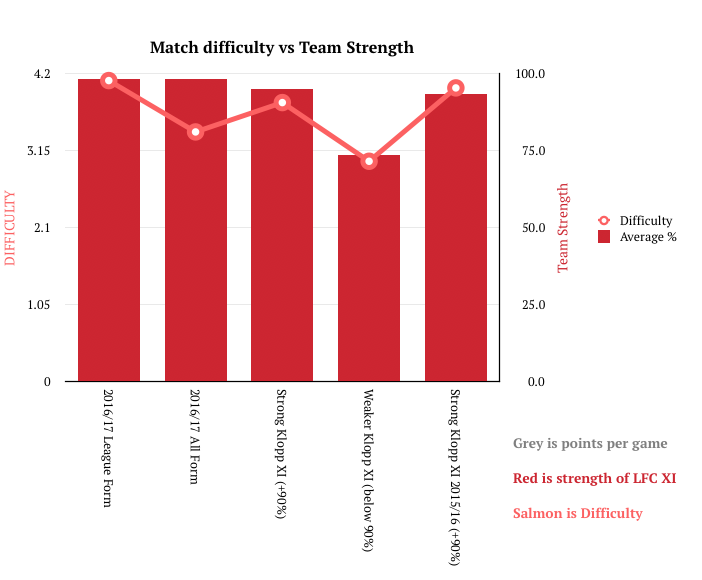
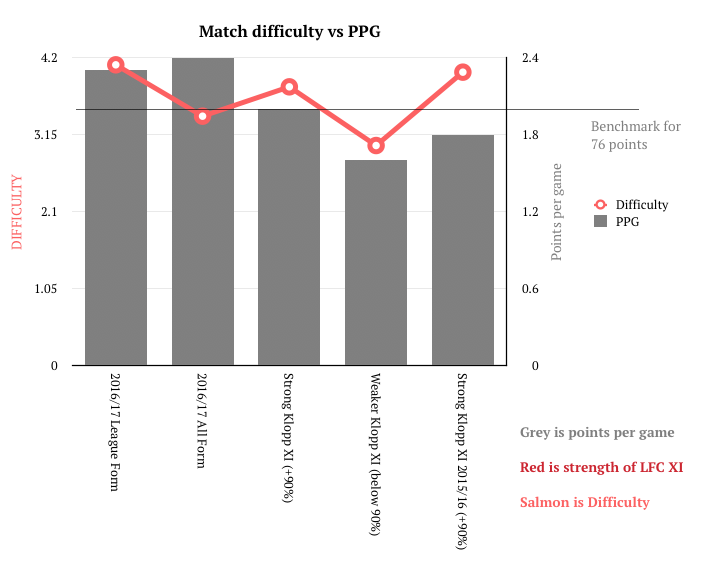
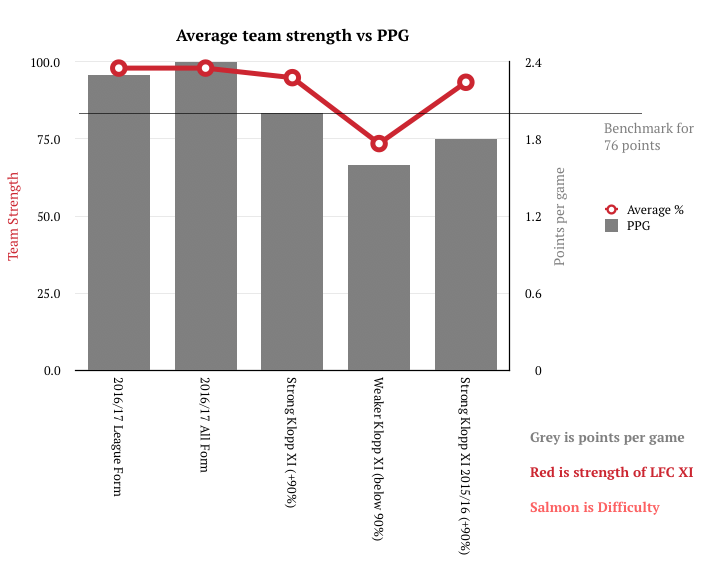
Look at the following three graphs, in case my words haven’t convinced you. Each graph has two axes, covering two of the three different measures: average XI strength (out of 100%); average points per game (range of 0-3); and average match difficulty (0-6). So closely do the results mirror each other that I had to triple-check if I wasn’t just using the data from the previous chart.
For the charts, grey is points per game; red is strength of LFC XI; and salmon is fixture difficulty.
match-difficulty-vs-team-strengthmatch-difficulty-vs-ppg2
average-team-strength-vs-ppg
It gets slightly confusing in terms of the overlap in results because last season Klopp tended to pick his strongest XIs for the toughest games – which makes sense, given that he wanted his best players fit for the massive match-ups, which came thick and fast, and when it came to the likes of Exeter in the cup, or league games sandwiched between massive European games, he had little choice but to heavily rotate. A manager totally happy with his squad, with a greater number of trustworthy players in reserve, doesn’t have to scrape the bottom of the barrel in terms of selection, injury crises aside. Remember, this was also a manager learning about his players, from the established to the youthful prospects.
We see that his points-per-game was better in the big matches – leading to to certain perceptions – even though the difficulty was greater, because his XI was stronger. People obviously said that Liverpool only got “up” for the bigger games, but the squad was spread far too thinly in many other encounters. When his XI was weaker, even though the games were easier on paper, the points per game dropped off – Liverpool were there for the taking, often in unfamiliar line-ups (and not because they weren’t up for it).
Again, this is due to the abnormal number of tough cup fixtures, where Klopp had to balance fitness concerns with winning the most important matches as the season unfolded – and priorities shift depending on what’s happening. After all, we can all say the league is the priority, but that was already “lost” when Klopp arrived; and who would have wanted him to go all-out versus Swansea and West Brom when, given that it was May, they’d become meaningless compared to the Europa League?
The only disappointing points-per-game figures within my breakdown come from last season; the first two columns on the graph are from this season, and they show that the Reds have an above-average PPG despite above average fixture difficulty.
One other thing I looked at in my article from May was an allowance for Klopp’s newness (and therefore the lack of time to fully address fitness and tactical issues) that diminished with time passed – and this again only highlighted that his effectiveness was masked.
It showed that the stronger XIs he picked early on didn’t necessarily know how to play the Klopp way; or if they did, they didn’t have the stamina to do so adequately. They were strong on paper, but not strong on understanding and fitness; both of which would logically be better by the spring months. In between – around December time – came an injury crisis. At this point there was neither understanding nor fitness, and in many cases, weaker player selections.
With the passage of time, results for his best XIs did indeed improve; but with time came more fixtures, more rotation, and more weakened XIs, which muddied the waters.
Now…
Now, even with three or four injuries the XI-quality can remain above 90%, whereas last season it couldn’t. To put in Origi now – the third-choice centre-forward behind Firmino and Sturridge – would be nothing to worry about; whereas last season, to put in Benteke – for whom the team was not set up, and where the player was lacking confidence (and carrying a big price tag) – was to clearly weaken the XI.
The challenge this season will be when players like Lucas (best days behind him, certainly as a midfielder), Klavan (very good but not elite), Stewart (improving but not yet a major force), Ings (good player but not elite, and hasn’t started a senior game in a year after serious injury), Ojaria (a possible future star but only 18) and Grujic (massive potential but still only 20 and adapting to England) are all called upon – either all together, or three, four or five them at the same time. Suddenly the XI will clearly be below 90% – these are, for now, back-up players, along with one or two others.
But of course, there aren’t likely to be sufficient games to throw these in, as Klopp has kept it strong even in the League Cup (because there’s no Europe on top), and with less likelihood of an all-out injury crisis with no chance of another 63-game season.
We also shouldn’t be seeing too much of the equivalents of Brad Smith (quick but raw and limited), Adam Bogdan (nervous wreck), Jose Enrique (totally disinterested outcast thrown into a few cup games), and even Christian Benteke (good Premier League striker totally unsuited to the manager’s style) – because no such equivalents are anywhere near the squad. Even the worst players this season should be much better than the worst from last season, and there will be nobody hopelessly out of kilter with the manager’s ideas.
Again, this is not being wise after the event – all this was covered in the article from May.
The second part of this article is for subscribers only.

PART TWO

Liverpool At Their Best Under Klopp Look Sensational
https://tomkinstimes.com/subscribe/