Saturday, January 2, 2021

Happy New Year! But What’s Going Wrong At Liverpool? By Paul Tomkins


Happy New Year! But What’s Going Wrong At Liverpool? 


Happy New Year! And here’s a festive freebie to begin 2021…

What’s Going Wrong At Liverpool? 

Multiple choice:

A) Nothing

This detailed TTT piece by Mark Cohen was written just before a narrow xG “victory” over Newcastle, which was itself a poor overall display (I can rarely recall so many poor touches by Liverpool players), but where the Reds still created several big chances, and also had Sadio Mané hauled over by the keeper to deny a clear goal-scoring opportunity (more on that later). 

In terms of many underlying numbers, as Mark shows, Liverpool have performed at much the same level as at the same stage in 2019/20. The finishing fairy – the randomness of taking chances some games and missing them in other, and thus sometimes distributing the points in a weird way – has clearly played a key role in results; as has things like Aston Villa scoring from three heavily-deflected shots when, in the entirety of 2019/20, there was just one single defected goal out of the 118 scored by (85) and against (33) Liverpool.

Liverpool “merited” a 3-0 win against Palace, a 1-1 draw with West Brom and narrow win against Newcastle. That would be seven points; but the finishing that was so super-hot against Palace went cold in the next two games.

The Reds are also conceding far more penalties (some fairly, some ludicrously), and although they are winning more penalties too (as is everyone), the Reds still are still halfway behind the spot-kick leaders (this year, Leicester, with 10). Jürgen Klopp’s Liverpool can be virtually guaranteed of getting only half the penalties that the top penalty-winners get, although the bigger change this season has been the ones awarded against the Reds, which in some cases were wrong and costly.

B) Klopp no longer knows what he’s doing 

Prior to his back-to-back title successes in Germany with seriously cash-struck Borussia Dortmund, followed by only narrowly losing the Champions League final in 2013 after mega-spenders Bayern Munich pilfered Mario Götze on the eve of the final (activating his release clause in a pretty underhand manner), Klopp had taken the most impoverished club in the German 2nd tier (Mainz) into the top flight for the first time in their history. 

So, Klopp has been exceeding expectations for nearly 20 years. There was a slightly fallow period where Dortmund became serial runners-up, but as well as Götze, Bayern also took Robert Lewandowski for free. (They later took Matts Hummels too.) Nuri Şahin, the playmaker, also left for Real Madrid while Klopp was at Dortmund. 

Imagine Man City taking Mo Salah, Virgil van Dijk and Sadio Mané, with all three costing very little overall. So, not just one rival taking the other rival’s best players, but with no great compensation with which to rebuild. Dortmund tended to stay second, but Bayern had ripped the heart out of Klopp’s team, which had broken the German points record.  

Klopp then had a few fallow years rebuilding Liverpool (two lost finals in his first season), but inherited a team that was 10th and finished that season 8th, before finishing 4th in his first full season.

Clear linear progress was seen by reaching a Champions League final (2018, losing in strange circumstances), A Champions League final again (2019, winning it), whilst finishing 2nd in the league with 97 points in 2019 (almost a 10% improvement on the Reds best-ever season), and wining it with 99 points in 2020, which, for all the travails, remains a high point in Liverpool’s incredible history. The Reds rose to be ranked the 4th-best team in European history based on a statistical model that has been around for decades, and the top English side. (This team and manager doesn’t quite get given the credit this merits.)

Right now, Liverpool are treading water somewhat, but I’ll get onto the reasons why – clear extenuating circumstances. (An ‘excuse’ is often flimsy; but if the 100m Olympic final favourite twangs a hamstring after 30 yards, that’s an ‘extenuating circumstance.’) You can mitigate against some bad luck, but not a ton of it.

Managers also do often lose their edge, in time, but not in one summer. It takes five years, usually. And the smart ones can see that decline delayed by constantly employing the best younger coaches, as well as psychologists, fitness gurus, and so on. (But not a lot can be done against grievous fouls on your best players. Alex Ferguson, in between a string of titles, once put a fallow season down to the injury of one player: Paul Scholes. Oh to have just one key player injured. And Ferguson had far more money to spend, relative to modern-day Liverpool.)

If anyone is doubting Klopp while the Reds are top, take a look at Arsenal. Their fans were sick of finishing in the top four and going out of the Champions League after the group stage, and harassed their legendary manager out of the club (even if it did start to look like he had lost his cutting edge, albeit in an increasingly toxic environment); since when, they haven’t even finished in the top four. Right now, they’re pleased with two wins that take them out of a relegation battle. 

Arsenal remain the poster-club for ‘be careful what you wish for’, just those who badly wanted Rafa Benítez out of Liverpool got the manager they deserved in Roy Hodgson. 

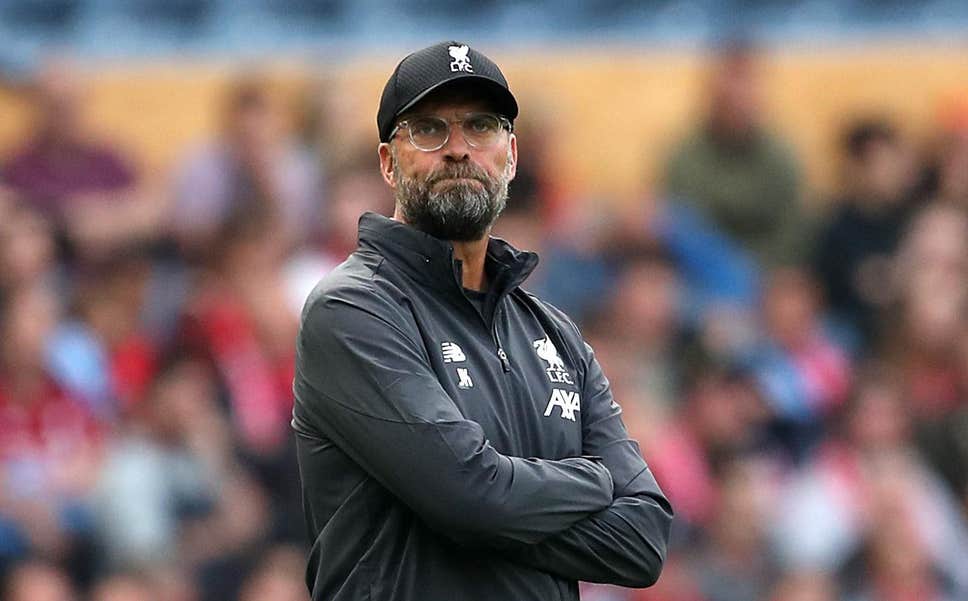
But as much as I still love Rafa, what Klopp has right now is a world away from the in-fighting seen in 2010, with those terrible owners, executives and administrators replaced by people with world-class reputations, and Klopp arguably the greatest manager, pound for pound, that the game has ever seen.

Liverpool, under the guidance of Michael Edwards, continue to buy brilliantly, but it’s hard to get the best out of a £20m midfield steal if some nutter chooses to put six studs in his knee. Even the best physios can’t bypass medicine and just perform magic.

C) The season is crazy. The world is crazy.  

The whole league has been weirder this season; more like the anomaly of 2015/16, that saw Leicester crowned champions with just 81 points, which was followed by winning totals of 93, 100, 98 and 99. This is football at its most random.

It’s been a time of no crowds, or tiny crowds; then, recently and depressingly, back to no crowds. It’s been a campaign with no proper preseason, and a proper preseason is where the stamina is built up. While footballers can be “fit” (i.e. they are not currently injured), there is fit, super-fit, ultra-fit and überman-fit. Klopp’s success has been built on hard preseasons. This year, there was no hard preseason. That is what often gives players the extra energy in the final 15 minutes of games (along with the depth in the squad to rotate a few players here and there, without having to resort to wholesale changes). 

Maybe this season suits lower-energy teams, as the highest-energy teams of the past two seasons often seemed to be Liverpool, Manchester City and Southampton, with Sheffield United working hard last season; of those, only Liverpool are in the top six, and the Reds, even if they beat Southampton to keep Southampton roughly where they finished last season, the Reds will be well down on points, like City. Sheffield United have made the worst start in all top four levels of English football since football began.  

Low-block teams who hit fast on the break – as Klopp’s teams used to (albeit without such a deep block; doing it via a higher back line to press with more players) – like Manchester United, Aston Villa and Leicester are doing better, while Spurs were too, until a few games ago. Spurs, Leicester and United won’t be in the Champions League, so the second half of the season may favour them. Of course, Spurs and United haven’t suffered many injuries, and it may hurt them if they do.

This isn’t a normal season, and so many things are combining. It’s been a difficult Christmas for a lot of players, many unable to see their families who live abroad, and strange results seem more likely in times of a global pandemic; indeed, Liverpool were utterly consistent before Covid-19, but less so since the restart in June (although it turned out that they only needed one more win the clinch the league, and the inconsistency in the final few games – as Klopp blooded youngsters rather than go all-out for the 100 points – was understandable; and again, there was no proper preseason after lockdown).

One of the hardest things for managers is to handle players to keep them in the Goldilocks zone: to avoid the red-zone of overplaying (which massively increases the risk of muscle injuries), and to avoid the undercooked rustiness you can get when going more than a week without games. The sweet-spot for a Klopp team usually feels like a game every five days, but that’s also with some rotation involved in the front three positions; and it’s not guaranteed to win games.

On top of this, every player is different. Some are more prone to injury. Some have more capacity for incredible stamina. Some are more suited to sprinting rather than covering a ton of KMs. Each and every one will have played differing amounts of minutes spread across different stages of the season, with differing stresses on the body, and sometimes carrying different knocks and minor muscle twinges. Each will have different things going on his life, with different stressors. Even not getting a good night’s sleep can highly affect performance.

D) Knees Up Mother Brown!

As of a week or so ago, Liverpool had ONE-THIRD(!) of all the knee injuries in the Premier League: six out of 18, many of them serious. What are the odds of that? – to have a squad that comprises 5% of the entire league and to have 33% of a particular kind of serious injury. That’s insane bad luck. And knee injuries are not usually ones you’d put down to bad preparation, unlike a poorly-warmed up hamstring.

Several of these catastroknees were from very bad fouls: the shocker by Jordan Pickford on Virgil van Dijk; the shocker from Richardson on Thiago; and a heavy foul in Midtjylland on Diogo Jota, with Kostas Tsmikas also suffering a heavy blow to the knee in that same game. Joe Gomez, meanwhile, has to recover from a truly horrific and potentially career-ending injury sustained not with Liverpool but on England duty.

Of the four Liverpool players recently named in the World’s Best XI, van Dijk may not play again this season, Thiago has started just one match, and while the first two were knee related, both Alisson and Trent Alexander-Arnold have missed a third of the season so far (with the latter also having Covid-19, and looking well below his best) due to other issues.

Jota was only playing Denmark because he hadn’t started against Wolves the previous weekend. He hadn’t started many of his early games with the Reds (coming on as a sub), and arguably needed minutes to keep in the Goldilocks zone. At the time, Liverpool were doing a lot of travelling and very little training; and so some match-time was presumably seen as helpful. But injuries can happen; just as really serious ones can occur in training, when no one is even near the player (Gomez, or Danny Ings on Klopp’s first day at Liverpool in 2015, which was also the same time Gomez had his freakish ACL tear; and likewise, getting a broken leg at Burnley was not due to being injury-prone but because of an overly physical challenge, albeit not your stereotypical “leg-breaker”, which Fulham’s Ademola Lookman got away with against Neco Williams with a shockingly late “tackle”; it was so late the ball was barely in the frame of this photograph. You will be hard-pressed to find a later tackle, and given that lateness and the height on the shin, it’s about as blatant a red card as you will ever see; up there with Richarlison’s and, er, Pickford’s…).
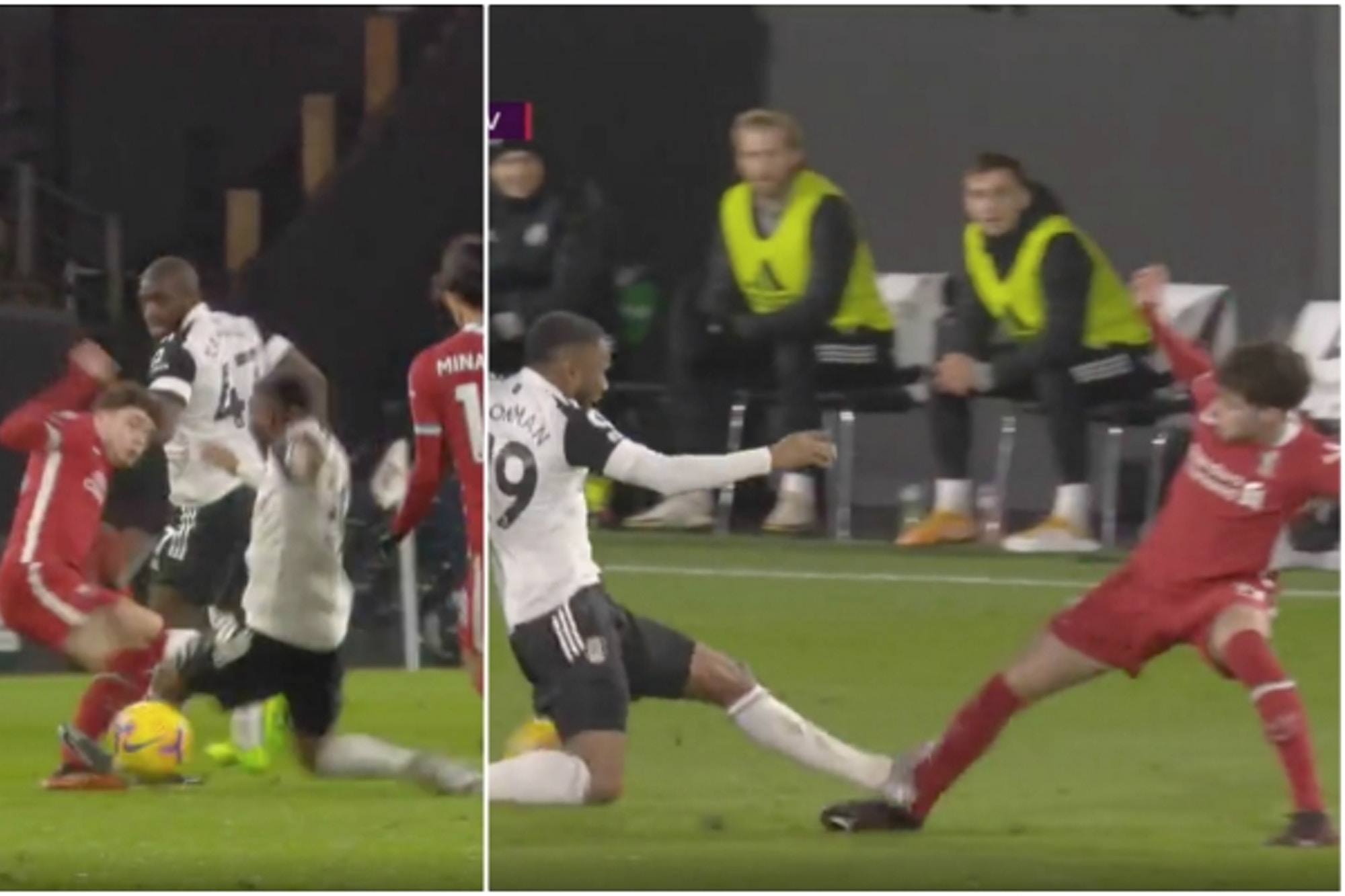
With hindsight Jota would have been far better left in England. But just as you don’t want players to play too much football, you also don’t want them to sit out too many games either; especially if you cannot organise the normal (intense and testing, but not over-tiring) training sessions as there just isn’t time, due to the number of games crammed into the calendar. 

E) The players aren’t good enough. 

Pretty much the same squad exists at Liverpool that won the Champions League and won the Premier League with the earliest ever capture of the English league title in the entire history of the game. It’s much the same group of players that won 110 out of 114 points between game 27 of 2018/19 and the same stage of the following season. 

Of course, Dejan Lovren has gone, but he was rubbish anyway, right? (That’s all anyone seemed to say.) And Adam Lallana, who barely played in his final two years at the club. Both are in their 30s now anyway. Lallana was also part of the limited injury-prone gang.

Aside from James Milner, who was already in it, not one single player has even entered the melt-zone of 31+, and Milner could be one of those fitness freaks who goes on until he’s 39. There is no Steven Gerrard or Jamie Carragher losing their legs, to go from super-men to also-rans.

If anything, the team/squad should now be better. Tsimikas, another victim of a knee injury, briefly provided cover to Andy Robertson. He’s a handy squad player that the club lacked last season, but who hasn’t had much luck this season; and another who had Covid-19.

Jota has been Liverpool’s most ruthless finisher this season; Mo Salah has more goals, but has played more minutes and taken the penalties. 

And obviously, Thiago is probably the best midfielder in the world right now. Or he would be, if he’d been able to train for the past few months. Instead, he’s been training for just a few weeks, and only joined in full team training days before the Newcastle game. It’s January and he was injured in October, after having had Covid-19. 

Liverpool won those major, major trophies with van Dijk leading the way. His knee is screwed. Joe Gomez or Joel Matip alternated as his successful partner; Gomez’s career is at jeopardy from a horrific freak accident, and Matip’s periods of staying fit are getting further and further apart. (Matip is, to me, one of only two “injury prone” players at the club, the other being Naby Keita. That said, Xherdan Shaqiri is starting to join the pair.) 

Fabinho was the 4th choice centre-back, because there are 11 players who can play in midfield, nine of whom are actual midfielders (plus Takumi Minamino and Roberto Firmino, who played in the role in the past). But of late Fabinho – generally superb at the heart of the defence, as you’d expect from a former defender with his skillset – has been partnered with the 5th- and- 6th-choice centre-backs (both inexperienced), as part of at least 13 different centre-back pairings this season already. With Thiago fit, Fabinho is probably not even needed in the no.6 role, and he could become a permanent centre-back; in his brief time alongside van Dijk in the role they looked imperious together. Obviously Fabinho is missed from the midfield, but Thiago and Jordan Henderson are shoo-ins, as is Gini Wijnaldum.

Henderson may end up having to play centre-back, and I wouldn’t mind that, if the midfield could still contain Thiago, Wijnaldum and one of Curtis Jones (albeit his form has suffered in the last two games, after an excellent run of performances), Alex Oxlade-Chamberlain, Shaqiri, Minamino and the hugely effective but equally injury-prone Naby Keita. If they can all stay fit, Liverpool have a chance.

Last season, Man City were given a free pass on their poor form due to the injury to Aymeric Laporte, despite often having John Stones and Nicolas Otamendi on the bench. Now Laporte can’t even get in the team. By contrast, Liverpool have not only lost a much better defender than Laporte in van Dijk, they’ve lost the 2nd and 3rd choices as well, who are also arguably better than Laporte – but also, at least, arguably his equal, when fit. 

In van Dijk, Liverpool have lost the best aerial player in the league from both boxes, and miss his stunning long-range passing – that stretches the pitch and enables the Reds’ full-backs to get very advanced to receive the ball – and the pace he offers. He started the season in strangely poor form, and there’s no excusing him in the 7-2 defeat at Villa, when the Reds’ high line came apart at the seams; albeit Adrian, in goal, set the tone with an early mistake. (The entire defence no longer seems to trust the Spaniard, who was great when he first arrived, then increasingly nervy. Equally, the Reds “only” created about 3-goals worth of chances at Crystal Palace when scoring seven, and the same was true of Villa against the Reds – it was a game of freak finishing, aided by three super-influential deflections).

It also felt like Liverpool’s players didn’t really trust Nat Phillips at Newcastle, and he’s an honest Championship-level centre-back, filling in during an emergency. He felt like a weak link that Fabinho, Henderson and Milner were trying to protect, at the expense of the team shape. 

Despite the squad being stronger overall – with more options, and no players in the melt-zone – the insane injury list, which at times was into double figures, has made for a weaker XI on many occasions. More teenagers have started games than could have been anticipated or hoped for – Jones, Rhys Williams and Neco Williams have all played a lot more than expected, and all have made costly mistakes (as teenagers do). Also, you can’t expect Phillips or Rhys Williams to provide the same kind of calming leadership and gigantic authority that van Dijk brings, because it cost £75m, and van Dijk was 26. You can’t have many spare van Dijks lying around. 

So it’s not been the same team; or even close. As incredibly frustrating as it was to not be able to put mediocre West Brom and Newcastle away, it’s a miracle that the Reds went into the New Year top of the table, given all the obstacles. There have been several weekends this season when all the big clubs have failed to shine, and the different fitness levels this season may have played a role. Playing a Champions League game every midweek is a new rhythm to football, as is three international games in eight days (not once, but twice).

The only positive from the crazy number of injuries is that the Reds could have a much fresher team in the second half of the season, as players continue to return. 

But of course, they still won’t get that proper preseason in their legs, and more injuries will probably occur as a result of both that shortcoming and the generally decreased time between matches. 

Some players haven’t played enough due to injuries, but due to those injuries, others have played too much. Unfortunately, returning after a long injury can lead to immediate new injuries, but if the Reds can get by with the likes of Thiago and Jota (when he’s back) staying fit, and picking up only the occasional minor injury (and the centre-back crisis can be solved in one way or another), this team can still win the league. 

But clubs with fewer injuries, and who have spent more on their squads, may have an obvious advantage.  

F) VAR and Refs have shafted Liverpool. 

Ex-referee Mark Clattenburg – who was one of the best – bizarrely revealed this week that he felt he should have been giving decisions equally to both sides, rather than just deciding what he saw. He admitted to prejudicial ideas going into games, by researching players. 

Ergo, as I always say: refs don’t referee what they see but what they think they see, or in some cases, what they want to see. Studies on ‘inattentional blindness’ have proven that people cannot see glaringly obvious things right in their field of vision if they are focussing on, or thinking about, other things. I’ve been talking about this issue for years, but no one seems to care about the science. When referees do see something, they have the foreshortening of one angle, which as with stage fighting, can make contact look like it occurs when it doesn’t (or vice versa).

I’ve also proven with seven years of all Premier League data (2012-2019) that referees give more penalties to British/British-qualified players than to overseas players (based on the minutes played by each category each season), and in a seriously statistically significant manner, award far more penalties against foreign players. And England internationals very rarely have penalties given against them (but win absolutely tons at the other end). Players like Raheem Sterling and Jamie Vardy win penalties at an insane rate.

Some English players are clearly the worst divers, but they often don’t do the back-arching, or as many theatrical roles as the stereotypical overseas player might have done in the past. In fairness, Luis Suarez was a total embarrassment on this, although even then, in the one outstanding season Liverpool have had in donkey’s years for penalties received, seven were won by English players (as many by a very young Sterling as by Suarez), and the manager was British. (Leicester’s English players and that same British manager win a ton of penalties.)

Unlike Suarez and the likes of Vardy, Kane and Sterling, Liverpool’s current strikers often tend to try and stay on their feet, and when they do go down after being fouled it’s often with a delay that gets them called cheats; but they only go over when fouled. Mané against Leicester last season and Salah against West Ham this season both got booted in the leg, but both went down a bit late – however, if you’ve been kicked and therefore fouled, and you stay on your feet, you rarely get them. This is different to the totally contactless dive, or the cheating by kicking the opponent to make it look like they foul you.

(Salah’s one dive in a Liverpool shirt was a correct booking outside the box on his first return to Chelsea.) 

Players like Harry Kane, Raheem Sterling and Jamie Vardy are expert at playing for the contact – they are waiting for any kind of touch and as such, the fall is instant and seamless, with no back-arching and often, just a graceless flop to the ground. They’re not thinking of taking a touch and trying to score – they’re just thinking of winning a penalty. 

Kane even backs into players to create the touch, as was highlighted by someone online with a litany of clips of his very dangerous play, that led to ex-pros condemning a move that is too dangerous for rugby! 

While Jack Grealish, like Vardy and Sterling in particular, kicks out his leg to hit the defender, to then tumble. I felt Aaron Connolly of Brighton did this to Neco Williams earlier in the season, although that was still a penalty, as Connolly’s foot – dangled out strangely – missed Williams as Williams was too slow (having been drawn out of position), and then Williams, when he caught up, totally booted him up in the air. Sometimes you can look for a penalty and still get one: just as drawing a foul is perfectly fine, if the defender doesn’t get the ball and recklessly gets the striker instead (unless the striker is the one that initiates the contact; Gary Neville seems to think that Robert Pires started this, but it’s like everyone Neville trained with England a few years back has the trick).

If you watch most referees, they don’t know what’s happened maybe 80% of the time. The older, fatter, slower ones – of which the Premier League (Best League In The World™) has many – don’t even keep up with play. Our refs are on average many years older than those on the continent, and many inches wider around their midriff. (Not to “fat shame”, but referees should be almost as athletic as the players.)

The game is fast, and it’s hard to tell what happened as the ball zips around and players collide or nearly collide every split second. In the Reds’ game against Spurs, the ref gave three consecutive throw-ins the wrong way based purely on whose shout was loudest and/or fastest. They still often judge the seriousness of fouls on the number of rolls; watch how much a player squeals (much easier in empty stadia) and see how closely it correlates with an opposition booking. Players rarely roll around after serious fouls; I broke both an arm and later a leg playing football, as well as rupturing a hamstring. Each time, the last thing I did was roll around; and it’s insane to roll onto the part of your body you’ve just injured. 

My thought was that VAR was going to change all these optical illusions, clear biases and all the prejudicial thinking (which includes the widespread fallacy that Liverpool get too many penalties at Anfield, especially at the Kop end, to the point where Liverpool went years without getting a Kop-end penalty, even for headlocks, high-kicks and defenders punching balls clear). But I didn’t envisage the VARs essentially just being the same group of referees, with the same petty beefs with certain clubs and managers, and the same prejudices. 

And it’s got even worse in lockdown, with Liverpool basically getting the same group of referees and VARs rotating every week. There are very few refs I trust, but the Reds now seem to get none of them.

Another problem was the fallacy of LiVARpool last season, despite the Reds only ending up with a fractional balance of overturns in their favour, ranking mid-table for VAR saving their bacon. It was a “truth” (that was untrue), and so, just as Clattenburg said, refs must be seen to give equal decisions to either side, even if the situation doesn’t merit that at all.

The more serious “corruption” with VAR is that there is some terrible confirmation bias going on to even get to a decision being reviewed. That inconsistency is actually far greater than any refereeing inconsistency, which is more human and fallible, due to the split-second nature of only seeing things once, in full speed. VARs have the power to be all-seeing, but they close their eyes half the time. It has made the game worse, not better. 

When Mo Salah was taken out in the box at Villa, with the score 1-0 to the home side, Sky’s replays showed (after the initial challenge in real time) a clear, undoubted spot-kick. But before Sky had even completed showing the angles that proved it – within 10-15 seconds – the commentators had already said that VAR had okayed it as a fine challenge. When van Dijk was karate-kicked into next season, the VAR didn’t even watch it. (He later lied to say that he had, but was suspended all the same.)

And now we have Sadio Mané being grabbed around the thighs by Karl Darlow as the Liverpool man went to tap into the empty net from a yard out. Now, I didn’t see the foul at the time in real-time, but that’s what the replays are for. Look at the image, and Darlow has his glove around the knee/thigh! Yes, Darlow is trying to get up from a prone position having made the save, but Mané tries to jump over him and he grabs his legs! It’s 100% a penalty.
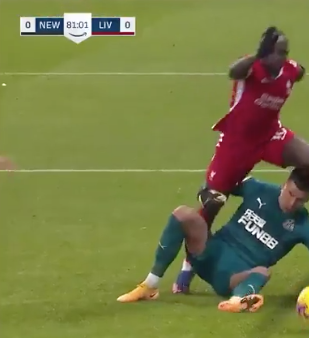
Mané had a 99.9% chance of scoring himself had the foot/leg he uses not been illegally grabbed. But the institutionalised corruption is that the VAR did not choose to stop the game to investigate, and Liverpool had no way of appealing for it; Mané was “blamed” for not going down by people in the media, but even if he goes down in the box when fouled, he gets accused of diving (due to an overall provable anti-foreign prejudice, albeit not necessarily so in every incident; and maybe the notion that Mané dives when he does not). 

Mané should have had the right to run straight over to Klopp and say “ask for a VAR review!” – it might not have led to them admitting that he was clearly fouled, but it would have made it clear to the viewing public. Add microphones so we can hear if the VAR is honestly discussing it or fudging it, which again, as with giving teams appeals, would bring football into line with sports that use technology far more honestly.

Now, I also didn’t see the “foul” on England striker Danny Welbeck from Andy Robertson in real time. And to be honest, I could still barely see it in slow-mo, as they showed it time and time again. It was the last minute, it was not going to allow Welbeck to get the ball and score, and Welbeck fell over and screamed. A second Brighton penalty was awarded for it, and they got a point, thanks to that VAR decision. The difference in punishment seems ludicrous.

As of a few weeks ago, there had been 16 offside calls that disallowed goals, and of those, five were deemed by the neutral reviewer as good as level. Three of these five were for Liverpool goals being chalked off. The Reds were cheated out of the win at Goodison Park, as Mané was not offside for the injury-time winner. David Coote spent the entire match as the VAR trying to find Liverpool offside, to the detriment of allowing crazy fouls on their players, and didn’t even review the assault on van Dijk; as such he got demoted, only to be re-appointed on his next game to … do Liverpool again!

There were, I believe, something like 53 replays of Fabinho’s perfectly fine tackle at Fulham, that took three minutes to analyse. Some angles made it look like it could have been a foul, but other angles showed him clearly getting the ball by nicking away with his toe while the Fulham player’s leg was drawn back ready to kick it (so he ended up kicking Fabinho as he planted his standing foot after Fabinho had touched the ball). The referee took a couple of looks and thought “What the fuck are you talking about you daft twat?” (my interpretation of what he said to Lee Mason).
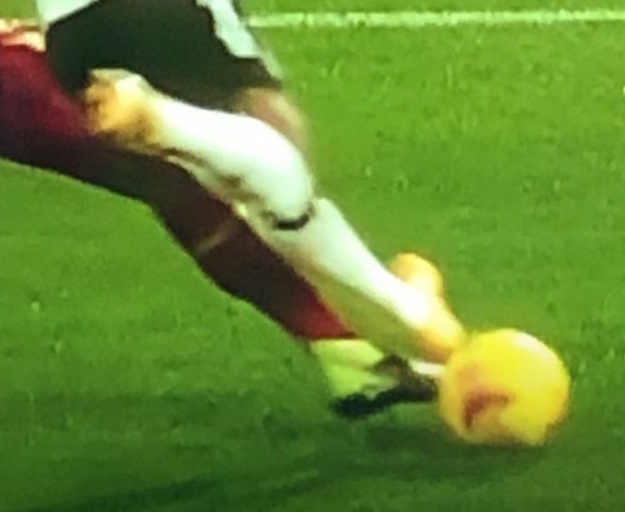
When Mike Dean – who doesn’t usually do Liverpool games, but has during Covid as refs seem to be sticking to their vague home area – gave Sheffield United what looked a fair free-kick 19 yards out, Andre Marriner turned what was actually, on the replays, another great tackle by Fabinho outside the box (it looked a foul initially, but replays show he got the ball and not the man, same as at Fulham), into a penalty. It was surreal. 

But shit happens. My issue, though, is that Liverpool’s own clear penalty calls are not even being checked by the VAR, and there is no one for them to answer to. Equally, any tiny infringement at the other end is micro-analysed for minutes and minutes, almost always to the detriment of the Reds. 

Think about it. If it takes three minutes to see the foul on Welbeck, the offside against Mané at Goodison, the offside against van Dijk in that fateful moment in the same game, and various other calls that have gone against the Reds, then it suggests that these incidents can require that much scrutiny to find a possible infringement. Not only does that not make it a “clear and obvious” error, but it shows the folly in “okaying” several clear penalties for Liverpool in 10-15 seconds, when all the replays can’t even have been watched in real-time, let alone super-slow-mo with extra zoom. 

If that had been done for Mané at Newcastle it was surely a penalty and a red-card. But it wasn’t done. It’s like the police only ever taking DNA samples from one particular group of people in a murder case, and then not finding the one that matches. If you don’t even look, you won’t find it. If you only review potential fouls by Liverpool defenders and not potential fouls on Liverpool attackers, you won’t find anything to help the Reds, just hinder them. I don’t think a single penalty has been given via VAR for a foul on a Liverpool player in the box, despite at least three clear cases this season. And the VAR did not disallow the West Brom goal for a clear foul on Fabinho, that didn’t even have the usual get-out clause of being off the ball. (While the West Brom player makes a great jump, he pushes down on Fabinho to stop him jumping too; not just getting a leap on Fabinho but fouling him in the process. Harry Kane can get a penalty for literally backing into someone – by looking back at them as he does so – but this is not a foul? Again, England players have their own rules.)
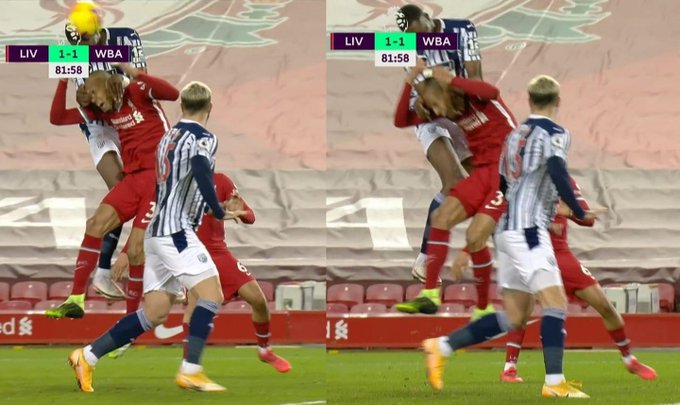
This is why the clubs – managers, assistant managers, coaches – need to be able to view the incidents themselves on pitch-side monitors and, within a minute or so, call for a ref to give it a proper review. 

Right now, it’s utterly arbitrary as to what even gets to be reviewed, and if the VAR doesn’t like your club, your manager or the various players he has prejudged – if he doesn’t even bother to check – then you don’t even get a shot a fair outcome. The VAR can be 200 miles away, with no one from the club able to appeal to his better judgement. They can hind from Klopp there, and mete out their petty revenge because, the poor lambs, he shouts at them during games. 

While decisions can go for you or against you, Liverpool are at -6 for VAR overturns in 2020/21, and that doesn’t include all the other obvious errors from the referees and the ignored penalty claims. 

It has cost the Reds a lot of points this season. Thankfully it’s not been as bad overall in recent games, but the madness of Andy Robertson being deemed to have fouled Danny Welbeck going nowhere, and Sadio Mané being stopped from scoring a certain goal a yard out deemed irrelevant, is maddening. These two decisions alone were worth a swing of four points, based on Salah continuing his 100% penalty conversion ready since 2017; and that’s without the definite winner at Goodison, and other key decisions.

And whereas you can say that Liverpool did not play well enough against West Brom or Newcastle to “deserve” the point, you “deserve” accurate, consistent and honest officiating at all times. That’s a given, and should apply the same to the worst team in the league as it does the best. It’s not a judgement of your performance but of the incidents in question.

There’s no doubt that injuries and officiating have hurt Liverpool more than any other club this season. That’s a statistical fact. So to still be top as 2020 became 2021 remains a minor miracle.

All that said, the side will have to dig deep, and also play better than in the last two games, without question. But as ever, it’s a complex situation, with various extenuating circumstances – and it’s hard to be at your best without several of your best players. It’s just not logical, especially over a longer period (players like Phillips might shine in the occasional game, but are not ready or suited for more).

More injuries, and more VAR madness, and Liverpool are unlikely to win the league, no matter how hard they try or how well they play. But a bit more fairness from VAR, and the likes of Thiago staying fit (with others returning sooner rather than later), and this side can still prevail. 

Here’s to Liverpool winning the title again, or at least being able to give it a bloody good go; but above and beyond that, let’s hope the world gets back to normal and the pandemic is finally brought under full control. Once the dust settles on Covid-19, we’ll still have a fair few years left of this brilliant Liverpool team.

This is a free article, so please feel free to share it. But if you want to support this site (help pay hosting and staff costs, allow me to pay my mortgage, etc.), then see the info below about becoming a paying subscriber.

Also, you can subscribe to our free newsletter via email here.

Plus, we have several books out right now. See my Amazon Author page for my recent books, as well as this site’s The Quarterly, and indeed, all my old books (if they’re still in print!).

Sunday, November 29, 2020

Tomkins Rants; Tomkins’ Head Explodes; Fuck The PGMOL by Paul Tomkins

 https://tomkinstimes.com/2020/11/tomkins-rants-tomkins-head-explodes-fuck-the-pgmol/

Tomkins Rants; Tomkins’ Head Explodes; Fuck The PGMOL

In By Paul TomkinsFreeTomkins Rants


Four big decisions went against Liverpool in this single game (in a season of bizarre big decisions going against Liverpool), three by VAR. Two were correct, and two were examples of VAR ruining the sport.

Sadio Mané was offside when putting the Reds 2-0 up, and it was a stonewall penalty from the young and inexperienced Neco Williams in the first half.

But Mo Salah was offside only by imagined degrees based on seriously flawed technology, and the penalty, awarded in injury time, was not a clear and obvious error by the ref. It might have been a foul, but then again, it might not.

If anything, consistency is getting worse as VAR and the refereeing community continues to be run by a eunuch with the gumption of a dead mouse that’s been put through a mincer, and the video refs are just part of the same pally bunch of blokes who all referee the games, and have their favourites, their biases, their ability to “unsee” the obvious.

Liverpool had a lot of VAR calls go against them last season, but also some go for them.

Many of them, for and against, were shocking, and illogical, and inconsistent. I didn’t necessarily like them either way, but as long as it evened itself out in that unscientific way, it was less of an issue.

And it worked out to be fairly neutral in terms of net result (Liverpool ranked mid-table for VAR damage/benefits), but it made the games all about the officiating. I hated the way a good idea like VAR was being used, even if it benefitted Liverpool – albeit, on the whole, it didn’t really benefit Liverpool.

This season, Liverpool are currently running away with the trophy for “how much damage can VAR do?”.

And this season it’s been worse overall, including the farcical application of the handball law. England stands alone with its use of three subs and its misuse of VAR. Even the Championship have now voted for five subs. The TV companies care one about themselves and not the clubs, and when a manager like Klopp complains, they “disappear” the evidence. (At least, Sky do. BT Sport at least doesn’t resemble Communist State TV.)

Now, a foul outside the box is taken into the box for a penalty, even though the official didn’t look to see that, actually, Fabinho only got the ball (outside the box), if not a clean contact on the ball.

That clear and obvious error was not overturned, as the official apparently only looked at where the offence may have taken place, not if it actually took place at all. Now, with super-slo-mos not even making it clear what happened, Andy Robertson is penalised for something more minor than most things that take place in the box each weekend, to gift Brighton a last-minute equaliser. If it’s a foul, fine – let’s just set the bar really, really low for a foul.

And all the time Liverpool spend in the opposition box – they had three of the four players in the league with the most touches in the opposition area last season – will lead to a deluge of penalties for the Reds (any time that Liverpool get penalties there’s an outcry and referees stop awarding them).

Jürgen Klopp speaks his mind and that terrifies officials and TV companies (and some hypocritical journalists who work for the purveyors of nasty, hateful news that destroys lives), to the point where they set out to stop him. How dare he! A pally Englishman would have no such problems; just as British managers have always wined and dined British journalists to curry favour. (Then, gang up on the foreign manager.)

We all want to enjoy the football more, and focus on the officiating less, but what’s the point if late (or timely in terms of the scoreline being delicately balanced) and terrible decisions keep killing your team’s hopes?

We can’t even enjoy goals anymore, in case someone with inaccurate equipment makes a decision on a mere millimetre when full inches are the tech’s margin for error. The spiffing lines drawn are accurate to within a pixel, but the pictures they are drawn over are full of distortions, and delays, and inaccuracies. It’s bullshit, dressed up as science.

In cricket, with better technology, they have a massive margin for error on whether a ball was going to hit the stumps or not, and even if they think it might have hit the stumps in an LBW shout, they’ll go with umpire’s call, as they know the tracking software is not accurate to within fine margins; in football they draw super-thin lines that turn inaccuracy into imagined perfection, and find someone’s pubic hair offside.

The schedule is making good football harder, injuries more frequent, and VAR is then rubbing salt into the wound of these soulless games by ignoring blatant fouls in the box one week then jumping in, to change the game, with something minor the next week. A bit of balance would be nice, but Liverpool are at seven (against) for net VAR overturns, in just ten games. Maybe three of them were the correct decisions, and the rest were either debatable or terrible. (At least three of them were terrible.)

And that doesn’t include things like the VAR not spotting Jordan Pickford kick Virgil van Dijk into hospital.

As subscriber andklopp noted on here after the game, “How can it take slo-mo to spot a clear and obvious error?”

What the fuck are the rules? Does anyone know? And even with the rules, the implementation, the emphasis on what is and isn’t allowed, are fudged week by week.

The rules change every summer, but the application changes every couple of weeks. Some officials don’t even know the latest rules, as seen by the mistakes they made; such as Brighton scoring against Liverpool last season with a player in the Reds’ wall (outlawed at the start of the season) or David Coote not knowing that you can send someone off for serious foul play/violent conduct even after the offside (that he had just invented) had been given.

Coote’s mistake meant that Everton didn’t have to take off an outfield player (likely Richarlison) to send on a sub keeper, with just 10 minutes gone. It also meant that violent conduct was condoned, and allowed Richarlison to violently and deliberately place his studs into Thiago’s knee. Coote essentially caused the injury to Thiago by not doing his job of protecting the players.

I pay good money to Sky and BT to watch Liverpool, but I want to see Thiago, and players like him. Why can’t I? Because of officiating disasters. Thiago’s career could be on the line, if his knee doesn’t heal, just as Virgil van Dijk has a less than 100% chance of returning to normal, and that won’t be before next season. Both are 29. We are being robbed of their prime, and the chances of Liverpool retraining the league title are lessened. Why? Because of officiating disasters. And that was just one game.

And if that was a penalty in the last minute today, for the slightest of touches by Robertson on Danny Welbeck as both tried to kick the ball (and both missed), then let’s see the VAR jump in when Mo Salah and Sadio Mané are tripped in the box, or grabbed around the neck, week after week. How much contact is allowed? Is it allowed around the neck? Is it allowed around the neck, with both hands, gripping tightly, if you’re England International Harry Maguire? Yes, it is.

If you’re England International Harry Kane, and you jump into an opponent outside the box, can you win a penalty? (The answer is: yes, yes you can.)

Why did we at TTT gather video of two and three players wrestling Virgil van Dijk to the ground at several corners last season, which the VAR ignored? It’s cognitive dissonance to just pretend you haven’t seen what you’ve just seen. I have my biases and I get stuff wrong too, but I’m not earning a fortune to make big decisions. When is WWE wrestling allowed in the box? Why do some officials spot it and others ignore it? Why have refs in all but one incident agreed that the VAR was right? Surely there should be more dissent than that?

Even when Salah was scythed down in the box away at Aston Villa this season, when the score was 1-0, the commentary team that included Jamie Carragher said “VAR has ruled no foul” or words to that effect with seconds as Villa broke out of their own box, only for Sky to show replays of a clear foul on Salah; Carragher, then seeing the replays, able to discern, like everyone else, that it was a clear penalty. Hang on, I thought we were now analysing these incidents?

[Edit: just to add, it occurred to me whilst debating the article with subscribers that in this instance the VAR intervened to give a “soft” penalty. Now, a soft penalty is usually still technically a penalty, but several get waved away every game, for various reasons, often because there’s not enough contact to constitute a foul. Yet, if it’s a soft penalty it can’t really be “a clear and obvious error”, but usually just a judgement call by the referee that, once given, is hard to overturn, as it’s soft, but it exists. However, for VAR to give one is just bizarre. How often do you get soft penalties by VAR? Have I just been missing loads of them? Why would you intervene for soft penalties? As I say elsewhere in this piece, I’m happy for them to be given if they are all given, but they are not; and some serious, clear and dangerous fouls are not given as penalties by the referee or VAR. That means we now have powerful, all-seeing tools and still reach bad decisions, which is harder to accept than a referee simply not seeing something, because he’s human, and may have been unsighted. If VAR can see soft penalties with minimal contact that’s not clear to the human eye, then there’s no excuse to miss the obvious ones – yet they still miss them.]

The decision to analyse or ignore is therefore just as prone to biases, laziness, cognitive dissonance, cronyism or any of the things that make referees so fallible to start with. There is no right to appeal, unlike other sports. You have to hope the VAR was paying attention.

Why was that okayed within a heartbeat, before the video could be properly viewed? It reminded me of those old court trials for murder: the trial, in 1907, lasted 43 minutes, and the jury reached its decision in 10 seconds. Seems just.

There is some kind of implicit bias at work in how referees choose to see the footage. They can ignore assaults one week and see the slightest of touches the next. It often seems to hinge on who is involved; an England international almost always has a free pass.

We also know that David Coote forgot to even view the assault on Virgil van Dijk due to forgetting the rules, in a game that continues to leave Liverpool without two players shortlisted for the best player in the world due to serious foul play damaging their fucked-up knees; but then we get about three different explanations from the Premier League afterwards, as they make stuff up to cover their tracks.

That’s the most galling thing, how they change their explanations like guilty criminals giving a fifth account of what really happened. They give us a load of old flannel, to fit a narrative, not the facts.

It was then said that Coote had indeed seen the incident and deemed it not worthy of a red card, and as ever, an England international or ex-international gets away with something few others would. No ban, as the VAR saw the flying two-footed assault, and … well, who knows? Welbeck got that decision today, but no way Mo Salah would via VAR. Instead, he’d be questioned for going over too easily. (Michael Owen brought that up again, yet he dived far more for Liverpool than Salah ever has.)

I wouldn’t be at all sad if all England’s players end the season too tired or injured to turn up to the Euros, and if the 14 clubs who effectively blackmail the rest of the game (stifling the Big Six and denying fairness to the 72 clubs below them, as they keep the financial gulf too large in order to fill their own pockets) continue to ruin our game with god-awful managers like David Moyes, Steve Bruce and Roy Hodgson, who, in 2020, can only spoil matches anyway, with dogshit football, and who couldn’t win trophies at major clubs even if/when given bigger budgets. Several have tried, and failed.

(At least some younger English coaches are getting their chances, and some of them seem to have more about them than just ruining football, and Graham Potter seems to be one of the better ones.)

If Klopp was English his team would get far more penalties and his players might get more protection; but he’s not English, as most English managers are rubbish, and couldn’t do even a tenth of what he has done in the game. When they get the big jobs they screw up, time and again, only for their drinking mates in the media to cry “foul play!”.

Liverpool also got lumped with the blame for Project Big Picture, but it was an Englishman at the FA and an Englishman in charge of the Football League who conspired to plot it; yet two American owners got blamed, as it’s always easiest that way. Little criticism was made of Greg Clarke, and then he got sacked for some unpleasant things he said, rather than being a deceitful gobshite who tried to shift the blame of the whole revamping idea. Only David Conn of The Guardian seemed to call him out over his duplicity with PBP.

Since then, Liverpool have had an insane number of bad calls go against them, and we continue to have 14 clubs – half of whom offer nothing to the top flight except big, talentless bodies clogging up the pitches – continue to have all the voting power.

Strange decision after strange decision follows, as 14 clubs – essentially “the Premier League” – protect what they have and try to deny the other 78, even though most of these clubs are instantly interchangeable with half the Championship. They made it to the top flight on merit (although some broke Championship FFP rules) but it’s almost like gerrymandering how they get to stay there.

Which isn’t to say Project Big Picture was fair or just; but overall, it was more fair and just than the 14 largely mediocre clubs protecting the crapness of the lower reaches of the Premier League, as they fight to stay up and sod the rest.

(Again, not all of the 14 are like this, but some of them were happy to expunge last season from the records after 29 games were played, despite playing in state-funded stadia as they reclined within their gold-plated suntanning beds, the fucking awful gobshites.)

If it wasn’t my job to write about football, and keep this site afloat, and sell a few books along the way, I’d be done with football for this season.

Maybe Klopp is another reason to stay, as he cares, he’s smart, he’s passionate, he’s considerate, and he wins big, big fucking trophies. The biggest. Time and again. Not League Cups – league titles, Champions Leagues. If Covid was combined with Roy Hodgson then I think I’d take up watching professional knitting.

It’s horrible with no fans, and that’s not really anyone’s fault within the game; shit happens, and Covid-19 is crap for us all. But the TV companies are actually getting to show more games, and were having bigger audiences the last I heard, but also took money back from the clubs.

The TV companies then tried to pull a fast one with the pay-per-view – and then no one wanted to watch Burnley or whoever play whatever alehouse dogshit nonsense for £15 a pop. Who knew!? Some of us would pay that much to watch a proper match, between two good teams, but not to endure that nonsense. Then they tried to blame the clubs. But hang on, aren’t the clubs essentially the block of 14 with all the voting and veto rights?

Several weeks ago Klopp stood up for Ole Gunnar-Solskjær and Manchester United, to say that the timings for the early games were daft and dangerous to players; yet BT Sports continue to pit Champions League clubs playing on Wednesday nights against teams away in the league just over two days later.

We are already paying good money to watch the matches on TV and as Liverpool fans, despite world-class fitness specialists, we’re getting to watch reserves, due to all the unavoidable injuries. Throw in the terrible officiating and the empty stadia, and at least try not to make a mockery of the action that does take place. Liverpool play Ajax on Tuesday, then have two more games within a week, one halfway across Europe. It’s a ceaseless treadmill that’s wearing everyone down.

Whoever Klopp selects he’ll get slaughtered; and the TV companies and media toadies will tear him apart for not winning a game, when he has so many injuries that players who were not even registered with the first team are being drafted in, and when some, like James Milner and Joel Matip, cannot play three games in a week; had Matip started today he’d probably be alongside Milner – asked to do too much – in the ever-expanding new rehab centre. The alternative was to ask a teenager to risk his developing body for yet another start, or someone coming back from an injury sustained with the fucking England team.

Meanwhile, England and the FA take the players whose wages we fund (as the club fans pay their wages, and fund that through TV subscription mainly), to play three games in a week, and hand them back on stretchers. Yay!

I don’t want special treatment for Liverpool, just some of the kind of competence Klopp shows, Michael Edwards shows, those running the club show.

Everything about the club is world-class, and they step onto the pitch to have their actions adjudicated by people who – and get this! – when deemed to have an incompetent game are then briefly demoted and brought back to do the same job involving the same team! You couldn’t make this shit up.

“Sorry, other clubs won’t get to have Coote for a week or two, as he serves his punishment for doing some/several things horribly and ruining the result and causing injuries, but we’ll bring him back to VAR you again”.

And the people who run the game are themselves fucking amateurs and chancers, who must bow the Little 14. (Almost sounds like a Depeche Mode song, that.)

I don’t want to be all elitist and entitled about Liverpool, but it seems that the club has found the smartest, most emotionally intelligent people and players, and the league is being run and officiated by a group of toadies, incompetents and wide-boys. We get to have all the sensible decisions made by WFH and DFM! (West Fucking Ham and David Fucking Moyes)

And all the planning, the hard work, is distilled into whether or not someone who is not very good at their job makes a call that suits you or harms you.

I can accept human error. But the handball law seems to change by the week, and is, along with the offside law, interpreted differently from match to match. Apart from the schedule and the injuries, I have no problem when Liverpool play badly and drop points, as it’s rare, and they are not perfect; they were crap in midweek, but it’s been an insane run of fixtures. The players have to make decisions that aren’t based on 12 camera angles. They have milliseconds to decide. They aren’t in plush VT suites in London.

The types of incidents VAR reviews is utterly arbitrary, based on who rolls around and screams, according to Danny Welbeck. If these decisions were merely cosmetic, that would be one thing; but they keep deciding games. And the games themselves are being ruined by injury after injury; there were as many injuries and incidents in the first half yet just two minutes were added, then suddenly five were added to the end of the second. The refs just make it up. I’ll add two minutes, despite six minutes of stoppages; maybe mindful of the TV companies getting all of their ad-breaks.

Liverpool started the game with their 11th centre-back pairing of the season and ended it with about the 5th or 6th right-back of the campaign.

As Klopp says, this is a Covid season, and special rules should apply – it’s shorter, there are more games crammed in, more often meaningless and uninteresting internationals crammed in, more illness as well as injuries, and there was no proper preseason. The TV companies keep telling Klopp that the clubs signed a contract; but the TV companies were happy to renege on their promised payments last season. If I were so inclined I’d ditch Sky and BT and look for streams instead. It’s what the smart people do.

Having an overbearing schedule when people’s careers are at stake shouldn’t be compared to people who work down a mine or frontline workers in the NHS, in order to say that it doesn’t really matter in the grand scheme of things; by that logic, just cancel the whole fucking shebang. Cancel your entire TV operations, as anything shown by Sky, BT and the BBC is not as important as people who go down the mines or those on the medical frontlines.

This is the same week that Peter Shilton came out as horribly bitter over the death of a remarkable player who far transcended his own limited ability (he was a goalkeeper, for fuck’s sake), and called him a cheat, when Gary Lineker was happy to go down easily twice against Cameroon in the following World Cup, in which Shilton was a waddling old embarrassment in the nets. No one brings up how we cheated the poor Cameroonians. No one went on about how Michael Owen threw himself to the ground in the Argentina box in 1998; yet these Brits continue to call the foreigners cheats. It is up to the officials to spot handballs, and dives, after all.

And we still have to accept the players we fund going off to play in three internationals in a week, including heading overseas for a god-damned friendlies, at a time when there’s a global pandemic killing millions. We pay the big TV subscription money, and money is tight right now. But Gary Lineker can lecture us on how there’s no need for player welfare, when he stopped playing because he had a sore toe, and famously once shat himself during a match? (Needless cheap dig, I admit. In fairness, he did play on, once he’d smelt it, just to make sure. We’ve all been there.)

I don’t really support Liverpool hopping off to a European Super League, but any big club would be nuts to not do do if given the chance to join something much bigger and better arose, as the game moves forward – just as it always has; after all, the Premier League itself was formed as a breakaway, lest we forget. England was too superior to even enter World Cups and European Cups early on. All leagues were breakaways at some point.

I don’t know if the refs are better on the continent, but the tournament organisers seem to think so, and the VAR implementation seems more sensible; there are few fewer daft decisions in Germany, it seems. They might even plan it so that teams can be at their best, to see great football, and not tired and decimated squads trying to just get through 90 minutes without being stretchered off (most can’t). But I’d take it, if it meant exciting German teams and fast-passing Spanish teams.

Anything to not have to watch Brit-dinosaur-managed Burnley, Newcastle, Crystal Palace and Sheffield United play a load of attritional turgid turd-ball to try and finish 17th. (Because, guess what? – few people want to watch that. It fucking sucks.)

I’m clearly ranting (I like to stretch my rant-muscles every now and then, albeit not every three days; not least as I occasionally do a Lineker if I get too excited). It’s partially tongue in cheek, of course, and not to be taken too seriously; but rooted in genuine frustration and disillusionment all the same. I want to learn to stop hating the officials, and start to love referees and their ilk, but as soon as I resolve to do so they make me lose all faith in even their basic abilities. We are stuck with them, and we need them; but can we have some better ones please?

And, fingers crossed, Burnley and Sheffield United go down this season, and football-playing lower-budget clubs like Norwich and Bournemouth, who prioritise “proper” football, can replace them.

And while I don’t think we can be picky about how any team chooses to play and phrases like “proper” football (I am not judging those teams because they play shite football), we can be choosy about what we pay to watch – and if it involves Brit Dinosaurs, and no Liverpool, I can take my hefty Sky and BT tariffs and do without it. If you want me to watch it, and continue to charge fortunes, then I choose to watch “proper” football. Okay?

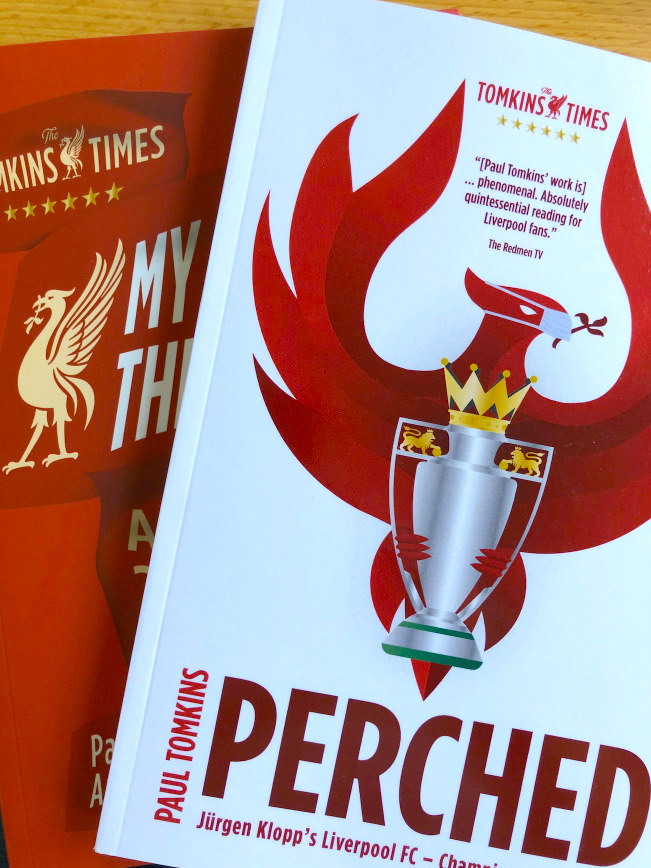
New Books here: “Perched” … and here “The Quarterly“.

Newsletter here: click me, it’s worth it.

Subscribe to The Tomkins Times: see below.


Tuesday, November 24, 2020

When I’m 64 (Unbeaten) – Liverpool Pummel Leicester by Paul Tomkins

https://tomkinstimes.com/2020/11/when-im-64-unbeaten-liverpool-pummel-leicester-free-read/


For the third game running, Liverpool absolutely mullered Leicester on xG, with Sky showing the Reds’ two best ‘expected goals’ scores since December 2019 have both been against Brendan Rodgers’ men (while the 2-1 league game last season fell before that timeframe and was another mass of good Liverpool chances in what xG had as a 4-0 win). Both were about as one-sided as big games get, with Leicester touted as title challengers at kickoff on both occasions. 

It meant yet another all-time record for Jürgen Klopp’s Reds, passing the Bob Paisley team of the late 1970s – for which the recently and sadly departed Ray Clemence was an absolute legend – for unbeaten home league games: now set at 64, which also included the club-best winning sequence of 22. 

As such, it’s worth making this piece a freebie and getting out the metaphorical cigar.

And this was a very under-strength Liverpool side that absolutely battered the Foxes. (Indeed, the xG was over a goal better than Villa’s in their 7-2 win over the Reds, which was a black swan event in terms of bad fortune.)

While I think it’s difficult to talk extemporaneously on a microphone live on national TV without making some odd word choices (I’d be crap at it), I did wonder why Jamie Carragher had to say in the first half that Liverpool were “slightly depleted”? Does he feel obliged to underplay Liverpool’s achievements at times, given his allegiances?

I do worry that some commentators (like referees at Anfield) are more concerned with looking unbiased than sticking to facts. Mo Salah, Thiago, Virgil van Dijk, Trent-Alexander Arnold, Joe Gomez and Jordan Henderson would be in the Reds’ best XI, so that’s six starters missing. Over half the team!

Four of them would probably also get into a World XI. Another of them would be in a world XI if it was picked on leadership and will to win.


Meanwhile, Xherdan Shaqiri, in fine form (and fitness) of late, was due to start, but he suffered a muscle injury, as did Naby Keita, who did start, only to be the latest to succumb to a problem in an insane schedule. (Liverpool will need to build a bigger rehab centre at the new training complex.) 

In addition, many of the Reds’ players had played two or even three international games this past fortnight, several in different continents, and Gini Wijnaldum has started six games for Holland since the middle of October. The man is an absolute machine; Dirk Kuyt once said that his compatriot had “the lungs of a horse”, and he has needed those gigantic lungs this season. (As an aside, I hope Gini signs a new deal, but I also wouldn’t begrudge him a new challenge in another league. He’s been a wonderful asset, and – touch wood – not susceptible to many injuries.)

Leicester, meanwhile, had the same matchday 18 as their game two weeks ago; although they did also have a small number of players out already. Yet again they looked clueless against a purring Liverpool team, except this was a makeshift Reds side with two midfielders in defence, and which played the final 30 minutes with another teenage rookie in the backline.

But it is a show of the strength in depth that the Reds could still field a fairly strong XI (and maybe that was the point Carragher was making), but that obviously meant a weaker bench. Yet another teenager (the stylish midfielder Leighton Clarkson) was thrust onto that bench for the first time, to show how deep the injury crisis runs. Liverpool have already fielded several 19-year-olds in major matches this season.

The elusive third goal, which looked like it would never come – to the point where Roberto Firmino found the ball repeatedly hitting him with an open goal at his mercy (and then, in one ricochet, the ball was 99.9%, if not 100% over the line) – but it finally fell to the Brazilian to kill the game, with the second goal from a “first” header at a corner in the game; the opener expertly directed into his own net by Jonny Evans, as if the back of his head was the front of van Dijk’s forehead. Boom!

However, the lateness to the much-deserved third goal meant it was hard to freshen things up with subs, other than Keita’s latest muscle twang. (Yet again Takumi Minamino came on in the 90th minute.)

It takes Liverpool joint top, although Spurs have still only played two Big Six games, albeit they won both (and those Big Six sides, from Manchester, are currently mid-table). 

Their tactics remain quite basic in the games I’ve seen, calling to mind the Leicester of 2016 – defend in numbers and hit on the break with searing pace (albeit Spurs have a better team and squad) – but it can occasionally be effective enough, especially in seasons where fewer victories are required, which should be the case this season, with such a bonkers fixture list. And it feels a long time since Jose Mourinho got teams into the 90+ points range – I think it must have been all the way back at Real Madrid in 2012 – in contrast to his record up to that point. It’s also effectively a Champions League squad (albeit wisely assembled over the years) that doesn’t actually have to endure the Champions League.

Mourinho has the advantage of being able to use the Europa League strategically, and to not deploy his best players unless they actually need the extra minutes. Liverpool, by contrast, have already played Man City, Chelsea, Arsenal, Everton and Leicester, and it’s just nine games in. The Reds have also gone away to Ajax and Atalanta, in the first three Champions League fixtures. The chance for Klopp to rest players would be lovely, if the Reds can beat the Italians at Anfield this week.

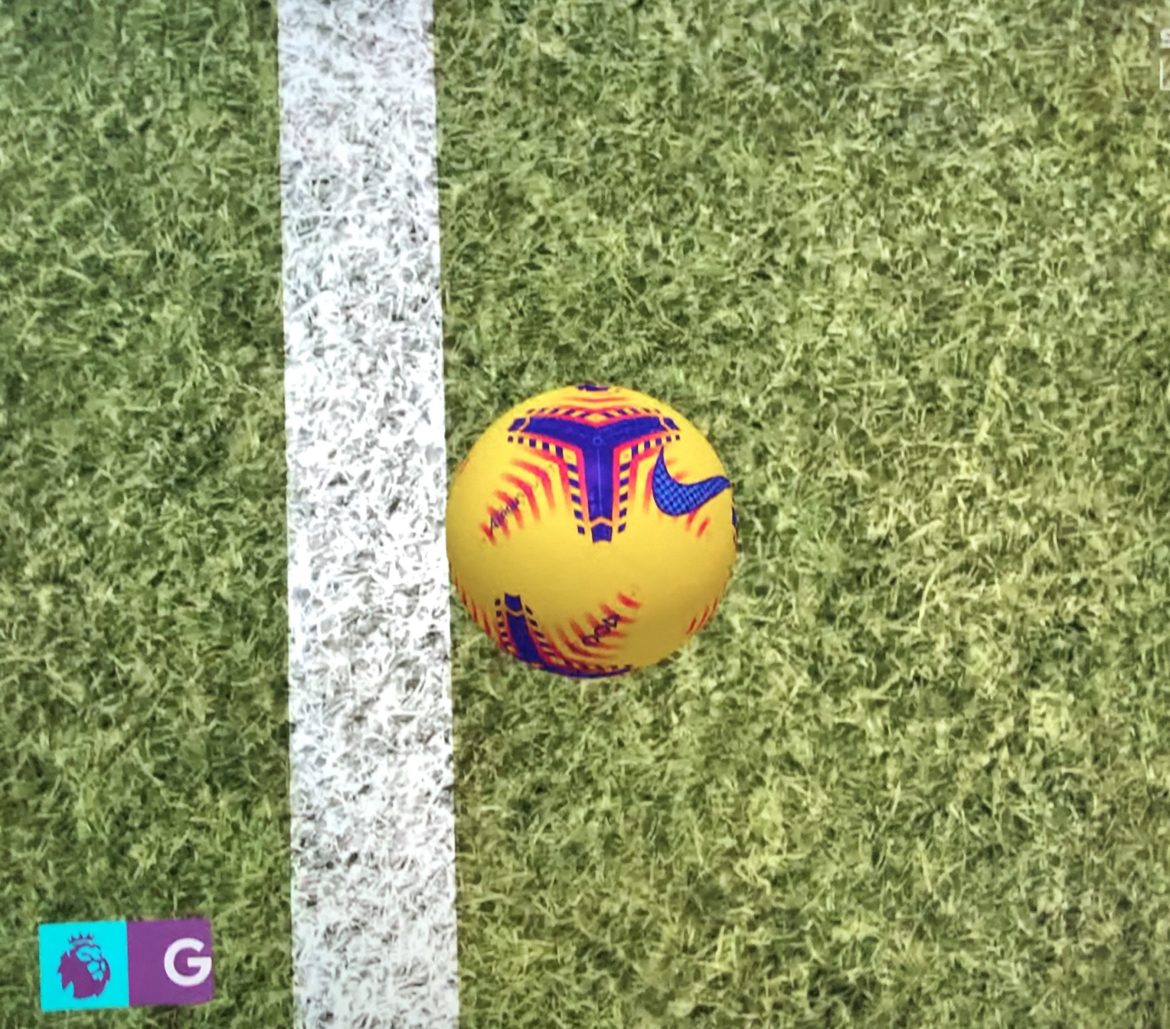
While it took a long time, I’m not sure I’ve been as happy for what was possibly a meaningless goal (albeit it did kill off any faint chance of a late two-goal Leicester revival) than when Firmino thumped the header in, having already hit the post and scored 99.9% of a goal in a move that also saw Sadio Mané strike the woodwork. This has been the most surreal season in living memory – as outlined in our new mini-book The Quarterly – and the denial of a goal by about one pixel on a video screen keeps happening to Klopp’s side.

This time it was the goalline technology, which, as some crumb of comfort, is ten times more detailed (500 frames per second) than the offside cameras (a measly 50 frames per second). That said, if that’s “10mm over the line”, as they said on Sky, then the ball is about three metres wide!

Add the injuries to so many key players, and they look every inch a team that can retain the title, having looked like a team losing its way as recently as the trip to Aston Villa in early October.

Since that game, which – surreally – had three times as many deflected goals as were seen in all Liverpool’s league games last season (for and against, 118 goals in total), defenders have fallen like flies. Yet Liverpool are generally defending superbly, with an ever-changing backline. With Villa 7th, and West Ham in 8th, as well as the fact that the Reds can’t play themselves, it means it’s only Spurs they haven’t faced from teams in the European places, in addition to the match-ups with Man City and Arsenal.

But Klopp’s trust of fringe players paid dividends yet again, with the most mature performance yet from from Curtis Jones, who is learning when to dribble, when to pass and when to cover back, and James Milner is defying time, logic and gravity; as well as defying the laws of physics, the Highway Code and the Night Poaching Act of 1828. He was one of the best players on the pitch and he is due to turn 100 later in the season. 

Andy Robertson has been much better this season, after some struggles (with extenuating circumstances) last season by his own high standards, even if he was often still effective in the title win. His powerful surges forward look stronger than ever, and this is a player currently running on only one hamstring.

Meanwhile, at the back, Joel Matip has oozed class and calmness, as has Fabinho alongside him. There’s no blistering pace there, but they both read the game so well, and have legs longer than a giraffe.

If anything, maybe the team – in his absence – no longer feels it can just rely on van Dijk. I do wonder if the Reds got a bit sloppy in thinking he could solve every problem, but while his laser-guided passing and his unstoppable set-piece threat have been missed, so far his defending (which had grown a bit sloppy) hasn’t. 

Still, it would be far better to have him available, but after two years when barely missing a single game, maybe he was a little jaded, and feeling the pressure as the team’s quasi-leader; but a couple of weeks off would have been far nicer than a totally fucked-up knee.

And as great as Matip and Fabinho have been at the heart of the defence whenever each has played this season, it leaves zero experienced cover, with the main two out for the entire campaign. That may catch up with the Reds later on in the season (although I presume Milner will just drop in there).

Up front, Mané is an unplayable live-wire, and Diogo Jota is a superstar goalscorer, whose game has gone up a level already, as have so many players as soon as they start training with Klopp and his team. Jota is so thrillingly alive to any bouncing ball, with excellent anticipation – and has great speed in getting his shots away, which is also a massive asset to have. He is such a clever footballer, and clever footballers with pace, and who can score goals, are worth their weight in gold. (Although presumably, footballers these days exceed their worth in weight of gold?)

The game was a joy to behold, and was so comfortable for Liverpool that I spent the final part spellbound by how much Marc Albrighton looks like Brendan Rodgers, and wondering how I’d never noticed before. From the side they look like twins.

And the bonuses of Liverpool doing so well without so many key players actually multiply: not only do the fringe players still win the Reds games (and the younger ones gain valuable experience), but the key men – aside from the two centre-backs – will presumably be fresher later on in the campaign. It may be a surreal season, but it’s also been fairly incredible in the difficult circumstances.

The Quarterly is out now; as is Perched, my look at the title win. Also, please sign up for our new Substack newsletter

Wednesday, July 31, 2019

Liverpool Don’t Look Ready” – Preseason Anxieties Justified? by Paul Tomkins


Well, let’s be clear: it’s hard to look ready when your players only finished their competitive club season in June (three weeks later than every other English club bar Spurs, and the first time since forming in 1892 that the Reds had a competitive game that late in the summer), then saw players go to the Nations League (four first-XI players and an impact sub), the Copa America (two first-XI players) and the African Nations Cup (three first-XI players and a borderline first-XI player), whilst others were out injured.
Last summer it was Spurs and Man City who had the greater number of players away during the summer, all at the World Cup, and in Spurs’ case, it probably contributed to their domestic collapse in the run-in (although playing in knockout Champions League games tends to damage league form, on average – compared against their league tallies from the season before and the season after a run to the final; and the less-expensive the squad, the greater the damage). Liverpool had an insanely tough start to last season on paper, but a lot of the players had come home early from the World Cup, or not even gone there.
Indeed, as I noted at the time, when Liverpool went to Napoli and lost 1-0, it was just days after they put in a mind-blowing 154 sprints at Chelsea, trying to until the end to rescue a point in a game where they played very well indeed. That kind of effort takes its toll; and so, despite losing all three away games in the group stages, I never wavered from my belief in the team. It was largely the circumstances, with tough league games penned in by tough Champions League games. Something has to give.
Between them, Liverpool’s two main rivals in the two main competitions signed just one player last season, and Spurs rushed all of their stars back for the first league game. That may explain why they ended the domestic season on their knees, but it was still their best overall season since 1961 (4th in the league and a Champions League final), and Manchester City had their best season ever in terms of silverware. They were not integrating new players (bar bench-option Mahrez), and were able to rely on greater understanding. But they probably didn’t start the season in peak physical condition; Chelsea made a better start that City, after all, and were top after five games.
In order for Liverpool to look fully ready now then they’d have had to have given all their stars zero time off this summer. That would mean they would be sharp and available for the start of the campaign (having lost no residual fitness), but likely done for by December. And the scheduling at the start of this summer is another huge spanner in the works. There’s no way around it. A crazy summer and a crazy number of additional games is the way the cards have fallen, in part due to the success of last season.
Liverpool have to play the Community Shield, the European Super Cup and then, before the turn of the year, the World Club Cup. That will make this season more challenging than last season in that it’s three additional “competitions” (no matter how brief and relatively unimportant they are in the grand scheme of things), and yet this is a team that I believe will improve due to time spent together, and the way it can mature from one of the youngest teams in the Premier League last season to a mid-spectrum average age this time around. Long-term, the future looks incredibly bright; short-term there may be some bumps in the road, just because the road ahead is full of potholes.
(Where it can get easier is in not facing teams as good as PSG and Napoli in the Champions League group, but a kind draw isn’t guaranteed. Longer domestic cup runs could then counter that, but these can be used as “reserve team” games. And I’m still in the “glorified friendly” camp on the Community Shield, but pretty much all foreign coaches see it as a proper trophy.)
Had the African Nations Cup not been put back from the winter of 2018/19 to this summer, Liverpool may have gone out to Bayern Munich in the Champions League (with players away or just returning, or injured on duty), and/or dropped more league points. We cannot now turn around and say that it’s unfair, because it worked in the club’s favour in securing a 6th European crown.
However, the decision by Guinea to call up an injured Naby Keita was reckless, and it sucks that Sadio Mané made it all the way to the final only to return with nothing. (Yet, of course, this is still an education for even players as old as 27. It can serve him well, long term, but he will need a long rest this summer, or, if he is to bypass that to some degree, rest has to be worked in at some point before the league’s first midwinter break. For instance, he could be excused the World Club Cup.)
The only Liverpool players who looked good – or “fit” – against Napoli were those who were at Melwood at the beginning of preseason: James Milner, Fabinho, Harry Wilson and a raft of kids who had no heavy international commitments.
That cannot be coincidental. Indeed, some of these kids look incredible every time I see them, with 17-year-old Ki-Jana Hoever, at full-back, having more tricks and turns than most top-class wingers (also, look at the goal he scored for the Dutch U17 side this summer for more outrageous skill, although that tournament is not gruelling like the others), and so many of these teenagers will only benefit from the social multiplier effect (training intensely against better players, with utter dedication and focus – as dictated by the manager but echoed by the non-stop professionalism of the senior pros – improves you like nothing else).
Alex Oxlade-Chamberlain, two very promising dribbles aside, looked below par, but is playing with a calf injury; while the midfield thrust of Keita and Xherdan Shaqiri – important in the absence of the ultra-cutting edge of the front three – are out injured (both from international duty). It all made for a bit of a lumpen XI, but take out so many excellent players and any team will look more prosaic. One or two can usually be mitigated for; six or seven, and any team will see a drop in quality.
Keita, Shaqiri and Oxlade-Chamberlain are the midfield “injectors”, and yet none is fully fit. And yet, of course, they offer Liverpool a lot of depth with that type of player – but when all three are out or impeded at once, it’s misleading to say there’s an issue with depth. If your 4th-choice goalkeeper isn’t very good (he’ll certainly be no Alisson Becker) or is just inexperienced, but you have the first three out injured, that’s just life; you can only build in so much insurance without having a 70-man squad. Probably only one of those attacking midfielders would start for the Reds in an ideal world, but none is “ready” right now. Shaqiri hasn’t even been able to reprise his role on the wing; he’s missed all preseason – although both he and Keita are at least now back in training.
And Adam Lallana, who seems to have an increasingly severe form of Cruyff-turn Tourette’s, is a handy midfield option to have, even if it’s well down the pecking order these days.
So even if there’s often a correlation between preseason form and the actual season form, I don’t think this summer can be counted, with first-XI players Alisson, Virgil van Dijk, Trent Alexander-Arnold, Jordan Henderson, Sadio Mané, Roberto Firmino and Mo Salah all at international tournaments, having had to extend their club seasons by three weeks, and with Keita and Shaqiri, who also played for their countries in the summer, totally absent. We have essentially been watching Liverpool’s B-team, often playing strong European opposition (after the two easier domestic matches). Even Van Dijk, Wijnaldum and Alexander-Arnold are only just back, and looking rusty.
Also, Liverpool do double and triple training sessions in preseason, designed to provide stamina for the campaign ahead, not to win preseason games; indeed, the club often trains on the day of a game in preseason, something no club would do before a meaningful match, as it’s counterproductive for the performance (as it saps vital energy). But this is not about performances, it’s about fitness. If you are building foundations, you cannot care if those foundations are pretty to look at or not – they have to serve the purpose for the long run. You could construct a building on shoddy foundations and it stay upright for a short while; but it will cause problems further down the line. The foundations are not to be seen, but are there to prop the whole thing up in the future.
Add in the travelling across time zones (jet-lag), the searing heat of previous games, and just the fact that pretty much every player – several of whom are yet to even feature – is at a totally different stage of fitness (and that Jürgen Klopp rarely picks his best XI at any one time in preseason before the final game/s), and you cannot read much into this preseason. It’s a freakish set of circumstances.
If someone looks electric, as Rhian Brewster has, then great, that’s a big bonus; but if they don’t, it doesn’t necessarily mean anything. In this case it probably meant that the kids, including the prodigious new arrival Harvey Elliott, are just unburdened by busy summers.
Indeed, Elliott, along with Sepp van den Berg, was wanted by a ton of Europe’s elite clubs. Elliott, from a family of Liverpool fans, was at Real Madrid’s training ground over the summer, but chose his beloved Reds instead. On hearing the news that he was Anfield-Bound, Zinedine Zidane made a last-ditch effort to try and tempt him to the Spanish capital. But it – along with the offer of more money – failed, clearly.
I’ve no idea if Elliott is ready for the first team right away, aged just 16, but he certainly has the ability and the confidence, as well as being a quiet and respectful young man off the pitch, lest anyone think that his haircut is indicative of some kind of rebellious streak. This is a player with immense skill to beat players in one-on-one situations and the eye to spot the kind of passes you usually only see from someone like David Silva. He is part of the new breed of young English player who has a great awareness of space, receives the ball on the half-turn and has sumptuous technique. But he will need to work hard (in games and in training), remain humble and avoid the bad luck of injuries. He may get games early on, but few players become regulars at big clubs before the age of 18 these days, and even then, it can be 20-21 for many of them. But equally, he doesn’t look like any ordinary 16-year-old. If he keeps his humility then the world is at his feet.
He is joining the perfect setup at Liverpool, with the “no dickheads” policy employed by the club in the Klopp era reaping dividends, which means everyone can get lifted up by the collective attitude. If you don’t train hard enough you’re gone, no matter how gifted. And there are no senior players arsing about to undermine the ethic; young players have supreme role models.
That said, some of the squad may still be adjusting to becoming European champions. Most athletes say that you can get a comedown after the elation of winning something incredible. They often talk of being depressed once they’ve achieved their aims, as something is then missing. But this can be overcome, and Liverpool have something big and as-yet unachieved to aim for – the Premier League title, and a first domestic crown since 1990; so it’s not like all their ambitions have been met. However, this season it seems that everything is set up to make that difficult; and the league must not become an all-or-nothing obsession.
And there’s the psychological resetting process, that can take time. Anyone who has played a video game for days, weeks or months (not in one sitting!) to continually progress, only to then die (within the game, unless you are indeed trying it in one sitting) knows how depressing it feels to start from scratch again, all previous progress lost. Liverpool won 97 points last season as well as the Champions League, but it’s all reset to zero now.
And of course, a little of the buzz from the glorious night in Madrid has gone, with the past four preseason results, but the confidence gained from digging in all last season long has to be drilled deeper into the core now.
Part of the issue is that clubs and television companies now seek to monetise preseason, when the games remain glorified training sessions, but the players have to be flown all over the world. It’s a great chance for fans on other continents to see the players in the flesh, but they cannot expect those players to be ready; they are watching the rehearsals, not the final production. In this case it’s not even the rehearsals with the main stars – it’s a run-through with the understudies.
People paying to view these games on TV cannot expect to be entertained. Yes, it’s lovely if it’s all beautiful football, but you cannot demand it.
Trent Alexander-Arnold, Virgil Van Dijk, Andy Robertson, et al, have been back for little or no time, and a Liverpool side without its world-class goalkeeper and all three of its world-class attacking triumvirate is going to be a weaker team, fitness or no fitness. That’s just indisputable.
To have the same kind of quality in reserve is nice in theory, but in practice it’s difficult to achieve, not least because someone is going to be very unhappy at not playing enough football, and that can affect the mood of the camp; while signing someone as good as the front three (which once at this level cannot be easy) is made harder by not being able to guarantee that new signing a starting position.
Adding players also means a further spike to the wage bill which is already increasing all the time (in line with increased revenues), in order to keep the team together (in contrast to 2009 and 2014, when key players left, and in 2009, the club was mired in an internal war).
Liverpool, it seems, will not offer higher wages to any new signing, because – based on my reading of it – the highest earners have to be those who have already proved their worth to Liverpool. That avoids the Alexis Sanchez shitshow at Man United. As soon as you go against a meritocratic wage structure you are planting a time bomb. But Liverpool’s younger players who have done well are getting new contracts, as are those who are becoming superstars.
And fans can only “improve” a team in their minds by adding players. They cannot coach or develop talent, or offer ways to make the team more unified, because they have no idea to do any of those things. Just add “better players” and it solves all issues.
Fans have no idea what the chemistry would be like, or how to make that side of the game work, or if signing those players would destroy the wage structure and therefore undermine the group ethic. They don’t know if players they crave are actually “dickheads”, whom Klopp and co. refuse to sign. (See my new book for far greater detail on all of this.)
And when some of the understudies are also out, or hampered by niggles, then it’s going to be hard to look good, and impossible to look “ready”. Some kind of compromise and “muddling through” the opening weeks of the season seems unavoidable.
Liverpool cannot bypass the late return of players, nor can they alter the fixture schedule. Signing someone to cover this temporary shortfall does not mean much if that player then takes six months to settle; and then, when everyone is back, there’s an excess of players when everyone is fit, and the problems that can cause (even if it’s lovely in theory). Liverpool also have players returning from loan (Wilson), and have promoted several world-class (in their age group) youngsters to the first team squad.
Another problem is that the league campaign now feels like you cannot afford to even draw a game; it has to be 38 wins, week after week after week, or panic will set in. But that’s not healthy. Liverpool cannot be expected to be at peak condition from August to May with such an insane summer that fell beyond their control, after a season that lasted 3 weeks longer than that of their man rival.
Go back to the last time Liverpool won the Champions League, in 2005, and by the August of that year I had just started writing my Wednesday column for the official Liverpool website. I was inundated with emails telling me that Rafa Benítez didn’t know what he was doing and had to go, after a start that saw Liverpool languishing in 12th in November. Indeed, the emails started raining in well before then (and to be frank, they didn’t stop for the next five years). Winning things just raises expectations (aka the hedonic treadmill), and so many people can never be satisfied. You don’t want your club to rest on its laurels, but equally, it cannot deliver relentless success, especially when the playing field isn’t exactly fair.
The Reds ended up finishing 3rd with 82 points in 2005/06, then the club’s highest of the Premier League era, and won the FA Cup after a tough run to the final. It improved greatly, overall, from the much weaker XI and squad that won in Istanbul.
The team was then at its best in 2009, after years of tweaking and development. It won nothing, but it would beat the 2005 side eight or nine times out of ten.
Because you don’t always get what you deserve, and you can’t always control the circumstances. You can only try your best.

Mentality Monsters: How Jürgen Klopp Took Liverpool FC From Also-Rans To Champions of Europe is available now via Amazon.