Thursday, October 15, 2015

Kop to Cop Klopp? – “Clap Clap!” By Paul Tomkins

http://tomkinstimes.com/2015/10/kop-to-cop-klopp-clap-clap/

By Paul Tomkins.
First of all, apologies for the tabloid headline. I thought it would be best to get it out of the way now. Let’s hope he doesn’t flop, hop, or go pop.
It seems nailed-on that Liverpool will announce Jurgen Klopp as their boss – possibly before the end of this week. After three boringly-named British managers (not that Dalglish isn’t anything other than special in its own way), it’s refreshing to have to work out whether or not to use a umlaut when typing Jürgen, just as I had to get used to the é in Gérard Houllier, and the special í in Benítez.
Truth be told, I prefer foreign bosses. And I prefer them because, as with foreign players, there are a lot more of them. I don’t prefer any old foreign boss. But I loathe the idea, as touted in 2010 – and something the club has struggled to recover from – that it has to be an English boss.
English football is specialised, in that we have a fairly unique way of playing, in a part of the world that differs from many footballing hotbeds (the Latin countries), but Britain houses less than 1% of the world’s population. That means that more than 99% of the pool to choose from exists outside this tiny island – an island that is far too insular in its outlook.
It’s the same with limiting the focus of talent to Liverpool itself – it’s just too small in this big, wide world, even if you want to see the best from the city in the squad, and maybe making the team. What you don’t want is tokenism – as was the case in 2009/10, when Rafa Benítez was accused of picking Lucas Leiva over Jay Spearing, when the manager knew that Spearing simply wasn’t as good. Give me a Lucas over a Spearing any day of the week, although we’d all want another Carragher, Gerrard or Fowler.
There are good British managers, just as there are good British players. But now that Ferguson has retired, are there any great British managers still working in the game? How many are testing themselves abroad? The British media champion British managers, and British managers demand the top jobs, but they just aren’t good enough.
Brendan Rodgers may be the best British manager working today. But his experience, like so many others from the UK, is limited to British football. There are always lots ofpromising young British managers, but they rarely get the biggest jobs these days; and part of the problem is that when they do they fail – or in Rodgers’ case, fail to succeedquite enough. At least he wasn’t the car crash that was Hodgson at Liverpool and Moyes at United, and to a lesser extent, Mark Hughes at Man City.
By the time he’s 50, Rodgers should be a much better manager (eight years is a long time; in 2007 Liverpool were in their second Champions League Final in three seasons – yes,that’s how long). But at 42 his experience is limited. Excluding Europa League qualifiers, he won just a third of his games in Europe, and while all but six of those games were in a competition that is hard to take seriously in its bloated group stage format, it shows a possible gap in knowledge. Of course, he wasn’t sacked for not being very good in the Europa League, although last season’s Champions League campaign was a black mark. (A big tick for getting there, mind.)
Right now Liverpool need to punch above their weight in the league, but over the past 46 Premier League games (38 last season, eight this season) it’s been below that. At some stage there had to be a cut-off point. Go back another season and we were close to heaven. But this season, rather than be in the hell that was Hodgson, it was a kind of purgatory – neither here nor there; dull, uninspiring, unremarkable.
I will state again that Brendan Rodgers did a good job at Liverpool, as I’ve been saying for the past 18 months. But it was starting to go stale – indeed, just as it does for most managers; often after three years, but sometimes five or six. It went stale for Klopp in Dortmund. But it’s vital that we can differentiate between the end of a cycle and the notion that the manager wasn’t actually that good after all, or that he got “found out”. Cycles end when the turnover of players falls short (the best players leave or retire and the new ones stop being good enough), and also when the coach runs out of ideas or energy.
Indeed, I was told that someone in the media was spouting off about Klopp getting ‘found out’ at Dortmund in his last season – which was also his seventh. He got ‘found out’ after winning back-to-back league titles and reaching the Champions League Final. His Mainz team also got relegated – what a failure! – but this was only after he took them into the top flight for their first ever time (in his first ever job), and into European qualification.
Again, after seven years the cycle ended. There’s no shame in that. He stayed with themafter relegation, to show his loyalty, but he’d run out of steam. Still, it’s not bad to have had two jobs with clear success achieved – incredible highs – and been in both for seven seasons. You have to go back to Bob Paisley for the last Liverpool manager to go more than six seasons (although there is more pressure, nay hysteria, surrounding Liverpool than Mainz and even Dortmund; certainly on social media).
Like Rodgers, Klopp lost many of his best players to richer rivals, although in his case he was losing them to Dortmund’s major domestic powerhouse; imagine if Suarez had gone to Manchester City along with Sterling, instead of overseas, and it was Liverpool’s job to finish above them.
Bubbles burst. The important thing is to be able to blow the damn thing up big and fat in the first place. And in fairness to Rodgers, he did just that. But whatever it was that combined to such great effect in 2013/14 (and it wasn’t just Suarez) had started to get lost 18 months ago.
Suitability
According to his agent, “Jürgen doesn’t like to speak to players’ agents or to carry out a transfer.”
This is perfect for what FSG are trying to do, and one way of avoiding the mixed-up messages of the transfer committee – which, to me, was flawed not by its selection of players but by the fact that the manager was asking for his own players, and them getting them …in addition to the committee ones. Too many players arrived, with Rodgers’ insular focus on Premier League talent a needless narrowing of the potential field.
After all, Liverpool couldn’t afford the best players in the league – they were already at least five clubs, who wouldn’t sell to a rival (plus there are always a couple of gems at Everton, who are also off-bounds), so what was left but to overpay for what was at the 13 remaining clubs?
I don’t think that buying a player from Swansea or Sunderland makes them limited to being a Swansea or Sunderland player; Jordan Henderson proves that. But you can’t keepshopping in that market.
The purchases Rodgers drove were from Swansea, Aston Villa and, famously on fouroccasions, Southampton – a club, incidentally, which were using much the same methodologies as Liverpool’s data and scouting gurus, and bringing undervalued talent into the country. To buy one or two players from these clubs is fine; to buy so many was concerning.
Southampton also have banks of data analysts hooked up to computer and video screens – but the difference is that they don’t then ignore that work to go out and buy overpriced Premier League talent on the manager’s say-so; and of course, the south coast side are bringing players into a lower-pressure environment, but where they were helped by English-speaking continental managers.
The manager at Southampton, and other clubs that operate that way, is not then looking to play his own signings; and while I don’t think there’s any proof to suggest that Rodgers ignored committee signings in favour of his own buys to prove a point, he was always going to choose them first, and therefore the committee buys were starting off at a disadvantage. Rodgers also bombed out his own signings, but possibly gave them more of a chance.
For me, Rodgers’ downfall was due to this inability to work with what he was given – not a failing exclusive to British managers, but something British managers seem unable to adapt to. As I noted in yesterday’s piece, and indeed, as I’ve said many times, the best players in Rodgers’ Liverpool sides have all been either inherited or foist upon him. None of the best players were ever the ones he brought to the club.
Klopp will work with what he’s given. He may not like everything he’s given, but he will be free to choose the best players, with no agendas (subconscious or otherwise) clouding his thought processes. He will work with young players, and not make a big deal of it.
A few years ago I worked out that Bob Paisley’s signings averaged just 22 years of age at the time of purchase; and while they weren’t being thrust into young teams, they back up my research that 20-23 is the best age to sign players – not just for potential resale value, but in terms of them becoming great players for your team. Yes, you can sign successful older players too, but they offer no greater odds on success, but often cost more in fees and wages.
The 10 players that I think Rodgers was most keen to bring to the club average out at 26, and yet almost all failed to deliver – when, at the peak stage of their careers, there’s less time to wait. (The whole point of buying players in that age-bracket is the perceived idea that they will be more instantly successful.)
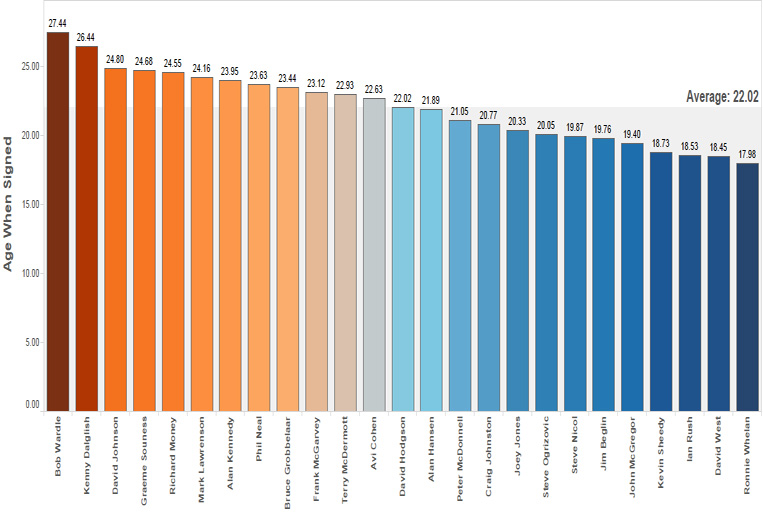
Bob-Paisley-Recruitment
Paisley’s signings. Click To Enlarge.
Whoever is manager, the club has to try and hold onto those players who are worth keeping and who are full of experience – the good players aged 25-30 – and keep bringing in 18-23 year olds, as well as promoting the best youth graduates. New signings have to be given until their second season before being judged, unless they are utterly awful or totally disruptive. Some kind of continuity is required, as the turnover has been too rapid. It also hasn’t helped that Rodgers’ approach seemed to change too rapidly, and how do you buy for that? Was he adapting to the players he was given, or was he changing systems before they’d had a chance to adjust?
Maybe one or two older purchases could be necessary early on to make up any shortfall in experience (Gerrard has gone, Kolo Toure isn’t much use these days), and to compensate if several senior members suddenly ‘fall off the cliff’ – but the committee are without doubt aiming in the right age bracket for signings. We can all debate the quality, but overall it hasn’t been as bad as portrayed.
Kloppite
German football expert Raphael Honigstein is as good as anyone to discuss the merits of Klopp, and this is what he had to say to the Fanscorner website a few weeks ago:
“I think Klopp would fit in at Liverpool in the sense that it’s a club full of emotions, a club that lives on the interaction between the crowd and the players. I think Klopp has learned to utilise that very well. He’s a passionate guy, he’s a motivator. He also has his tactical knowhow, but I think he thrives on the energy that he manages to create in the dressing room and inside the stadium.”
“What he would need though, and this goes for any club he goes to as well, is a Director of Football. Sometimes there’s a flawed view of managers, from an English perspective, as the guys who buy and sell players. He’s never bought or sold a player, apart from maybe one or two from Mainz … I don’t think he would want the responsibility of signing players. I think you need a great partnership between him and a guy who manages to bring players which fit into the system.”
“The way Liverpool have been buying and selling players has been… well, it’s hard for any coach to really understand what he’s doing. It’s especially hard for Rodgers who doesn’t seem to have a clear direction and changes his philosophy every six months. First it was possession, where they had to keep the ball at all costs and they got a hundred 0-0’s. Then the next year they played counter attacking football which nearly won them the league, and the year after that was when they crossed the fine line between being flexible and being all over the place.”
“I think perception is very important. As a player he needs to feel that the coach knows what he is doing, even if he changes 3 or 4 times a game like Guardiola. If it was Claudio Ranieri players would be looking at him and thinking that this is a joke, but because it’s Pep they appreciate it. With Rodgers, I’m not sure that’s the case. There’s a lot of change going on, maybe because he doesn’t really know what idea works. But yes, it would be hugely exciting to see Klopp come in.”
Why Now?
Klopp would arrive after a short sabbatical, and that’s always better than going straight into a new job, especially given that he’s admittedly a very emotional man (he cried for a week after leaving Mainz).
Ideally a new man would have been appointed in the summer – that’s the obvious time. However, I think it was fair to give Rodgers a chance – but it had to be a special start, not a mediocre one – and it may be more beneficial to get Klopp now than straight after the end of his Dortmund tenure.
A few months isn’t a long time, but in football it’s an eternity; especially when managers can’t genuine take holidays whilst in charge of a club, without thinking and thinking about every last detail. (Although Ferguson’s longevity seems in part due to his other interests, and maybe an ability to switch off – although he was only a part-time manager, rarely on the training ground in later years.)
Of course, had Klopp signed in the summer we may not have had the latest round of tit-for-tat signings (Rodgers apparently only agreeing to the signing of Roberto Firmino if he could have Christian Benteke).
Then again, I have a lot of faith in both Firmino and Benteke – with the former a clear talent who Klopp would know well from their time in the Bundesliga, and the latter a hugely underrated player, albeit one who may not be suited to what Klopp wants to do. (Firmino seems more up his straße.)
The problem Rodgers had was that he didn’t seem to know what to do with Firmino, who arrived late due to international duty, and whom he didn’t seem to have planned a starting position for; nor how to get the best out of Benteke in the brief experiments he tried, even if the results were initially good. Both players were injured after just a few games. It remains to be seen if either is worth c.£30m, although these are not astronomical fees in 2015, even if they aren’t exactly cheap to a club run on its turnover and not dodgy oil money.
However, as with Lazar Markovic, who was bought at the same time as Adam Lallana to play in much the same role, and Dejan Lovren, who was bought as a left-sided centre-back when Liverpool had Mamadou Sakho – making for four players at c.£20m each, only two of whom would usually start – there appears to have been no provision for what would happen with Firmino. This is where the transfer system broke down, because of the manager’s vested interest in those he believed in, at the expense of those he perhapsneeded to be more open-minded about. Rodgers may have some valid gripes about players given to him, but it never once seemed like everyone was working to the same end goal.
At least FSG will now know that whoever gets picked has nothing to do with any type of bias – something I sense they felt wasn’t the case under Rodgers – and given that Klopp clearly knows what he’s doing (even if it doesn’t end up working), we will know whether or not the committee are supplying duds or not.
Also, Klopp can help Liverpool tap into the undervalued German market – something done with Emre Can for just £10m, although Firmino’s fee was fairly full-on. It’s the ideal league to import from, due to the similar work ethic and weather conditions; and Bayern Munich aside, it’s not full of elite clubs that can definitely afford to hang onto their best players. Klopp’s reputation is also global, so that will help in any market.
What Will He Find?
So, let’s take a quick detour around the squad as it stands.
Klopp will find a lot players he can build a strong team with, even if there isn’t an abundance of elite talent. The aim has to be to get the side to be greater than the sum of its parts, something that Rodgers briefly did.
The giant German will find Coutinho, who has been looking disillusioned this season, and in need of a lift. And he will find Sturridge, whom I’m sure he’ll love, if he can be kept fit. (Although Klopp likes wild team celebrations more than wiggly arms.) And he will have Jordan Henderson, a player it’s impossible not to love, if you have more than two brain cells.
He will have Benteke – a player who can be unplayable on his day, and has scope to improve, at 24. And he will find Firmino, who may fare better under the German. What he will struggle to do is form a team with all of these aforementioned players, but he will want a strong bench, too.
There’s James Milner – who may have to revert to utility man, now that he is no longer tied to Rodgers’ promise of central midfield. There’s Lucas, who, like Henderson, is hard to dislike if you know your football. Both Milner and Lucas are, at worst, very solid squad players; at best, experienced internationals. What you might not want is both in the same XI, especially at home, unless fielding several very attacking players around them.
There’s Emre Can, a massive talent – and German, to boot – but one whose versatility currently makes him a jack of all trades and master of none. I’m so glad that Liverpool have him, but I have no idea what should be done with him. At 21, there’s time to shape him into something special. Will he be a midfield lynchpin, or could Joe Allen yet find full fitness and consistency?
My guess is that Klopp will really like the pace of Origi – who had his best game a week ago, when he tore past Sion defenders – and Ings; the latter having more heart and energy, and having hit his goalscoring stride, while the former, though barely used, possesses the change of gear to leave defenders for dead. After a great loan at Derby and bright period after returning from loan, Jordon Ibe, still only 19, is having the kind of dip you’d expect, but maybe Klopp can help lift him out of the slump. He’s another quick, exciting attacking talent, albeit like Origi, still very raw. Klopp will also find Lazar Markovic on loan in Turkey, which won’t be a lot of help, and the promising Sheyi Ojo doing well at Wolves.
There’s Mamadou Sakho, a defensive lion whose ability on the ball is inversely related to what most pundits see (he rarely gives it away, he passes forward more than Liverpool’s other central defenders – including Agger, when he was at the club – and his average distance is 20 yards, not three or four). And there’s Martin Skrtel, as reliable as he is unreliable – but at his best, one of the standout centre-backs in the division (it’s just a shame that it’s only half the time, and that when he’s bad, he’s dreadful). Both could benefit from better protection. Even Dejan Lovren has looked a good defender when afforded some protection – but without it he’s a total liability. (Oh, and there’s the bloke in the corner, with a big smile on his face – Kolo Toure.)
There’s Joe Gomez, Nathaniel Clyne, Alberto Moreno and Jon Flanagan – four young/youngish full-backs, with a real mix of abilities. Moreno is currently starring as a wing-back, but it’s debatable whether he could thrive at full-back in a country where long diagonal balls are used to exploit anyone under 6ft tall – but his pace is great when going forward, and in recovery challenges. Gomez is a thoroughbred for his age, but almost no big clubs risk 18-year-olds at centre-back, so full-back may remain his position for a good while yet. Clyne is quick and strong, and defensively solid, but average on the ball. And Flanagan is hopefully going to return at some point with all the guts he showed in the past. There’s enough to work with here, if not the ideal all-round full-back.
In Simon Mignolet he will find an improving goalkeeper whose shot-stopping can reach the elite level, and whose command of his area has improved since being dropped last season, but who still doesn’t inspire confidence. He’s poor with the ball and not too quick off his line. With Mignolet you feel it really could go either way.
What’s left? Adam Lallana – talented, but featherweight. (If Klopp rates him highly enough to make him a regular, then we can all accept that Rodgers wasn’t showing bias.) There’s João Carlos Teixeira – now 22, and clearly a talent, but in need of a boost or a move. There’s also 18-year-olds Jordan Rossiter (who looks like a cross between Spearing and Gerrard, falling in between the two on the spectrum) and Pedro Chirivella, who looks like a world-class midfield recycler in the making, but who still has a long way to go.
So as I said, a surplus of very good players, but a shortage of truly outstanding ones. There’s enough to build a strong team, and have seven strong substitutes, but it could indeed be teamwork that gets results, rather than relying on individual brilliance – especially if Coutinho isn’t at it, and Sturridge isn’t fit.
A lot will depend on how the vast majority of players – still not at their hypothetical peak – improve in the next year or two. What we won’t want is another mass turnover of players, after three such summers – quality, rather than quantity, should be the aim in January, if the market permits, and certainly next summer.
Winner
Klopp has the aura of a winner, and while it can seem meaningless to say that the manager must have that trait – great managers turn into winners somewhere along the line – it seems important at Liverpool, at this point in time, where a track record of success is lacking in all areas of the club right now.
And FSG need it too, to add credibility to what they’re trying to do, after 18 months of doubts about their credentials and intentions. To appoint another relative rookie could prove a gamble too far, at a time when things haven’t been going well. (It would also stop them being deluged on Twitter with cries of #Klopp.)
Klopp would represent a massive coup, and guarantee an injection of belief into all aspects of the club, when most of us are getting used to Liverpool being a B-list club in the oligarch age. The Kop might even start rocking again – although its atmosphere these days falls well short of what Klopp was used to at the Westfalenstadion, where 82,000 would attend games, with few of them tourists and jaded punters, and when they weren’t paying a lot of money for the privilege.
But if he could get just some of the old passion back – something that Rodgers managed two seasons ago – then Liverpool would have one extra weapon in the aim to push beyond the ‘natural order’ limit of 5th as par.
Klopp

Liverpool Need A Proven Winner (Like Klopp) By Paul Tomkins

http://tomkinstimes.com/2015/10/liverpool-need-a-proven-winner-like-klopp/

By Paul Tomkins.
My main worry with the appointment of Brendan Rodgers three years ago, and an argument I made until about halfway through the 2013/14 season – when I started to “believe” – was that Liverpool needed a proven winner. It’s a job that comes with a lot of pressure, and while proof of past success is no guarantee it can be replicated, it’s usually a pretty good sign that someone knows what they’re doing.
My understanding in 2012 was that Liverpool were looking for a world-class name to become Director of Football (or a title along those lines), under whom a younger man would work. Whether that was then abandoned as a concept, or fudged when Brendan Rodgers stated in his first press conference that he would not be working under a DoF, the result was that Liverpool had no discernible gravitas. The whole football side of things was more-or-less in the hands of one man, and while he spoke a good game, his CV was thin.
He did a great job of getting a small club to over-perform with Swansea, but as I wrote well before then (in 2010), this type of achievement is something that people like Sam Allardyce, Roy Hodgson and countless others had racked up, and they found life much harder when expectations were higher; their ideas didn’t upscale.
And in fairness to Rodgers, he did a better job than either of those two, and countless other “overpromoted Peters” from within the Premier League (including David Moyes, another I warned would suffer the same fate; a talented manager, but not suited to the highest level of pressure). Indeed, it looked like Rodgers’ ideas could upscale. At least he valued technique, pace and pressing. He had big ideas.
But by the end, it was no longer clear what Rodgers was trying to do, and whether he himself knew – such can be the engulfing fog of pressure when things start going wrong in a high-profile job. His teams no longer seemed to press in unison. They often lacked pace in key areas. And although he had spells where clean sheets were racked up, there was no consistent sense of defensive organisation.
In some ways he may have been lucky to last the summer, but it seemed fair enough that he got a chance to show if last season was a mere blip. It just meant that he had to be doing better than 10th after eight games, in addition to three unremarkable cup games; games that were not necessarily that important in themselves, but which still failed to show any sign of progress.
Rodgers arrived with the aura – the swagger – of a winner, but he hadn’t won anything. My fears were somewhat allayed by the way he spoke – not the cliches and riddles, but the forcefulness of his personality, and the way he carried himself, which projected confidence. I genuinely warmed to him.
But then came Being:Liverpool, and he was exposed as something that people took to be a fraud; Brenton Rodgers, etc., with the management-speak that people found cringeworthy. Here was a young manager in his first major position, getting to know the club and its players, whilst his every move was filmed for a worldwide audience. It did him no favours, just as it would probably have done very few managers any favours. In some ways the programme was a good idea, to help spread interest in the club at a time when global income was vital to stop falling further behind richer rivals, but it left a band of critics with a lingering sense of distrust of the manager.
His early transfer work was fairly disastrous, and on top of not wanting Daniel Sturridge that first summer he tried to swap Jordan Henderson for Clint Dempsey. (I noted yesterday, in my initial reaction piece to his sacking, that his transfer business could have been the main reason he lost his job.)
One flaw I noticed in his appointment from a mid-ranking club (albeit one he lifted to that stature), which I mentioned at the time but didn’t cover yesterday, was the usual zeal to go back and raid his old employers. This is common for managers, and indeed, is socommon that it should be part of the thinking when it comes to appointments.
Rafa Benítez had worked with Luis Garcia at Tenerife. Louis van Gaal brought Danny Blind and Memphis Depay from his Holland squad. Arsene Wenger arrived and instantly brought in players he’d worked with in France. But Rodgers wanted Joe Allen (which was fair enough – he’s a talented player), Fabio Borini, Ryan Bertrand and Ashley Williams, two of whom he’d worked with at Chelsea’s youth team before they were offloaded as failures to make the grade. Any one of these players on his own would perhaps be fine; to go after all four rang alarm bells. Whatever he saw in Fabio Borini wasn’t replicated in a red shirt.
And as Rodgers’ coaching was limited to England, he couldn’t bring with him the underpriced gems from another league, in the way that Benítez did with Alonso, Reina and Torres, Wenger did with Vieira and Anelka from France, or Mourinho did with various players from Portugal and Spain.
This is one of my major bugbears with British coaches: they want to be respected and taken seriously, yet so few of them even dare to try life beyond these shores. (Our players are no better; and going to America at 35 doesn’t count.) Simply being foreign doesn’t automatically make a manager better, but it often means a broader range of experiences.
To his credit, Rodgers is fairly well-travelled and speaks Spanish, but his inexperience was always likely to be exposed without the weight of a senior figure working above him. Yet he did not want that help. Perhaps had that arrangement been in place, his tenure would have been over even sooner – who knows? Also, he didn’t appoint a major coaching name, with vast experience to draw from, to sit alongside him on the bench. He chose Colin Pascoe.
The richer the Premier League gets, the less sense it makes to shop here – struggling clubs don’t need the money like they used to. And Liverpool have spent too much of the past five years buying from these shores. Some English players are a necessity, to give the club some kind of identity, but I see no advantage in prior Premier League experience when assessing which buys over the past 10-20 years have proved successful.
I don’t agree with Jamie Carragher’s assertion that Liverpool have become like Spurs, buying young players to sell for a profit – not least because the club’s best buys in the past 10-20 years have almost all been young players, aged 20-23 (it was the same under Bob Paisley), and anyone sold has been because they wanted to go. Liverpool held strong over Luis Suarez in 2013, and did the same with Raheem Sterling, until the price was too good to refuse. Indeed, had some of the more experienced players and older purchases been better, then it might have been easier to hold onto the bigger names.
I don’t know why 20-23 year olds make for the best buys, but my guess is that they are old enough to be ready, but not as yet worn down by injuries or jaded by success. Perhaps they are less nervous – the fearlessness of youth – and more adaptable, too. Perhaps crucially, the transfer fees they have to justify are usually lower, because they are yet to have “done it all” (and this is where they differ from managers, who aren’t relying on athletic skills).
Torres, Alonso, Henderson, Suarez, Coutinho, Sturridge, Reina, Agger, Lucas, Mascherano, Skrtel, Sakho, Moreno, Ings, Can – all are in that age bracket (whilst Sterling was just 15, and the successful youth graduates like Gerrard and Carragher were eased into the team in their teens). Just three from that list are English; just three had prior Premier League experience. And of those, Daniel Sturridge was about as non-English as you can get in terms of technique.
None arrived for an outlandish fee. (Indeed, the most expensive younger players the Reds have bought in the Premier League era, once TPI inflation is applied – Carroll, Heskey and Cissé, all at fees ranging from £40m-£50m in 2015 money – were perhaps weighed down by an unhelpfully large price tag, although none was quite good enough to consistently overcome that pressure.)
Sakho, Moreno, Ings and Can are all still improving, and aren’t at the level of the others, but they definitely look amongst Liverpool’s better players right now – whereas overpriced players like Lovren and Lallana – “finished article” purchases past their mid-20s – have been pushed to the fringes.
Getting players young, and having them grow into your club, seems vital. The trouble is hanging onto them, of course – and that’s got harder since 2010, when Manchester City effectively reduced the available Champions League spaces for other clubs from four to three, at a time when Liverpool fell away under the gross mismanagement of Gillett and Hicks; just as it got harder when Chelsea’s spending guaranteed them a place from 2003 onwards (although maybe it’s now their turn to have a wobble).
That’s why Lucas became emblematic to me. You have to have some players who know the club, and who have grown up in these surroundings; and why I was so surprised that he was out of Rodgers’ plans up to the point Henderson got injured, and almost out the door. As he so frequently did, Rodgers did a u-turn, and it was the right decision; but the vice-captain’s armband was given straight to James Milner, who had just joined the club. Milner should have been left with his own form to focus on, as he settled into the club.
The other trouble, as I’ve stressed many times, is that if you have too many young players you will be lacking in experience; and most of the best sides average an age somewhere between 25 and 30; with the average age of Premier League champions 26.5. So it’s a difficult balance to strike, when most of the new arrivals are young. And it’s been made harder by the phasing out of Carragher and Gerrard, and the sale of Suarez, now at his peak.
Rodgers arrived at Liverpool when the club was already in its Champions League exile, and while this was not his fault – indeed, it made life harder – this presented another problem: he didn’t have the gravitas to attract the best players, even when the Reds dideventually qualify.
Of course, not that he was the sole problem: Liverpool, as a location, is not glamorous to cosmopolitan players, and the club didn’t have a recent history of being regulars in the competition. But had Rodgers himself had more pulling power, it might have helped with the 2014 recruitment, at a time when the club could offer Europe’s elite competition.
The big names who played for Rodgers seemed to respond to him, but most were already at the club (Suarez, Gerrard, Sterling, Henderson) or foist upon him by the committee (Sturridge, Coutinho). Once Carragher retired, Suarez left, and Gerrard emigrated, there was an even greater lack of gravitas associated with the club. It says a lot that Rodgers was having to get Gerrard to text big-name players in attempts to tap them up, presumably because they wouldn’t have heard of him, or been sufficiently impressed; yet we all know the story of Rafa Benítez calling Fernando Torres, and Torres’ desire to play for his compatriot. It’s a fact of life that players want to play for the best managers, albeit perhaps further down the list of must-haves than getting £300k-a-week.
Liverpool still has its legendary name, built on an incredible history, but no one joins a club for what it did before they were born – at least not if they have better alternatives that offer a higher standard of football and bigger wages. No one wants to play for Nottingham Forest because of what happened between 1978 and 1980, or Newcastle because of the Fairs Cup in 1969.
That history keeps Anfield as one of the most meaningful stadiums in the world, but it’s no longer one of the biggest, nor the best; and its atmosphere – such a help when things are going well, as was the case just 18 months ago – becomes a hindrance during struggles. Things might improve with the new Main Stand, but will that just mean another 10,000 quiet or grumbling souls? You can’t keep changing the manager to pep up the Kop, but once the boos start ringing out then it’s no longer a helpful atmosphere.
Right now, its historic reputation is what gives the club a chance, because it has been financially outmuscled, and as the focus in England shifts south, nudged into an unfashionable area when it comes to football, when, like the north-east, it used to be a genuine hotbed. Liverpool has its name, but little else. The club has what I feel to be a good young squad, but no major players, and until yesterday had a manager who wasn’t well-known beyond these shores (I believe a survey last season in France showed that people there thought Kenny Dalglish was still the Reds’ manager).
Rodgers chose to do things his way, and in a way I respect that. However, without a Director of Football he was always going to be the person with whom the buck stopped; there was no one more experienced to help out, or even to take the fall if it came to that. He arrived with no major experience on his coaching staff, and when he had the chance to replace them this summer, he went with good solid coaches, but again, little gravitas, and zero proof of top-level success in their coaching or managerial CVs. The initial impression was that they added nothing.
Everything seemed surprisingly insular; Rodgers’ desire to further the causes of British players and British coaches is admirable, but not something the Reds’ rivals were too bothered about while pulling further ahead. In some ways it made Liverpool different to those other clubs, but it didn’t prove a helpful distinction.
Kloppite
Rodgers needed to win something to become a winner; to become a global phenomenon. In 2014 healmost achieved that. Everything came together brilliantly – and I will not have history rewritten to downplay his role in it, for it was a quite brilliant team to watch – but instead of being the man that gave us the one thing we all crave, and gave us it in style, he fell agonisingly short. He made us deliriously happy, for a while, and football was fun again. But it didn’t last.
Proven winners have to start winning somewhere. But Liverpool is perhaps not the club for such experiments; not at this juncture, anyway. It doesn’t matter to me how old the next boss is is, but I would say that it needs to be someone who has coached and won things at an elite level, and who can bring a point of difference to the club within the Premier League. It needs to be someone who can help attract the best possible players from around the world, even if the very elite talent will remain beyond reach. Jurgen Klopp fits that bill, as does Carlo Ancelotti.
It’s time to bring in someone who knows how to handle life at a big club, and who can project an aura of success – something that Rodgers could only do for so long before people stopped believing him.
The new boss can be a good man-manager, but let’s not obsess over it, as many good man-managers end up pissing off their players anyway (Gerrard, Sterling, Agger, Downing and others took some harsh parting-shots at Rodgers), and they can also be taken advantage of. You don’t want to lurch towards a disciplinarian headcase who’ll be pinning everyone up against the wall and head-butting the goalkeeper, but I really don’t care if the manager is the players’ friend, or whether or not they can still text each other after they’ve parted ways. I can’t think of anything I care about less.
Perhaps most importantly of all, he needs to be someone who can bring a sense of belief, for however long that ultimately lasts, in a cynical, want-it-now age. Whether or not he achieves success, it’s important to believe that he might.

Saturday, September 26, 2015

This Feels Like the End: Rodgers and LFC by Paul Tomkins

Posted on September 25th, 2015 Posted by by Paul Tomkins


By Paul Tomkins.
When relationships start to sour there is often a period of denial. Things are going wrong, but you’re not quite sure why. You may come close to breaking up, and then make amends, but something is missing.
At the end of last season I argued for Brendan Rodgers to be given a chance to turn things around (although the Stoke defeat, which led to dropping from 5th to 6th in the final table, felt like an infidelity). Having not initially been too excited by his appointment I was won over by the second half of his first season, and then fully converted in his second season. Even his first five games in charge, which yielded only two points, were full of promise, before things limped along until that first January transfer window.
Last season sowed the seeds of some doubt, but a lot of weird stuff was happening: players had left, others wanted out, a legend was ‘melting’, and there was the harmony-breaker Balotelli; and I’ve always argued that good managers can have bad seasons. But this now feels more like stagnation.
This season has already been incredibly grim; a continuation of the awful end to last season, despite the chance to draw a line under it. It’s yet another slow start under Rodgers, and while that’s okay if you excel in the second half of the season to meet your targets, that has only happened once in his three seasons to date. If getting into the top four was the target, then that’s further away than it was in August.
It’s now 66 games since 2013/14 ended. Aside from a 13-game run in the middle of last season (not all of which was top-notch, but which I found very encouraging), and the thrilling 3-0 thumping of Spurs a year ago, it’s been approximately 50 largely poor or unremarkable performances since the start of 2014/15, with perhaps the odd good display here and there. There have been some extenuating circumstances – injuries, departures, ‘bad eggs’ – but Rodgers is losing the belief of the fans who still backed him, and, you have to conclude from performances, possibly from the players themselves.
Brendan-Rodgers
And with just 16 points from the last 15 league games, and the shipping of so many goals, and now the terrible result over 120 minutes against Carlisle (all the worse because it was a strong Liverpool XI), it’s hard to say that this is just a temporary dip. It feels like the final days of the tenures of Roy Hodgson, Kenny Dalglish, Rafa Benítez and Gérard Houllier. It feels like David Moyes at Man United, although instead of 81 pointless crosses in a match it’s 29 pointless shots from distance.
Indeed, it feels like pretty much all failing relationships: you’re holding onto the memories of the good times, and then you realise that they’re all in the distant past. You get to keep those memories – their yours, to take home with you – but no longer are you creating any new ones worth retaining.
The eight games of this season is a small sample size, but with new coaching staff and new players, the least you’d expect is some early season optimism, and a bit of energy and aggression. Total cohesion is hard to forge right away, but it’s difficult to discern anything of value in Liverpool’s performances. If the manager is asking for something from the players, he’s not necessarily getting it. Or maybe he’s asking for the wrong things.
Some managers are capable of turning around a side’s fortunes when all looks lost, and Alex Ferguson was at a similar stage in his 4th season (he also had one 2nd-placed finish, but scraped through in the FA Cup when it was more coveted). Ferguson is the obvious touchstone, but there are far more managers who have failed after being given time – once things look this bleak – than have gone on to be outstanding successes. You cannot stick with managers indefinitely in the hope that they might be the next Ferguson, especially when Ferguson himself had provento be a European winner and duopoly-ender at Aberdeen beforehand.
My guess is that most managers are actually powerless to turn things around. It gets beyond them. The players lose confidence. Everyone knows the manager is under pressure. The crowd turns quiet, and maybe worse, antsy – possibly even angry. The players get more nervous. The crowd gets hostile. The manager looks uncertain. And so on.
Reversals in fortune are not impossible, but it’s hard to play well when everyone is under this much negative pressure. (Positive pressure is different: it can still be hard, but the rewards are enticing – go out and win, and you’ll be heroes; that’s still a kind of pressure, but there’s a big reward. At the moment, even winning feels like losing, as it did on Wednesday night. Anything less than a scintillating victory and everyone remains zeroes.)
A big part of Rodgers’ appeal in 2012 was his charisma, his salesmanship. He had ideas that seemed bright, but crucially, he could sell them to players as exceptional as Luis Suarez and Steven Gerrard, having already sold them to the owners.
But he needed success to turn those promises – and promises are what salesmanship essentially relies on – into reality. And in 2013/14 he was damned close. But ultimately, despite some good seasons in management in the past five years, he still has no medals to show the players in any demand to be trusted. He was unlucky in 2013/14, if anything, but nearly-men are rarely inspirational.
After last season Rodgers needed a strong start. He brought in a well-respected coach in Sean O’Driscoll, a likeable ex-player in Gary McAllister, and promoted the highly rated Pepin Lijnders, but again, in terms of management and coaching there is no record of top-level success. In and of itself that’s not necessarily a bad thing – if the ideas are good enough – but when combined it adds up to promise, rather than proven delivery. Meanwhile, the owners’ success is in baseball, and Ian Ayre’s success is in commercial dealings.
And on top of this, with Jamie Carragher, Luis Suarez and Steven Gerrard gone, there are no iconic players left. Losing these may not have been Rodgers’ fault – Carragher retired at about the right time, Suarez was never going to say no to Barcelona, and the Gerrard situation was complex: he was a fading force who wanted regular game time, and there were clearly communication issues. And one potentially iconic player, Raheem Sterling, also left.
However, no iconic players have been added during Rodgers’ involvement with transfers, with Sturridge and Coutinho the two closest to that level – Coutinho could still become iconic – and they are two signed by the committee, before Rodgers apparently gained extra influence. It’s too early to say too much about this summer’s signings, but aside from a couple of promising displays apiece from Danny Ings and Joe Gomez, little impact has been made. (Nathaniel Clyne has done nothing wrong, mind, and looks a good buy, but the defence has become shaky again.)
It’s not easy to add iconic players, of course. But Liverpool’s only experienced league winners are Kolo Toure and James Milner, with the latter currently performing like a man who hasn’t played at central midfield in five years. There is an encouraging core of 23-and-unders who could become great players – Can, Moreno, Ibe, Gomez, Origi, Ings, Firmino, Markovic (albeit loaned out) and the almost-there Coutinho, as well as some bright teens emerging – but there is not a strong sense of identity about the team right now, and the manager has lost a lot of his hard-won cachet.
If the team could transcend its lack of big names, that’d be one thing. But that’s not happening. Meanwhile, managers have walked into other clubs, added a lot of players, and got instant results. At the very least, they have engineered spirited displays with pace and verve.
The Rodgers who arrived – clean slate, bold promises, firm ideas, time on his side – might actually be better for this Liverpool squad than the one who now looks understandably flustered, and undermined by his own recent failures. It’s hard for him to deliver genuine positivity right now. Maybe it needs someone with more stature, more gravitas.
The further into the past Rodgers’ ‘success’ recedes, the less authority he projects. (I use inverted commas on success because I think that 2013/14 was a big success, but others will still view it as failure.)
Indeed, Rodgers is almost certainly a better manager now than when he arrived. He has accumulated various experiences, worked with better players, and as long as his confidence isn’t dented beyond repair, he can take it into his next job. But at Liverpool his effectiveness is undermined by failed experiments, whether they were good ideas or not.
So it feels like the end, with just the agony prolonged. A convincing victory over Aston Villa might kickstart some kind of revival – and perhaps FSG see things differently to what now seems like a majority of fans – but if feels like time has all but run out. As with the failure of any relationship, the next suitor may prove the beneficiary. Both parties get a clean slate in terms of trust and belief. The problems you had in your failing relationship need not apply in the next one.
Sometimes it just passes a point of no return. The trouble with starting over is that as soon as things get difficult the old gripes come to the fore. Liverpool started over with Brendan Rodgers this summer but now it feels like there’s too much baggage. The past is everywhere, and not in a good way.

Monday, September 14, 2015

Is It Time For Rodgers To Go? By Paul Tomkins

http://tomkinstimes.com/2015/09/is-it-time-for-rodgers-to-go/

It was incredibly telling that a lot of the people who’ve backed Brendan Rodgers snapped after the 3-1 defeat in Manchester. This came from the select band of usually calm heads I follow on Twitter, at a time when the paying fans had already filed out of Old Trafford early.
Perhaps it’s not the best fixture on which to make judgements (especially at the final whistle, with no time to calm down); and when two of Liverpool’s five league games so far have been away at Arsenal and Man United – tough opposition the Reds have faced with several key players missing. And in the last of my minor caveats before I get onto the big impending ‘but…’, Liverpool created no less at Old Trafford than the much more expensively assembled home team, who though labelled “crap” by so many people, now sit second in the table – which is where Liverpool could have been with a win.
But … Brendan Rodgers’ team has not played even remotely well enough in the five games so far. While five games is a small sample size, it’s been four poor or average performances (the display was just about acceptable at Stoke on the opening day), with only one really positive half of football from the 10 played (the first 45 at Arsenal).
The summer was a chance to move on from last season, and regroup, but the poor form in the final months – which I was prepared to draw a line under – becomes relevant again because the same problems are apparent. New players were brought in, new coaching staff appointed, and after five games the mood is right back down where it was after the shocking defeats at the end of last season. The team looks flat and nervous, and is defending as poorly as it did when shipping nine goals in the final two matches to mid-table opposition.
Rodgers-new
In fairness to Rodgers I felt that he spoke well immediately after the United game, and didn’t hide from the problems – the sloppy passing, the failure to create chances. Managers have to finesse things, although he was correct here not to sugarcoat things. But it’s his job to fix those problems; indeed, to try and ensure they don’t occur in the first place. I hope that he can, but if he doesn’t he will obviously be in danger of losing his job.
Once the tide turns against a manager, it really can be ‘any time soon’. It feels like that’s the case here. There’s no sense of belief anywhere around the club right now, with Anfield no longer bouncing in the way that it did two seasons ago. If Rodgers gets the next two games, both of which are at home, then you sense that anything short of six points against Aston Villa and Norwich would send the last remaining fence-sitters over the edge.
Lost?
I don’t get the sense that Rodgers has “lost the dressing room”, in that I don’t think they dislike him or think he’s the fraud that so many fans seem to believe. I don’t get the sense that they’re eager to see the back of him, and are ready mount some kind of player-power coup d’état – although perhaps in part due to the fact that there don’t seem to be enough strong/senior personalities in the squad to even try it, even if they were sufficiently disillusioned (who can you imagine leading a coup?). Or maybe the personalities are there, but they just haven’t been at the club long enough to feel it’s their right to kick up a fuss. (Not that I’m suggesting player power is a good thing, or necessary right now – just that certain Liverpool players of the recent past, along with those at Chelsea and Manchester United, would not be slow to intervene.)
So even though I don’t think the dressing room is lost, I do wonder – based on the performances of the past six months, either side of the summer break – if they just aren’t inspired by him. Something is missing, and from the outside – we don’t witness training or hear the team-talks and tactical instructions – we have to draw conclusions based on impressions, body language, performances, and trying to locate the kind of basic fight you’d expect. And whatever Rodgers is trying to do, it’s not working.
Weirdly, I thought that if Liverpool had something like two points from the first five games Rodgers would be gone. But even with seven points it seems that he’s on very shaky ground. If his side had drawn at Stoke, beat both Bournemouth and West Ham at home, and lost valiantly at Old Trafford and the Emirates, then it would still equal seven points, but paint a very different picture.
Although it’s still early in the season, the problems that turned the run-in into a nightmare are still evident – or, at least, the same number of problems. Weaknesses have been addressed – such as adding physicality up front and a true defender with pace at right-back – but the net result is the same lack of cohesion. The defence is back to gifting three goals in games, and there’s no winger on the books beyond the raw Jordon Ibe, and no specialist crossers to play wide on either side (with neither full-back a gifted crosser, either – certainly not Gomez on his wrong foot).
This is all part of football management – the short blanket, and how you pull it one way and it leaves your toes cold; pull it the other way and exposes your shoulders to the chill. By the time you’ve solved one problem, another has arisen. The best managers stretch things that bit further, but almost all of them lose the fight in the end.
Shelf life
In the history of football there haven’t been too many managers who didn’t reach the end of their shelf life – indeed, most do so within a few seasons – and maybe it’s at that stage with Rodgers. Three years is often stated as a natural end for managers (it seems that way for Jose Mourinho), because all the players have heard everything you have to say by then, and it’s hard to be motivated by what you’ve heard a hundred times before (three years can easily mean 160 games).
But with Rodgers, you can’t say that’s the case with this squad, as most of the players arrived within the last 13 months. He should be lifting them, and right now he’s not. The new players have been sucked into the malaise of last season.
My sense is that someone like Jurgen Klopp would lift everyone immediately. I feel he’d inspire them, and the Kop too. But the question becomes whether he’d be a better fit long-term; whether Rodgers is still the potentially great manager so many once felt him to be, and if, as happened in 2013/14, he can produce a near-miracle out of nothing. (Yes, he had Suarez, but poor managers don’t finish 2nd with the 5th-best squad in the Premier League. He also had Aspas, Moses, Cissokho and various others, lest we forget.)
The problem with Rodgers is that the team just hasn’t looked anywhere close to that vintage since things fell apart at home to Chelsea in April 2014. The distractions of last season – Balotelli, Sterling and Gerrard – have all gone. But it’s got no better.
It’s also undeniable that Dortmund totally fell apart at the end under Klopp – his shelf-life reached – with the team facing a relegation battle for much of last season (albeit then recovering well, but only to finish 7th). Now, under Thomas Tuchel, they’re top after four games, with maximum points.
Rather than suggest Klopp is not the great manager who won loads of trophies, it shows how a manager’s time can come to a natural end. Dortmund are now responding better under Tuchel.
Slack
I cut Rodgers a lot of slack last season as there were extenuating circumstances (sales, injuries and unsettled players), and he was coming off the back of a thrilling season that no one saw coming – least of all me, as someone who was on the critical side of the fence up to that point. But those 101 goals, 26 wins and 84 points seem a long time ago now, and that’s the brutal reality of management. You don’t get the time you probably think you need, and deserve.
And things do change so quickly in this sport, as can be seen at Stamford Bridge. Far be it from me to dig out a Rafa Benítez quote to come to the aid of his Iberian nemesis, but the Spaniard’s line that “football is a lie” seems to ring true now more than ever, when trying to make sense of how the ‘preening one’ seems to have lost his ‘special’ powers.
Mourinho usually guarantees clean sheets, at the very least. He’ll get you 1-0 and 2-0 wins. Not a lot has changed from his title-winning side in terms of personnel, and yet now they are shipping over two goals per game, and are toothless in attack. The players who hit the ground running last season – Fabregas and Costa (their ‘here and now’ stars who were the kind of signings ‘everyone else should have made’) – have faded away miserably. The confidence of winning the title has been eroded by the anxiety that seems to come to teams defending it these days.
Manchester City, the club usurped by Chelsea – but who are looking a sure bet to re-usurp – have never been renowned for their defensive stability, yet they are the first side since Mourinho’s 2006 Chelsea to start with five clean sheets. City have not added many of their new players to their starting XI (yet), but the remaining ten regulars are so changed from the team that limply defended their title in the first half of last season.
Pellegrini’s City are not what Pellegrini’s City were last season, and Mourinho’s Chelsea are not what Mourinho’s Chelsea were last season. This is why it’s sometimes so hard to work out why bad results, and poor runs of form, happen. If you can’t make sense of a Mourinho side, and if you have to look all the way down to 17th to find them in the table (and possibly in the relegation zone by the time Newcastle finish their game tomorrow), then football is clearly far more complicated than almost anyone admits, with a whole host of things we struggle to make sense of.
All we can say about Liverpool is that it’s not working right now, and hasn’t been for a long time.
On balance
Over the past five seasons Rodgers has: overachieved (Swansea promotion); overachieved, in finishing 11th, nine places above the £XI rank of 20th, with the Welsh side; underachieved, in his first season at Liverpool (but which got better as the campaign went on); overachieved, in his second season at Liverpool; underachieved last season (with me having made the par argument about Liverpool being 5th, as expected, before they fell to 6th at the final fence); and currently his side are underachieving, albeit after just five games, with two of them comprising half of the trickiest fixtures of any season (along with City and Chelsea away).
If you did the same for Jose Mourinho it would read no better in terms of meeting or exceeding the expectations of the clubs he managed. Crucially he won the league title last season, but with a mega-squad; both before and after that his Chelsea side have been unimpressive. His stint at Real Madrid was, on balance, neutral at best – one title in three seasons isn’t amazing at such a club (ditto with Chelsea this time around) – and he left, as per usual, when all hell was breaking loose. Even so, no one doubts he’s one of the best around – yet he’s on course for two really good seasons out of six.
Rodgers’ time at Swansea is appropriate, but not defining, when it comes to assessing his body of work. Managing Liverpool is harder than Swansea due to the insane pressures and expectations, most of which outweigh reality. Most other major clubs were able to parlay their decades-long superiority into great wealth, but Liverpool managed to screw this up in the ‘90s, and by the 2000s that boat had sailed. The club’s history is overpowering, its fans noisier on social media than they are on the Kop these days. You need someone who can carry that weight – the manager’s tracksuit is as heavy as the players’ shirts. Carlo Ancelotti would no be fazed, while Jurgen Klopp has the stature to impress and intimidate.
But I certainly wouldn’t sack Rodgers for the mere sake of it; it’s not as bad as it was under Hodgson, when his job became untenable, and when 10,000 stayed away on Boxing Day. However, if better managers are available and willing to come, then a club like Liverpool has to be alive to that possibility, just as any manager has to think about replacing good players with better ones.
Problems
Rodgers has talent, but he’s not done enough in his career to warrant an extended period of underperformance. He talks a good game, which I don’t have a problem with (but which irks a lot of fans). But is he transmitting the same confidence and belief as before? It seems not.
I think he can be inspirational – certainly up to a point – but the longer any manager goes without getting the necessary results the more hollow his words start to seem, to players and fans alike. Unlike some managers, Rodgers doesn’t have that aura of being a winner that ultimately comes from … winning things. All managers start out having won nothing, but winning things backs up their words. If a friend wants to convince you to climb Everest with him, you’d be more likely to believe in him if he’s already climbed Everest.
It doesn’t matter to the fans making so much noise (check Twitter, if you dare) that Rodgers was a couple of games away from what I feel would have probably been the toughest title Liverpool would ever have won, playing some outstanding attacking football. They put all that down to Suarez anyway. To them, Rodgers is not a winner, and that’s a tsunami of opinion that is amplifying all the time. Right now, Rodgers needs to win every game, and do so in style, to quieten the dissenting voices. That’s a tough ask, and why I think things may be getting away from him.
And the personality that his teams have showed in the past – mainly from months 6-24 of his tenure – has looked sorely absent for the best part of 13 months now. I thought it would return this season, but so far it hasn’t. At what point do you say that he’s the problem? Or if he’s not the problem, that he’s incapable of solving it/them?
The longer he stays, the less exciting the team seems to become. That may not be all his fault, but then part of that comes back to the controversial subject of the transfer committee, and who is shaping the squad and the team. Are the players not good enough, or just not good enough under this manager, in this system, with this run of form? Has he been responsible for signing too many of the duds, or has he been supplied the wrong players? Is he treating all the signings equally fairly, or showing favouritism? (and let’s note here that any manager will pick the players he himself rates, especially if his job depends on results – if he doesn’t he’s a fool. And in fairness to Rodgers, he has bombed out his own signings, such as Fabio Borini.)
Someone pointed out earlier in the season that this is essentially already Rodgers’ fourth Liverpool team. This is not like Shankly or Ferguson rebuilding entire XIs after many years, but down to the faster transition of players in the modern game, allied to Rodgers losing key ‘identifying’ components of his sides: Suarez, Gerrard (in gradual stages of meltwater), Sterling, and, due to injury, Sturridge.
On top of this, Rodgers has switched formations and approaches numerous times, to the point where you wonder if he’s very clever and adaptable (which is at least partly true in how he deployed the talent he was blessed with in 2013/14), or flighty and faddy, and unsure of what he truly believes in – which is getting harder to dismiss. I hate the notion we have in this country of people being ‘too clever’ (usually fired by people who aren’t very smart), but perhaps managers can overcomplicate things. Managers are allowed to change their mind, but it can start to look muddled.
Having been vehemently all about possession, Rodgers became all about counter-attacking and bossing the space. Having not wanted a target-man in Andy Carroll, he ended up with one in Benteke (who, as I’ve argued all summer long, is actually a much more rounded player than the big Geordie, so this is only a half-valid comparison at best). Even so, Liverpool are neither crossing the ball to Benteke, nor getting up to support and play off him. Sometimes these things take time, but after last season Rodgers doesn’t have that luxury. And right now, it’s just not clear what type of team the Reds are.
Having been all about exciting football, and style, it’s got to the stage where the manager has sold or sidelined the best ball-playing centre-backs he’s had, in Agger and Sakho (even then, Agger was no longer physically up to the task – although Sakho’s treatment has been more baffling). The centre of midfield is utterly honest but workmanlike, and outside of Coutinho it’s hard to see where the spark of genius is going to come from. It’s a pretty good squad, and better than quite a few I’ve seen at the club in the Premier League era, but it does lack a little of the X-factor, and in the absence of killer game-winners, it’s not compensating with outstanding teamwork and brilliant passing and interplay.
Even many of Rodgers’ most ardent supporters have no idea of what the identity to the current team is. Is this confusion a mixed message filtered through the transfer committee, or is it down to him, in terms of not finding the best blend for the talent at his disposal? And could it be that it’s not just the X-factor that’s missing, now that Suarez has gone and Gerrard, a faded force, moved on – but also a handful of leaders?
Or have players like Henderson, Sturridge and Coutinho become too important to lose at once? With so many key departures in a 24-month period, are these now the equivalent of Gerrard, Carragher and Torres as the types that you wouldn’t want to be without at the same time?
The players bought this summer would be okay – perhaps much better than okay – if they transferred their best form to Liverpool, but as Rodgers said early on, it’s a heavy shirt. James Milner was a very sensible addition to the squad, but he appeared to have been promised a central role, something that he hadn’t excelled in since the 2009/10 season when playing in a team with lower expectations. That struck me as a little odd.
I like Milner, and he’s the kind of player you want in your ranks, but not the type to take things to the next level – and he’s not played well enough across all five games from someone who is supposed to be the kind of English bedrock that stops sloppy, lightweight performances. In theory he’s a shrewd acquisition, as he adds a lot of experience in what is mostly a very young squad, but he didn’t show that against West Ham or Man United. If Liverpool are going to pay big fees and/or big wages to English players in their mid-to-late 20s like Milner and Lallana, then there needs to be fairly instant dividends. These are not 20-year-old prospects with time on their side.
Although the Reds have no undeniably world-class talents right now, they do have some top-class players – up there with the best in the Premier League in their positions – but the three best were missing against United: Daniel Sturridge, Philippe Coutinho and Jordan Henderson.
But still, it’s not like there has half a dozen reserves in the line-up. Nathaniel Clyne is clearly one of the best right-backs in the league, and Christian Benteke is definitely in the Didier Drogba mould of a target man with pace who can score amazing goals, and who, to date, has only been troubled by a lack of service, rather than the heavy price tag (albeit a tag dwarfed by Anthony Martial’s). And Roberto Firmino has the pedigree to be a big success at the club, although he arrived late due to summer action with Brazil, and has come into a team that are playing like strangers.
Assuming that Firmino adapts to the Premier League and/or Liverpool’s game (at this point it’s worth noting that apart from Arsenal away you’d perhaps wonder if James Milner had played in England before, had you not known his past), then those six players are all more than good enough. And in theory, Milner should be, too – if perhaps not as the central midfielder he wants to be.
Beyond that it’s a series of hugely promising teenagers making the kind of mistakes, or experiencing the dips in form that you’d expect (Gomez and Ibe), and a series of players who are not totally convincing. Perhaps the most crucial of these is the goalkeeper, Simon Mignolet, who has come on leaps and bounds in the past six months, but who doesn’t inspire total confidence in the way that elite keepers do. Still, he’s no longer the obvious weak link he was in the first half of last season.
In between are players in their early 20s with a lot of potential – Can, Origi, Moreno, Ings (and Markovic, now loaned out) – who perhaps need to be carried a bit better by those currently around them, particularly with the absentees. Indeed, one of these absentees, Jordan Henderson, was himself such a player three or four years ago, needing to be carried along by the senior pros. (They didn’t do that successfully enough – in the league, at least – and Kenny Dalglish lost his job.)
Dejan Lovren – one of Rodgers’ leaders – has made too many mistakes for anyone to feel comfortable with him, and Martin Skrtel seems to be either really good or really bad, with little in between. If Sakho were to now get a run, it would be hard for the manager to turn around and say he had faith in him all along. I’ve never had a majorproblem with Skrtel, who has his qualities, but along with Lovren and Mignolet it doesn’t make for a cool and commanding defensive triangle.
In fairness to Lovren he was probably the only Liverpool player aware of the free-kick Man United were going to pull, but his pointing came too late. And the defence as a whole are just not awake to these situations, as seen when being repeatedly picked apart by passes to an unmarked Aaron Cresswell from corners just a fortnight ago. Again, is Rodgers not being supplied with the leaders he wants? Or are the leaders he is persisting with also part of the problem?
It’s bad, but…
I genuinely don’t think Liverpool are as bad as many are making out. But without half of their six best players, they’re certainly giving people like Harry Redknapp room to snipe. Rodgers may argue that he was also without his perceived favourites, Joe Allen and Adam Lallana, but neither has been consistent enough (or consistently fit enough) for me to make a strong argument on that front.
When the Reds have all of their attacking players fit and in form then I believe that a combination of Coutinho, Sturridge, Benteke and Firmino, with Henderson pushing on from midfield, could be truly exciting (especially if Ibe becomes the player I believe he can grow into, and gets added to that list).
But will Sturridge stay fit? Will Firmino transfer his pedigree? Will Sturridge and Benteke work as a pair? And how do you get a balanced team with that lot whilst protecting the back four and looking for sufficient width, especially if Coutinho is in the side?
As with everything about Liverpool lately, there are more questions than answers. And the clock is running down.

Monday, August 3, 2015

在大马成功的八 - 原载《南洋商报》

在大马成功的八招
(玛丽娜马哈迪) 当这个国家的每个人都是指导他人的专家的时刻,虽然完全没有人要求,我也想参加一份,慷慨提供我的意见,给所有那些期望加入任何种类的纸箱或者厨柜的人。如果跟我们周围任何熟悉的东西有任何相似之处,自然纯属巧合。
首先,请别再想由于你有任何专长,因此有人要你或者需要你。谁理你是否拥有“如何使任何东西变好”和“如何使任何东西变得更好”的双学位呢?你所需要的是“如何使你的上司感觉良好”的哲学博士学位,副修“如何使你的上司显得真正良好”。如果你擅长“如何清理一团糟”,尤其是如果涉及摆脱“难缠的人”,也会有帮助。
其次,你必须去面试这个职位。永远别期望像灰姑娘那样脱颖而出。别忘了她并未真正受邀参加舞会,她的继母的两个丑陋女儿却受邀。她们为此非常努力,确保她们引人注目。
所以,设法受人注意,如果这意味着当众出丑也无所谓。谁理你的音容是不是像个蠢人,只要那个可能是你上司的人喜欢?通往职位与不义之财的道路布满吹嘘与排场!誓表忠心,即使并没有人要求你这样做!此举能加分。
美国人可以我们也可以
第三,总是表现谦虚,说你从未想过这一切,不过一定是“上苍之佑”。哪个神志正常的人会质疑“上苍”要什么?“他”一定已通过他的代理人发言———即将是你的上司。乔治‧沃克‧布什(小布什)说上帝使他当总统,在地球上执行祂的旨意。当然,如果一个美国人可以这样宣称,我们也可以!
第四,别人给你什么,别挑剔。就只是感谢!这究竟有什么关系?都是好处来的,像一所华丽的房屋(一定要有装修预算),有司机的漂亮汽车,你和夫人的“一等”旅游,以及所有各种各样东西———以前你听过别人讲,不过现在可以亲自体验。即使工作非常沉闷,那又怎样?别的人可以替你阅读所有的报告,给你一篇摘要。噢,如果你遗漏报告里的一些东西,可以归咎很多人,甚至是派送文件的书记。为什么要担心,你时来运到了!
第五,现在你得到了职务,你的工作就是微笑,点头。卖力的点头。一直这样。此外,尽可能跟你的上司一起拍照,最好是非常仰慕地看着他。如果你可以举起一面适当的、崇拜的标语牌,就更好了。虽然一些人发觉这并不保证工作安定。也许练习吻手,以资替代。
没有一位大人物没随员
第六,我们别忘了你是一个配套的交易,其中包含你的配偶。好好训练她,因为她的工作跟你的一样重要。跟你颇为相反的是,她的工作不是跟她的上司竞争。所以,如果你要购买很贵的东西给她(现在你能够了!),确保别让她在上司面前配戴。尤其是如果她配戴起来显得相当魅力四射。支持本地牌子,让你的妻子穿戴。把国际入口货让给她的上司,教导她叨念适当的仰慕之词。
第七,看过电视连续剧《明星伙伴》(Entourage)吗?一支随行团队是你所需要的。
让形形式式的人包围着你,让他们做低薪琐碎的工作,不过给予适当的衣服,穿起来像是重要人物。没有一个“大人物”是没有随员的,拿手袋,拿购买的东西,在机场为你办登机手续,这类事情。你再也不必自己做一件事。
第八,自己成为随员的一分子。你一直处于上司目光所及之处,是非常重要的,因为你不要他忘记你是存在的。或者他下一次清理櫥柜时,忽略了你。所以,到处都跟着他;毕竟这是你的主要工作。你的妻子要当她上司随员中的女侍,这也是她的工作,所以,如果她受召服务,你要祝贺她。这将是有回报的。
就是这些了,在我们亲爱的国家,如何在生活中成功的八个窍门。对于那些必须每天真正工作来生存的人,祝你们好运。有时会掉下一些碎屑。
原载《南洋商报》在大马成功的八招