Thursday, September 2, 2021

Liverpool’s Successful Summer – Squad Harmony and a More Important Type of Signing by Paul Tomkins

In By Paul TomkinsFree


https://tomkinstimes.com/2021/09/liverpools-successful-summer-squad-harmony-and-a-more-important-type-of-signing/

 As I’ve been saying all summer, vital players – often leaders, not just regular footballers – valued at hundreds of millions of pounds have returned from injuries, and the new and often improved contracts to the key personnel was more vital than adding shiny new signings.

Jürgen Klopp has made it clear that he wants unity, stability, and to work with the squad he has assembled. Does he want to waste time having to train new players to do all the things the existing players took years to learn, and from which they will continue to improve and benefit?

Add the one new big buy, Ibrahima Konaté, and the Reds have now tied a staggering 12 first-team squad players down to long-term new deals, and of course, the negotiations don’t have to end with the transfer window; new deals for the Terrific Trident will be negotiated. As it stands, no fewer than 14 of the Reds’ first-team squad are contracted until 2025, and six to 2026 and beyond. 

New deals signed so far, with potential first-XI players in bold:

Adrián – 14 June 2021
Caoimhín Kelleher – 24 June 2021
Ibrahima Konaté – 1 July 2021
Harvey Elliott – 9 July 2021
Trent Alexander-Arnold – 30 July 2021
Fabinho – 3 August 2021
Alisson – 4 August 2021
Virgil van Dijk – 13 August 2021
Andy Robertson – 24 August 2021
Jordan Henderson – 31 August 2021
Nathaniel Phillips – 31 August 2021

Rhys Williams – 31 August 2021

Seven of the 12 (thus far) getting new deals this summer started against Chelsea, while Konaté and Kelleher were on the bench. After the £100m+ losses through Covid, there was also the loss of certainty; deals were harder to renegotiate for a club that balances its books until it was clear that fans would be back in the stadia.

The below graphic, by Andrew Beasley, is a stark contrast from just a few months ago, as players get moved from the 2023 line to the right-hand side of the graph. (The aim now is to update as many of those left on the 2023 expiry date, too.)

Stronger Than Ever

genuinely believe that this is the strongest squad Liverpool have ever had. 

Kelleher is a superb young keeper; better than any backup in years. Liverpool have added the prodigious (and giant) Konaté, to provide the best four centre-backs I can recall the club ever possessing. 

Nat Phillips has emerged to be the best 5th-choice centre-back at any club that plays a back four (clubs that play three central defenders may have more options, as they need six centre-backs, at least). Phillips was effectively a nobody 12 months ago; now he’s a cult hero. In all the setbacks of last season, he benefited, becoming a proper Premier League player.

Against Chelsea, Liverpool fielded what could be close to a strongest XI, but on the bench were Diogo Jota, Ibrahima Konaté, Thiago Alcántara, Naby Keïta, Joe Gomez, Alex Oxlade-Chamberlain, Takumi Minamino, Kostas Tsimikas and Caoimhín Kelleher. Wow! Has the bench ever been stronger, unless the first-XI players were being rested?

For various reasons, not even in the expanded 20-man squad were Curtis Jones, James Milner, Divock Origi, Nathaniel Phillips, Neco Williams, Rhys Williams and Kaide Gordon (plus Adrián). Many of these are at the level of player who, a couple of years ago, would make the seven-man bench. Now they can’t even make the nine-man bench; and if they did, excellent players would have to drop out.

Ignoring the often mindless obsession with new signings, can you honestly say that Liverpool have ever had a stronger squad? And as I will show, there is more depth and variety than when racking up 97 and 99 league points.

I won’t go into the benefits of how the club is currently run, but you can read more about that in my piece that covered the madness going on at other clubs in 2021, and how it seems that, mostly, it’s the oil-backed clubs that are thriving.  

Didn’t replace Gini Wijnaldum?

To me, this is a fallacy, as at the start of last season, Liverpool had Wijnaldum, but no Thiago.

Then Thiago arrived, which could almost be seen as like Liverpool buying John Aldridge six months before Ian Rush left to Juventus. For a while, Liverpool had both players, and then there was only Aldridge for the remarkable 1987/88. 

There was no Harvey Elliott either, as a kid sent out on loan. There was Curtis Jones, but he wasn’t really part of fans’ thinking. So, Thiago, Elliott and Jones are now strong parts of the equation that has seen Wijnaldum go. As great as Gini was, that seems like an upgrade overall.

Alex Oxlade-Chamberlain was also missing – out until the second half of the season. Like Naby Keïta, he needed a good fitness guru to sort out his issues; midway through 2020/21 Klopp said Liverpool had hired the “number one in Germany” in new Head of Recovery and Performance Andreas Schlumberger.

The emergence of Jones means a strong 20-year-old midfield option; the signing of Thiago occurred a year before Wijnaldum departed (if Thiago had arrived now, everyone would think Wijnaldum had been replaced!); and the prodigious talents of Elliott suggest that Liverpool have far better midfield options than in the recent past. Jones and Elliott are surely only going to improve.

I think Man United have obviously got a top talent on their hands with Jadon Sancho, and I’m not making the comparison in the longer term, but so far this season, Elliott, aged just 18 and at £3m and a bag of tracksuits, has outshone Sancho, 21, at £73m. Sancho has to learn to fit into United’s system, and to play with the brand new pressure of a £73m price tag, as well as overcoming some disciplinary issues in his career so far (a habit for being late to training or returning from international duty). He’s even played less professional football in England than Elliott. 

Again, Sancho may end up as the next Ryan Giggs at United – the lad has ability and pace to burn – but if Elliott keeps playing like he has, and indeed, improves with age and experience (as you’d expect), Liverpool won’t need to have paid £73m for anyone. 

Elliott at 18 is good enough to be contesting Man of the Match awards against big bruising Burnley bullies and the European champions; Elliott at 21 could be mind-blowing; especially in a team that he has grown up in, where everyone knows each other’s game. Elliott in just three months’ time could be a step up from what we’ve seen so far.

Again, had Liverpool just paid £47m for Elliott from a Bundesliga team – after he was rated as one of the best five teenagers in Europe last season – then everyone would be overjoyed. It’s all a question of framing and anchoring: frame things the wrong way, because of anchoring to a certain idea, and you can miss the glorious reality. 

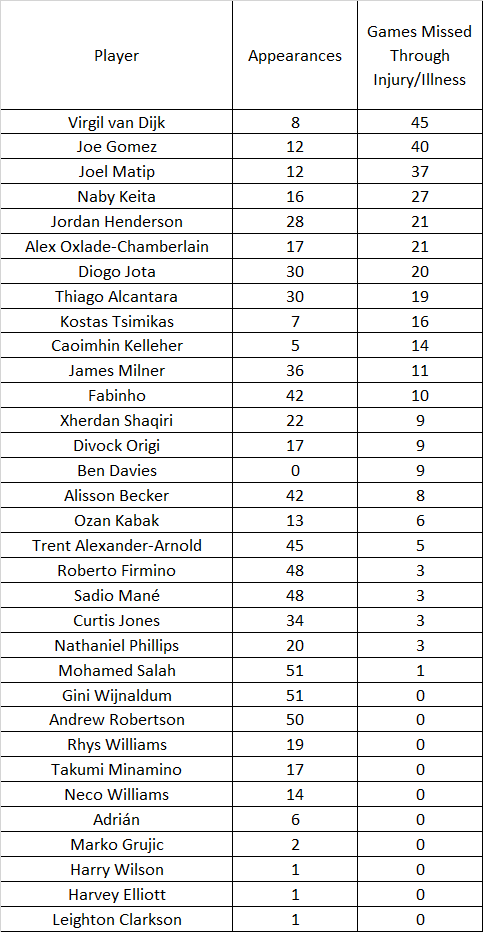
Take it further. If, this summer, Liverpool had paid £350m for van Dijk, Matip, Gomez, Thiago, Jota, Oxlade-Chamberlain, Jordan Henderson and Keïta – who missed huge chunks of last season, if not virtually all of it – then people would view things very differently. Even better than new players, they are integrated players. (A reminder: Jota played only a third of the available league minutes.)

There’s this idea that new is always better; but the most comfortable shoes are the ones you’ve been wearing for a while; ones that, day after day, increasingly suit the shape of your feet. If they’re not falling apart at the seams, they are perfect. New ones that look better but give you blisters are not exactly ideal.

Not enough strikers?

Again, Liverpool’s strikers in the first half of the record-breaking, title-winning season were Mo Salah, Roberto Firmino, Sadio Mané and Divock Origi, with the much-melted Daniel Sturridge having left after playing a very small part on the road to winning the Champions League the season before. 

Taki Minamino arrived, and has yet to really fire, but is now probably finally used to English football. He is what most good squad players are: talented, eager and professional, but humble enough to bide his time. (He scored the same number goals for Liverpool in the first half of last season than Sturridge, a superb finisher, managed in a full final season of 27 appearances.) 

However, the key addition has been Diogo Jota, who scores non-penalty goals faster than any other Liverpool attacker; even more regularly than Salah. The main three have insane fitness records, which makes it hard for understudies to settle into the team, but Jota is so good that it’s any three from four.

Divock Origi remains, and I want to point out how easy he is to overlook. He didn’t feature in 2018/19 until December (and that goal), and only really got a run of games in the run-in, where he was vital. Then the season ended. Ditto 2015/16 when he ended the season on fire, until he had his leg broken. Each time the next season started with Salah, Firmino and Mané, and why wouldn’t it? Indeed, he scored against Norwich in the opening game of 2019/20, and was still dropped. It’s tough, but that’s life.

Origi almost never gets a run of games to get fitter, sharper and stronger, and to relax into the role (anyone who has played sport knows that it’s easier if you get a run of games and just relax, rather than trying too hard with every rusty rare start or six minutes as a sub). He never gets to find playing rhythm, as a consequence of the Terrific Trident having played over 500 games for the Reds between them. Few players would look good playing only once a month. When Origi has had a run of games he hasn’t let the team down; far from it. Again, he was absolutely irrelevant at the start of December 2019, yet came to define that season. That’s how it can work with Klopp: players come in from the cold and, if they get a run of games after some shaky moments, do the business. See Nat Phillips and Rhys Williams last season.

Liverpool have better striking options than in 2018/19 and 2019/20, the two best seasons in the club’s recent history (and possibly its entire history, given the points tallies involved and the European Cup). Now, rival clubs are spending £100m at a pop on their strikers, or bringing superstars in on £500,000-a-week – but Liverpool can’t do that. 

If you live life with a compare and despair attitude, it will wear you down. Liverpool cannot stop what their rivals do. Going into debt to keep up with the Joneses is a dumb way to live.

When the Reds spend nothing in 2020, Man City spent £120m on two players; and had a bad season. Those two players did much better in 2020/21, once settled. Buying for the sake of it helps no one; see Man United’s panicky usurping of Alexis Sanchez from Man City, who did far more harm to United than good. 

People never get it, but you can subtract when you add: you can lose cohesion, shared understanding, and you can see the wage bill distorted by a new arrival. Sanchez not only failed, but he pissed off all the other players, who wanted pay rises, to match his mega-deal. 

I learnt this lesson in 1997, when I felt Paul Ince’s grit would help the Reds’ midfield; but the loss of John Barnes’ 99%-possession meant Ince was often winning tackles just to retrieve balls he lost. Ince had qualities, but Liverpool were no better overall, because in adding Ince’s steel they lost control of the games. 

Egos-A-Go-Go

Anything you add into an ecosystem can change that ecosystem in unexpected ways, and anything you add into football’s egosystem can change that egosystem. It’s much easier to disrupt an utterly united group of players than to improve it.

New players can upset the applecart, disrupt the wage structure, and cause all kinds of issues, if they are not right; and finding the right players is not easy. Liverpool’s transfer success this past decade or so has been due to limiting their own options, to avoid toxic talent; Brendan Rodgers took a gamble on Mario Balotelli, and rather than help, he helped ruin a season. He ruined training. He ruined the atmosphere. He was a good laugh at times, but a pain in the arse more often. 

A lot of players fail the Reds’ current “no dickheads” test, but it’s not just the players: parents or siblings who are overbearing in inserting themselves into the picture; agents who are disruptors, eager to constantly cause unrest to move their players on; entourages who get in the way of the actual football. Liverpool avoid dickhead players, but also dickhead families, dickhead agents, dickhead entourages. Dickheads are distractions, after all. 

Instead, the Reds make fewer signings, but develop the players via a system of intense training, world-class coaching, clear-eyed tactical visions and shared values and understandings. 

For example, at the end of last season people told me Kostas Tsimikas was garbage; but a proper preseason, after a year of adjustment, and he’s a different proposition. Just wait, I told people four months ago. He could yet adjust. The more time with this group of players, playing in this league, training intensely every day, under Klopp and Pep Lijnders’ tutelage (having overcome Covid and a bad knee injury), and see what happens. 

Now, Man United are getting all the headlines for re-signing Cristiano Ronaldo, who was clearly one of the great of the English game first time around. (I can’t stand the guy, but he was brilliant for them, after a slowish start.)

But he’s nearly 37 now, and instantly the top-earner at a club where others will work harder.

When you buy an ageing superstar who does no running on the pitch, you have to factor in what you lose, as well as what you may gain.

As noted above, every player you add has the ability to not just improve things but also to subtract from the team, when the sport is maxed out at 11 players; each new signing has to replace someone whose qualities may be missed, but the key is if the new addition may add more.

Individually the big new name may thrive, and their presence may give others a lift. They’ll sell more shirts, for certain.

But if you buy a player who is on too much money, and is too high-profile to drop despite being in the melt-zone, what then? In fairness, Zlatan Ibrahimovic and others have defied Father Time exceptionally well, but older players come with more risks. Any player can get a serious injury, but only players in their 30s tend to “melt”. Phasing out iconic players is almost always a messy affair.

Cristiano Ronaldo and Lionel Messi still score a lot of goals (albeit from taking a lot of shots and penalties that other players could be taking), but they do the least work of any strikers.

In a team sport, you lose the pressing and the running into spaces, and football is not like basketball where an individual can carry a team.

Big names can inspire, but they can also hog the ball, hog the limelight, and unbalance the egosystem. Too many big egos and a squad becomes a powder keg.

Plus, how do you phase out a superstar whose legs are going, and who won’t take kindly to some kind of managed decline? (It went badly with Steven Gerrard at Liverpool, while Kenny Dalglish had the luxury of managing his own reduction in playing time, as the boss.)

Ronaldo is in great shape, but can it really last that much longer? Maybe, but the odds are that it won’t.

In that sense, are some clubs signing impending problems, rather than solutions?

Attack!

A low-key signing made back in February (ancient history, which means it doesn’t count) could prove another gem within the next 12 months. And while he may not feature much in the league in 2021, Kaide Gordon is the best 16-year-old Liverpool have had in donkey’s years; with the exception of Harvey Elliott. 

I also see zero decline in Sadio Mané, with his pace and ability to go past players clear, and his goalscoring form at the end of last season, in preseason, plus a goal already in the Premier League, suggest there’s no decline. He looks as good as ever – and that’s a one-in-three scorer who does so much more than that. He’s sharp, inventive, hard-working, and stretches teams. His pace hasn’t dropped one bit.

Strikers’ seasonal tallies often vary, and he doesn’t take penalties (or even free-kicks) to bolster his numbers and get him out of dry spells. If he’d taken (and scored) Liverpool’s penalties last season, no one would mention that he doesn’t score enough goals; ditto Roberto Firmino, who also ended last season on fire, had a great preseason, and had scored in the league already before what seems a minor hamstring injury.

Both had a confidence dip in front of goal last season but their attacking play often remained excellent. If you only judge players by their goals you miss all the ways they help others to score and to win games. And last season they were playing in much-weakened XIs, lacking leaders, and all the set-piece giants. 

(Again, the correlation between Firmino scoring from set-pieces and Liverpool fielding giant centre-backs is clear, as I showed several times last season, prior to him scoring from set-pieces once Liverpool switched to the giant Rhys Williams and the bonkers, ball-nutting Phillips. Only van Dijk has scored more set-piece goals for the Reds than Firmino since the summer of 2018, and both are in double figures. But without the big guys, Firmino, at 5’11”, becomes easier to mark and nullify. And people don’t tend to notice that quite a few of his goals come when Virgil van Dijk and Joel Matip are being crowded and fouled, or when someone like Rhys Williams, just via his presence, was dragging several men away.)

I know I’ve gone over this ground before this summer, but the story never changes: Liverpool have to buy new players is the constant mantra.

No. Liverpool are a team built on small numbers of signings, gradual integration, extreme professionalism and motivation, and improved interplay; within a tightly-managed and heavily incentivised wage structure that seriously rewards success, and not mediocrity.

Indeed, after the hell of last winter – endless lockdown, soulless stadia, never-ending injury list and for Klopp, the death of his mother and a funeral he could not attend due to Covid restrictions (ditto Alisson and his father) – and we should be counting our blessings that Klopp is still at the club, as I feared he looked close to burnout. (As we all did, often without those added stresses.)

In time there will need to be new signings, and maybe some shakeups behind the scenes, but for now the squad remains at a great age. And it can be a gradual evolution over the next couple of years.

It’s easy to want new things, but in the case of Klopp, and players like Alisson and various others, a proper break to recharge and decompress may be the most valuable benefit of the summer. As ever – such as the total fanbase meltdown when Coutinho was sold, and when the club preferred to wait five months for van Dijk instead of signing someone else, and when people thought Andy Robertson was a waste of £8m, and the lack of a ‘proper’ signing before 2019/20, etc. – it’s often best to wait and see.

Friday, May 28, 2021

How the Autopsy of LFC’s Black Swans Became a Celebration of Overcoming the Odds by Paul Tomkins


The “Black Swan”: that event so freakishly rare you rarely see them.

As I’ve noted throughout the season, pretty much the only swans seen at Liverpool Football Club in 2020/21 were of the jet-black variety (with all the sheep mysteriously that variety too). In this bizarro world, perhaps there has been a proliferation of white widow spiders, white crows and white jaguars; and of course, throw in some pink giraffes and green elephants, just to make it all the more trippy.

I had been preparing to point out how these Black Swans killed Liverpool’s Champions League qualification hopes, and yet despite more setbacks than you’d probably expect in 20 seasons, the Reds clawed their way back from the brink of mid-table, to finish 3rd. They did so minus all their senior centre-backs – fielding their 7th and 8th choices – and their leader and captain, amongst other absentees in the run-in; having had long-term injuries to various other players.

It will never be Jürgen Klopp’s most celebrated achievement, but it could be his most impressive.

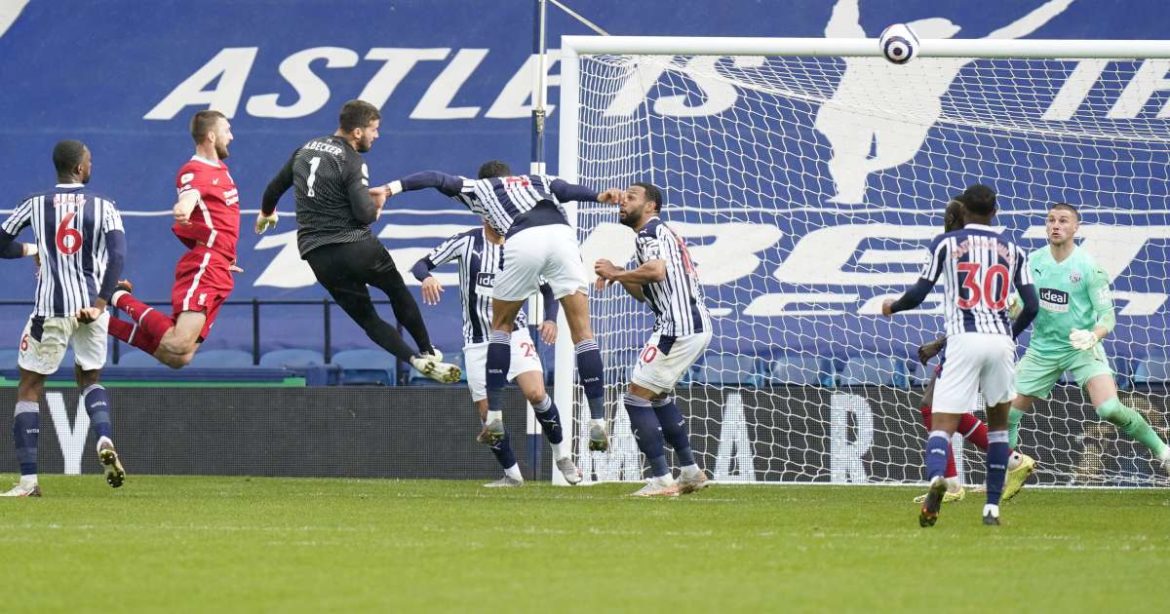
Indeed, as the corpses of Black Swans littered the Anfield area in this era of plague and pestilence, we got to see something even rarer: a flying Golden Griffin, complete with gloved talons, as Alisson Becker channeled his inner mythic beast to head home the goal that potentially earned the Reds in excess of £50m and, more importantly, the cachet of elite football – and most vital of all, the chance to win next year’s Champions League (or, to at least enjoy some big Anfield nights that transcend the “ropey” league).

The Golden Griffin swooped, and for the first time in nearly 6,000 games of football in Liverpool’s history, and perhaps getting close to 100,000 top-flight games in England since the inception of league football in Victorian times, a goalkeeper scored the winning goal in a game (as well as, I believe, becoming the first to score at that level with a header – most of them have been long clearances that caught the wind).

In that moment the last living Black Swans fell from the sky, dropping dead to the ground.

Diagnosing Disaster

Working out what was going wrong – in a football sense – in a season when so many factors were having an influence was almost impossible. I compared it to trying to diagnose one specific illness from an inexhaustible list of symptoms.

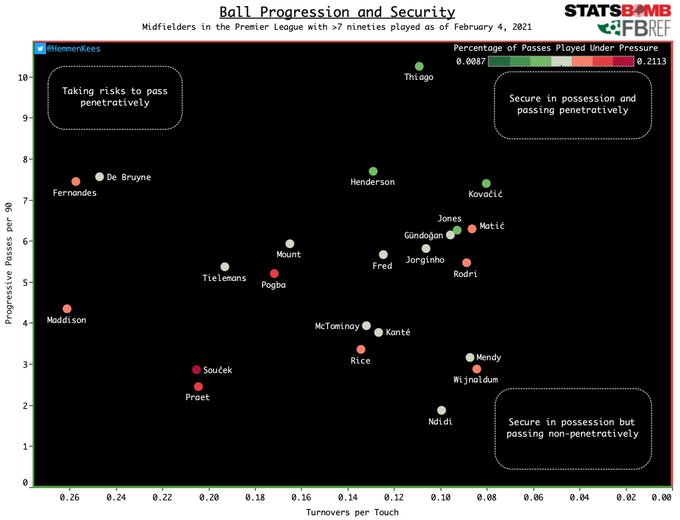
People would pick one simplistic (and often incorrect) thing and focus on it: “Thiago slows Liverpool down”.

Yet this didn’t explain why, during the midseason slump, the Reds were still creating good chances from open play – just a) missing them (was that Thiago’s fault?); but b) no longer creating them from set-pieces (and he neither took the corners, nor was expected to be on the end of them).

This is an image from a few months ago, at the peak of the “Thiago slows Liverpool down” nonsense. You can barely see his name, as he’s almost literally off the top of the chart.

They saw the addition of Thiago coinciding with the slump, but didn’t note the loss of the third and final major centre-back as a far more decisive moment; especially at a time when Nat Phillips and Rhys Williams had one Premier League start between them. At that point, Liverpool were top of the league.

Both came into the side and had harrowing games that perhaps suggested they were not ready for the deep end; but while they appeared to be drowning, they were simply learning to swim in public. Fabinho (and even Jordan Henderson) at centre-half made sense in that the others did not appear ready; Ozan Kabak, who arrived in an emergency deal, was himself only 20, and he had to get up to pace with the Premier League with zero time to adjust. (He did very well considering, even if he didn’t quite convince the higher-ups at Liverpool that he was ready for a permanent deal.)

Thiago had his ups and downs this season, after returning from open-knee surgery performed by a snarling Brazilian, but slowing Liverpool down was never true. He made too many fouls, and at times his lack of pace (and fitness after injury) caused optical alarm (he appeared to be too sluggish), but he always made the ball do more forward-thinking work than any other midfielder in the country. And as the season progressed, he increasingly bossed games. Vitally, he was able to have a bodyguard in Fabinho – although he continued to battle for the ball and win a surprising number of headers.

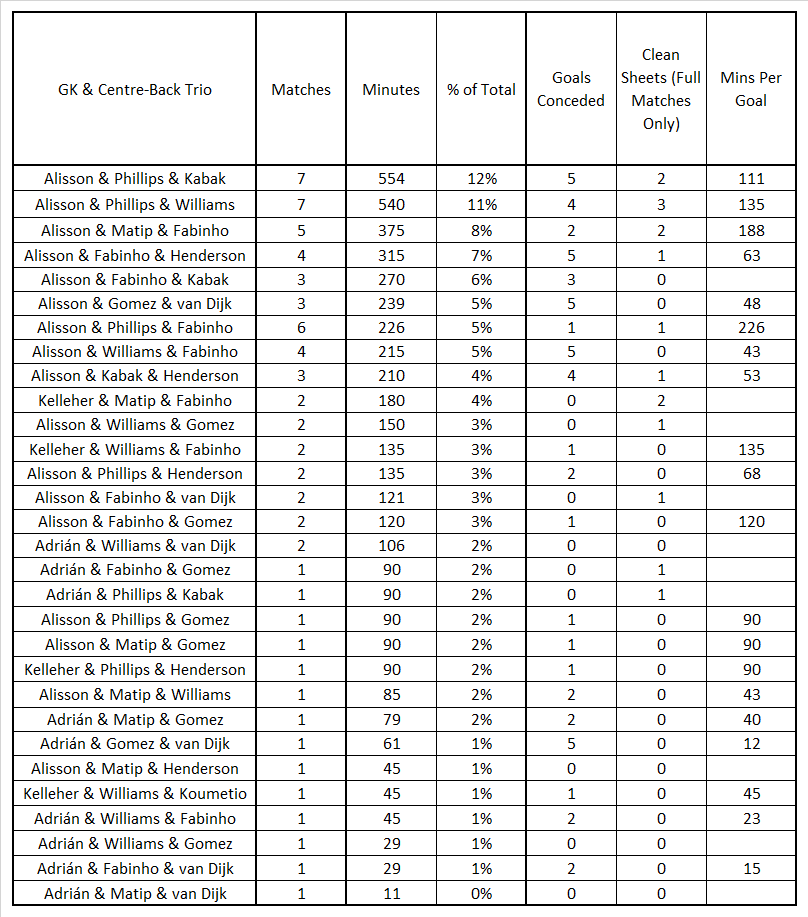
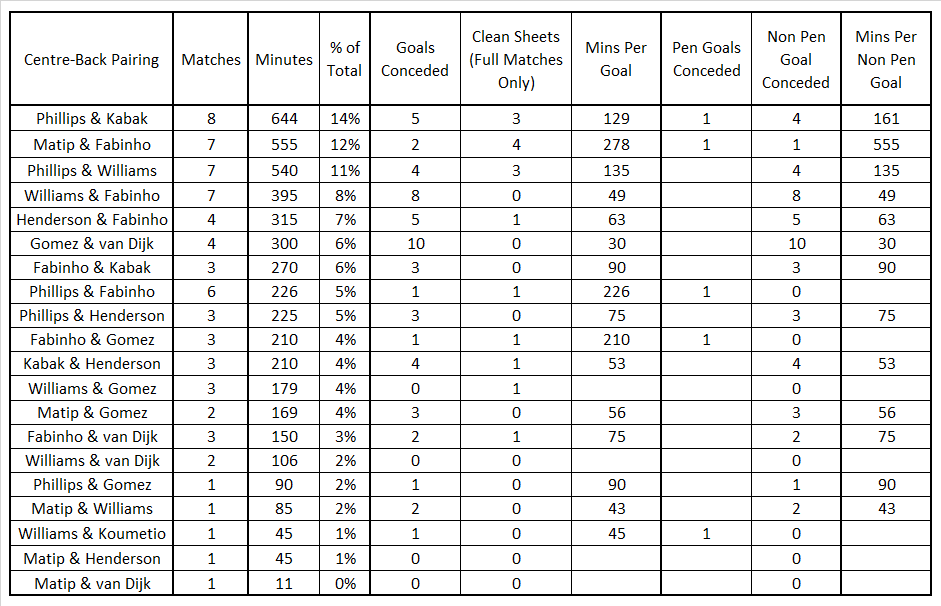
Such an explanation – Thiago was the problem – ignored that lack of stability at the other end, with a different goalkeeper and centre-back pairing almost every game. Liverpool used twenty different centre-back pairings, and thirty different rearguard trios (GK-CB-CB).

Such narratives ignored ten or twenty other important factors.

They ignored that injuries to the two main goalscoring midfielders from open play: Alex Oxlade-Chamberlain and Naby Keïta; the two who would run ahead of the strikers.

That pair also happen to be elite pressers, too (Keïta remains the best at the club, but he needs to get an injury specialist to sort him out. He remains a fantastic player, but at this stage cannot be relied upon. I wouldn’t write him off, but I wouldn’t bank on him either. My view is that you try to limit the churn in the transfer market, and work on getting talented fringe players to challenge for starting berths; as seen at Manchester City this season, with İlkay Gündoğan, John Stones and João Cancelo, amongst others whose form completely switched this season).

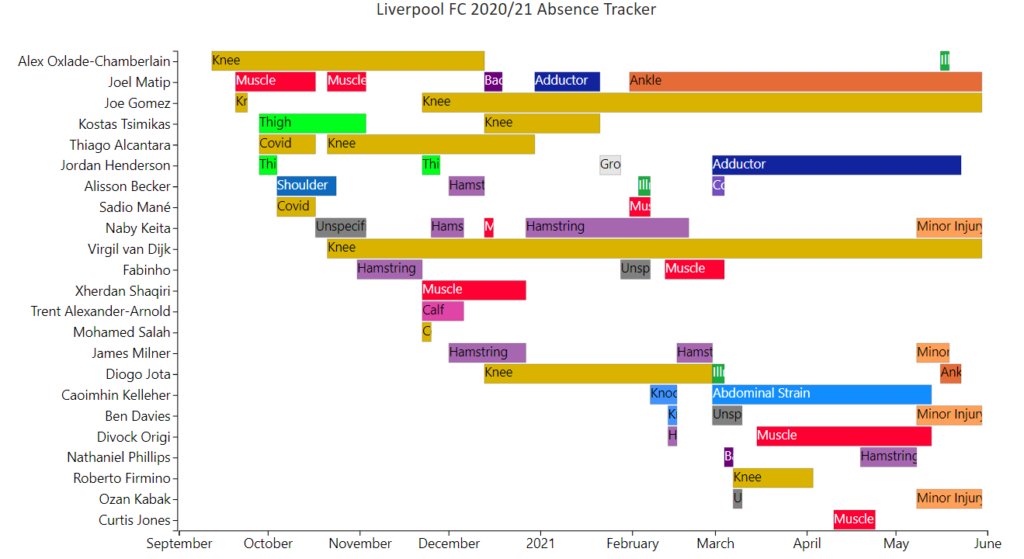
Another elite presser was Diogo Jota, the league’s best marksman in terms of shots on target per game, who missed three months. Indeed, Liverpool had just two games where a total of four serious long-term knee injuries were sustained. These two games alone cost Liverpool c.100 appearances (from Virgil van Dijk, Thiago, Jota and Tsimikas: three major players, and one much-needed backup).

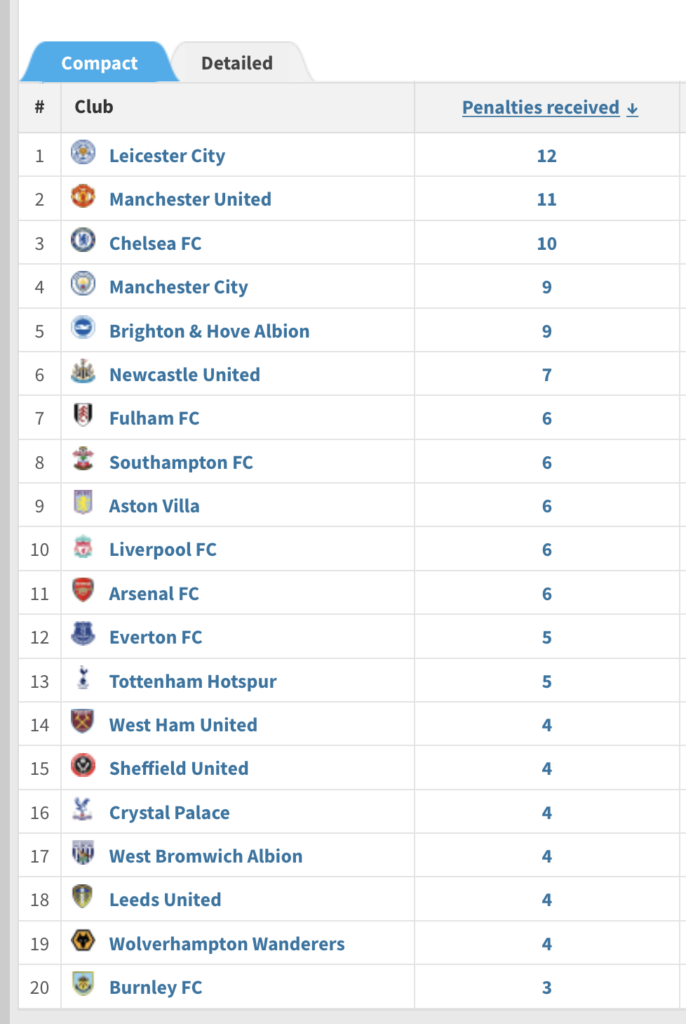
The narrative ignored how Liverpool were not being given penalties (an ongoing trend), but were conceding them at an unusually high rate (a new trend). Despite doing two thirds of the attacking, the Reds conceded more penalties than they won.

The four teams vying with Liverpool for the top four each won between 9-12 league penalties, ranking #1-4. Liverpool ranked joint 7th, level with several other clubs, to mean that every single season has seen Klopp rank lower on penalties won than league position (as did Rafa Benítez), while every single season in the top flight has seen Brendan Rodgers rank higher in penalties won than league finish.

While that may be merely coincidental in Rodgers’ case, there is this very weird pattern where not only do British players get favoured in both boxes by referees (based on in-depth studies we’ve undertaken), but the teams of British managers seem to fare much better too – it certainly applies to Liverpool: Benítez, lower every year; Rodgers, higher every year (ditto Dalglish and Hodgson); Klopp, lower every year.

(The absolutely scandalous diving by Jamie Vardy explains some of this recent trend: the most egregious one I’ve ever seen was how he grabbed Davison Sanchez’s arm and then threw himself to the ground. What next? Vardy to get hold of a centre-back’s hand and thrust it into his face, to pretend he’s just been punched? All teams have players who go down easily, but this is some new-level conniving, that the VAR inexplicably failed to recognise, when all neutrals could see it a mile off.)

For the second season running a relegated team won more penalties than Liverpool, who had the best attacking xG figures in the top division.

Again, this makes no logical sense. (And no opposition player has been sent off at Anfield for several years now; Jordan Ayew continued the trend of players staying on despite at least two bookable offences.)

One thing we studied on this site was how officials from the north-west show a clear bias against Liverpool, and that the closer to Liverpool their hometown, the more biased they are; as if it’s a bend-over-backwards bias that is so prevalent in modern society (trying too hard to look unbiased, as the optics are all the counts).

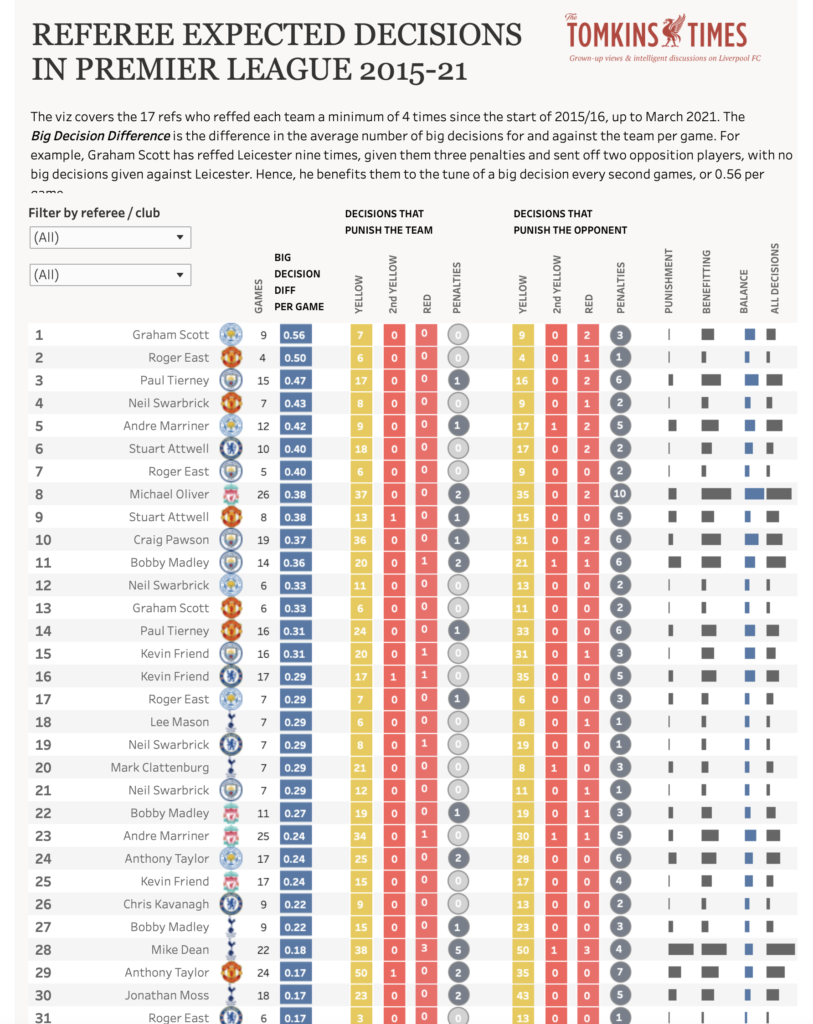
With subscriber “CVT” and old friend Rob Radburn, we created this interactive chart (click this link for the longer and fully interactive version):

As you will see from the full version, the three least generous refs are all examples of officiating Liverpool matches, and most referees – when it comes to their treatment of Liverpool – rank towards the foot of the table. The only active referee who is even remotely generous to Liverpool is Michael Oliver, whilst the older the refs are (and the more north-west their place of origin), the worse things get on average.

(Note: data was correct up to March, and as such, no further penalties or red cards were awarded in Liverpool’s favour. In fairness, Anthony Taylor did award one, but Paul Tierney overruled it.)

This overly harsh treatment by north-west refs would explain why, in a season when north-west refs did most of their games due to Covid-19, the officiating got even more punishing. While we must all be aware of our own biases (mine are pretty clear!), we must also be aware of bias overcorrections, which are about appeasing the masses, and not being honest. We have to correct for our biasses, but not overcorrect to look virtuous and just.

Outrage on social media leads to a lot of accusations of bias in all areas of life (and sport), and so people veer towards anti-bias virtue signalling. People will accuse Mike Dean of favouring Liverpool, yet he remains a nightmare for the Reds in terms of big decision balance (excluding VAR interventions). Dean gives tons of penalties, but he’s given none for Liverpool, and two against (one was outside the box, but he gave the foul).

My aim has always been to mine the data, not work on raw emotion (although I also tweet some absolute horseshit in times of high stress, which, along with the toxic nature of social media in general, is part of the reason why I try to avoid those places these days. It thrives on our worst instincts).

Anthony Taylor, from Manchester, has bottled some big decisions for Liverpool (most famously at Man City in 2019), but has awarded the Reds a healthy six penalties, albeit with one overturned by the VAR from Wigan. While we may recall the Vincent Kompany assault on Salah that only resulted in a yellow card (and helped tip the title in City’s favour) and think he’s biased against Liverpool, he’s actually a fair ref, according to the data. Again, the optics are what we remember – the high-profile events. The data is what reveals the bigger picture.

I would put Taylor with Oliver and Andre Marriner as the only three refs who are even vaguely fair to Liverpool. (The Premier League and the PGMOL may be aware of which referees favour which teams when appointing them. It certainly felt like they were trying to handicap Liverpool this season, to the point where favourable refs were replaced at the last moment by unfavourable refs in the run-in. That’s not to say it’s a conspiracy, just that I wouldn’t necessarily trust either the Premier League or the PGMOL, with their rampant self-interests.)

Liverpool had to dig themselves out of a hole without a single penalty after early February, which was itself the only penalty since December 13th, as refs and VARs otherwise dished them out left, right and centre. As ever, Michael Oliver was the only referee who gave Liverpool a vaguely logical number of penalties, based on the data. He gave the Reds three this season, and all were correct decisions; no other ref gave more than one.

The simplistic narratives ignored the lack of a home crowd, which turned Liverpool’s best-ever home record (four years without defeat, which still applies if you exclude three-quarters of a season in an empty stadium) into the club’s worst-ever run, in a season which – for the first ever time across the whole top flight – saw more away wins than home wins. Burnley also suffered their worst ever home run, and Everton and Manchester United had their worst home runs for many, many decades. Manchester City won the league, and lost a fairly hefty four of 19 games at home; yet adding together the previous three title winners (Liverpool, City and City) saw just two home defeats in 57 league games in those three seasons. So, the lack of crowd was clearly a big factor too.

Simple one-fact narratives don’t even cover the way the Reds’ preseason – already truncated – was thrown into chaos by last-minute changes to the training camp location due to Covid issues. They do not cover the lack of fitness in the squad as a result, and how, with up to a dozen injuries at a time, rotation was harder; and therefore fatigue in the middle of the campaign became an issue for some players in a more heavily-packed schedule.

Andy Robertson desperately needed cover, but his cover got Covid and then a serious knee injury; and when his cover was fit again, Klopp essentially admitted he couldn’t really change much of the core of the team, due to the ever-changing centre-back pairings. The manager could have given more minutes to Kostas Tsimikas had it not been two rookie centre-halves, who needed Robertson’s know-how alongside them, and a settled midfield ahead of them.

Robertson was clearly knackered, but normal rotation was out, as Klopp strove for stability. And he was proven correct to do so, albeit in a gamble that could have gone either way (as is the case with all judgement calls).

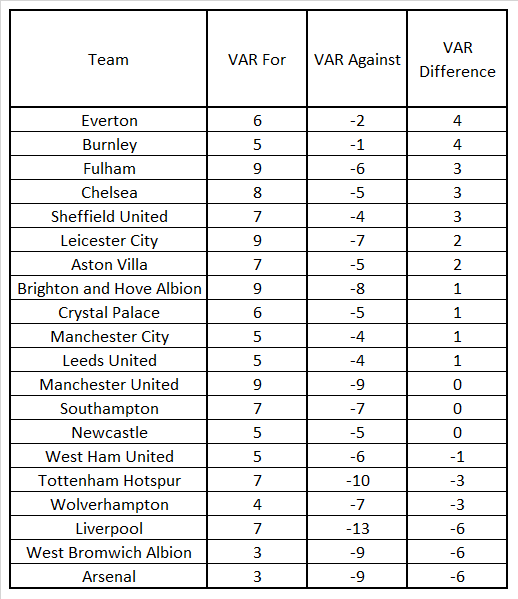
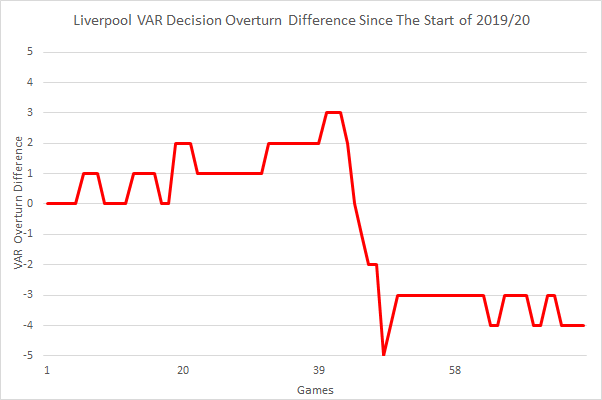
The simple narratives do not include the insane balance of VAR calls that went against the Reds, mainly in the periods when the team was struggling. Seven decisions went in their favour, but a whopping thirteen went against. Of these 13, some were as clear as day – but about half were scarcely believable.

I’m not being wise after the event. I have been tracking these things all season on TTT, with the help of Andrew Beasley, Daniel Rhodes and others. This has been a shocking outlier of a season, and the notion that these were Mentality Midgets and not Mentality Monsters has been disproved beyond all doubt.

The Biggest Factor

But if I had to pick one single factor – or rather, the biggest contributing factor – then aside from often lacking so many world-class players (whose value often exceeded £300m, which meant the Reds had more financial investment in the treatment room than on the pitch), I’d say that a lack of height (itself due to those injuries) was killing the Reds.

Possession stats had not changed much, open-play xG stats had not changed much, referees were still not giving Liverpool many penalties, but set-pieces at both ends (and an inability to win headers in the middle of the park) were – to my mind – behind the slump against big-bastard teams.

They just happened to be the “smaller” clubs, which incorrectly implied that the Reds just weren’t up for it; but these little clubs had the tall, bodybuilder players that overpowered Liverpool’s technicians in the absence of the Reds’ enforcers (and fair refereeing).

They played aerial percentage football that was Liverpool’s Achilles heel (if only there was an Achilles head). These alehouse units played the kind of football that Joel Matip, Virgil van Dijk and Fabinho (as a midfielder) were brought in to combat.

The most simple are startling statistic I can find is the disparity between when Liverpool – overall the shortest team in the league this season (and by an even greater margin when you look only at outfield players) – were at their smallest, and when they were at their tallest (which wasn’t even within an inch of the average of the tallest side, Manchester United).

“Shortest Liverpool” had relegation form, over a run of 13 games. PPG: 0.8, or 29.2 for the season. Or, the same as Fulham.

“Taller Liverpool” had league-winning form, over a run of 25 games. PPG: 2.3, or 89.7 for the season. Or, better than Manchester City.

It’s that simple. (Even if it’s not really that simple, as nothing ever is.)

But the stats really are that startling.

(Another thing: Man City added height to their team this season, and fielded taller centre-backs than last season, and Rodri won an absolute ton of headers, to rank 4th in the entire division, while John Stones has improved in the air with age and experience, and ranked in the top 10.)

However, which Premier League player ended the season winning the most aerial duels as a percentage? Rhys Williams.

Which player’s inclusion in the team suddenly increased the set-ball threat at the other end? Rhys Williams.

Nat Phillips, four years his senior, is clearly more aggressive, and goes for less-winnable duels, and helps in this regard too, as he’s in the top 75 percentile for centre-backs; but Williams is just bloody tall.

Williams won over 82% of his duels, and he contested almost 40. That is an elite figure, and the only player I’ve seen better it in recent years is Joel Matip, with 90% last season (from 46 duels).

Who ranked 2nd last season? Virgil van Dijk, at 80%. Who ranked 1st the season before? Virgil van Dijk.

As good – and honest – as Ozan Kabak has been, he’s just 6’1″. He won just 55% of his aerial duels this season, and whilst Fabinho is good in the air for a midfield (in that he’s tall for a midfielder), he’s substandard in the air as a centre-back. (Indeed, he doesn’t even go up for corners anymore.)

Most young players improve in aerial duels as they get more experienced and beef up a bit. Their timing improves, their ability to use their body improves, and they gain power from the gym. But height seems key. (Note: as ever, set-piece goals exclude penalties.)

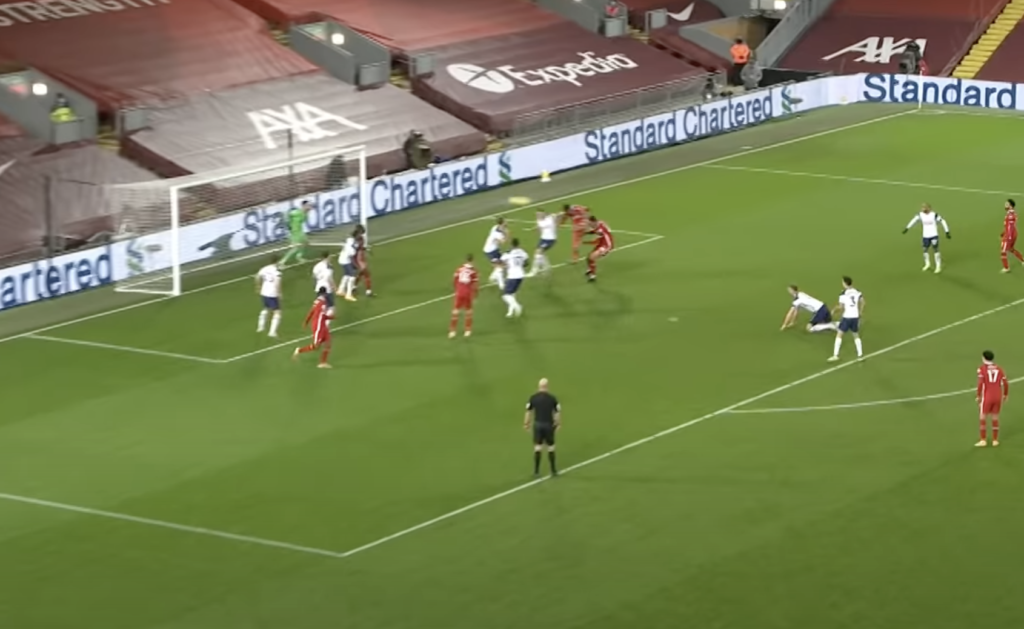
Williams was also standing right next to Roberto Firmino in December when the Brazilian headed that remarkable winner against Spurs. That was the last set-piece goal the Reds would score until Williams returned to the side for the final five league games.

The Reds won all five, and scored their first set-piece goal for five months. Coincidence?

They also scored their 2nd, 3rd, 4th, 5th and 6th set-piece goals since the game after that Spurs fixture back in 2020.

Coincidence?

This was after an admittedly Black Swan run of no set-piece goals for five months. There was one more set-piece goal after Firmino’s against Spurs in December: the next game, when Mo Salah headed home. This was also Matip’s last full game, and Matip – 6’5″ – headed the assist, before he got injured again in the next game at West Brom (when Liverpool threw away a 1-0 lead after his exit, and the slump started).

According to Andrew Beasley, between Salah’s goal against Crystal Palace and Diogo Jota’s at Old Trafford, there was a gap of 2,383 minutes and 91 set-piece shots without a goal, across a shit-ton (my technical term) of free-kicks and 183 corners. The quality of the balls into the box wasn’t necessarily different, as both full-backs played all these games – albeit after Covid and injuries, Trent Alexander-Arnold was looking sluggish. The balls were whipped into the danger areas, and Liverpool had no height to contest them. Smaller players can score from set-pieces, but rarely if the opposition’s tallest players have no tall players to mark, so mark them instead.

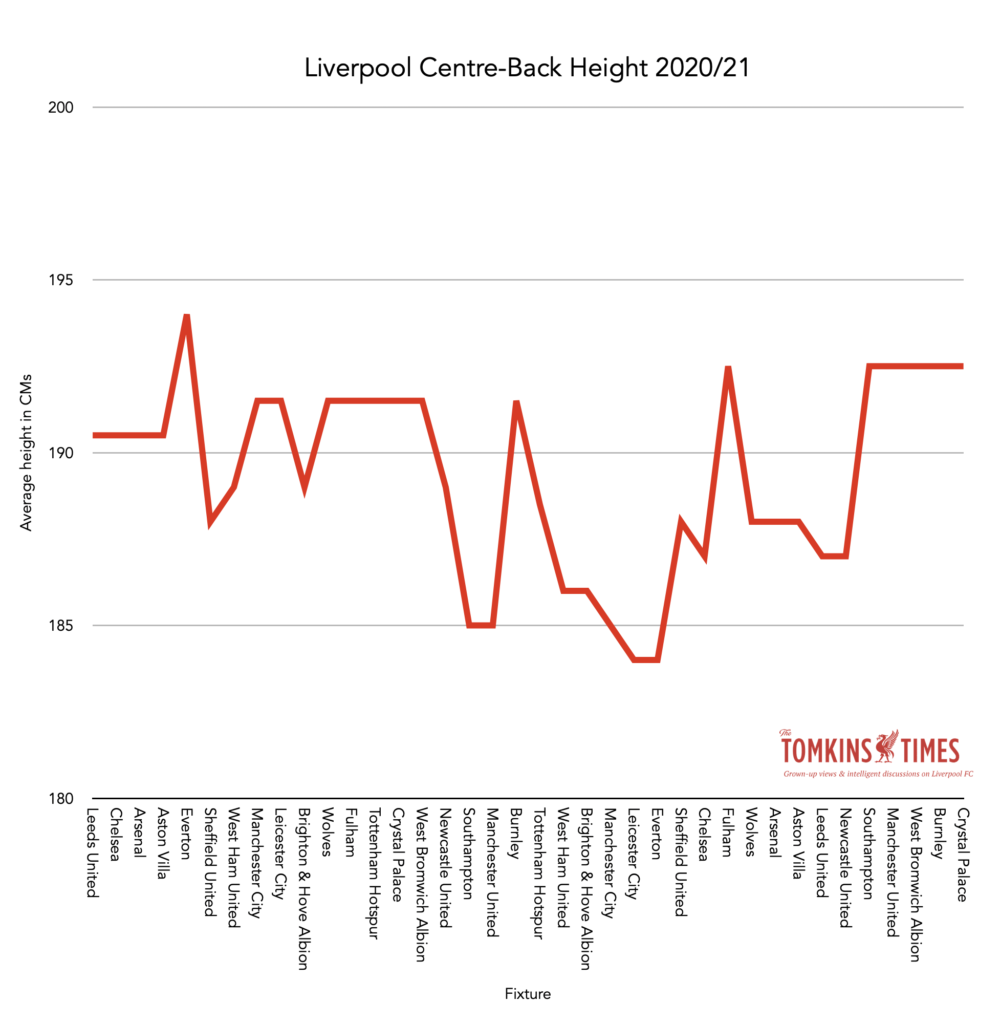
That five-month drought saw Liverpool field mostly shorter centre-back pairings, and that meant an increase in set-piece goals conceded, too. The dip in height correlates directly with the slump in results, albeit height won’t have been the only factor; it just feels like the main factor to me.

While I haven’t done so, if you overlaid the league table, it might look quite similar! The Reds started the season as the best team (and were top until all the senior centre-backs fell to injury), and ended the season as the best team.

As I said, surely other factors applied, including that the stand-in centre-backs were not always specialist centre-backs (and when the average was lower earlier in the season it was with the elite-paced Joe Gomez, 6’2″), but from the ten league games where the Reds fielded centre-backs who averaged below 188cms in height, they took just 0.6 points per game, with just one win: against West Ham away. Centre-back pairings 188cm or taller resulted in title-winning form.

Now, I admit that this is an area of fascination for me, but I’m not cherry-picking the data.

For many years I’ve been talking about the importance of aerial duels in English football. I started focussing on it in 2015, when the Reds were the smallest team, and the worst in the air by some distance.

It’s even more important if your strikers and midfielders are superb but small. You wouldn’t swap Mo Salah for Ashley Barnes because one is a giant bodybuilder and the other is 5’9″, but if over 30% of goals are from set-pieces, then you end up essentially gifting results to the opposition if you cannot compete on them. Brendan Rodgers tried to add height in Christian Benteke, but it was at the expense of quality. (Benteke was excellent at Aston Villa until he suffered a serious injury that robbed him of pace.)

Remember, Liverpool’s 13 shortest starting XIs in 2020/21 scored zero set-piece goals, and conceded five, and had relegation-form results.

You don’t need a tall team per se, but you need four or five tall players to handle the aerial onslaughts. This is why Man City bought Rodri, and Stones scored four goals as well as improving defensively. In the last two seasons they have bought several players who are 6ft or taller.

Rhys Williams – as tall as Joel Matip, and aged just 19 until fairly recently – started seven Premier League games, and the Reds won six of them. The Reds scored a staggering c.60% of their set-piece goals in these seven games (and the other 40% came via goals or assists by van Dijk and Matip). The age of 19/20 is an absolute baby for centre-backs, where almost all players (especially what I call Slow Giants) start to look the part at 24/25.

Williams and Phillips both clearly lack pace, and both lack experience. Both are Slow Giants, and the last thing you want is to pair a Slow Giant with a Slow Giant. So how did they succeed? It seems that Liverpool had enough quality, just not enough height. Ozan Kabak and Fabinho are quicker than both, yet it seemed that height was the missing factor.

While Phillips seems to be the chaos-monster, Williams is the unmarkable object. Phillips’ aggression helps, without doubt. He’s the one that goes looking for the duels, and will head a 50-50 even if the ball is on the ground. But Williams is just a giant, and one who will surely only improve in the air with time spent on the pitch (and in the weights room). I was lucky enough to be at Anfield on Sunday, and I really appreciated his composure and touch, as well as how he caused chaos in the Crystal Palace area (and Palace are one of the league’s tallest teams, as well as being its oldest. You can count on Roy Hodgson bequeathing a team aged 30 to his successor, time after time).

Incredibly, Roberto Firmino has now outscored Virgil van Dijk from set-pieces since the summer of 2018, albeit van Dijk has played only two full seasons in that time.

But Firmino cannot score from set-pieces without a giant or two to act as distractions. It doesn’t even need an elite aerial threat like van Dijk; it just needs some bloody tall kid, to get in the mix. Being 6’4″ or 6’5″ makes a huge difference to aerial win percentages, and it makes flick-ons at corners all the more likely. Years ago I worked out that the best aerial win percentages belong, on average, to the very tallest players (if you group them by height), and they fall in line with every inch lost in height.

Peter Crouch was not a wonderful technical header of the ball, nor could he jump that high. But he was (and presumably still is) 6’7″, and thus scored the most headed goals in the modern era.

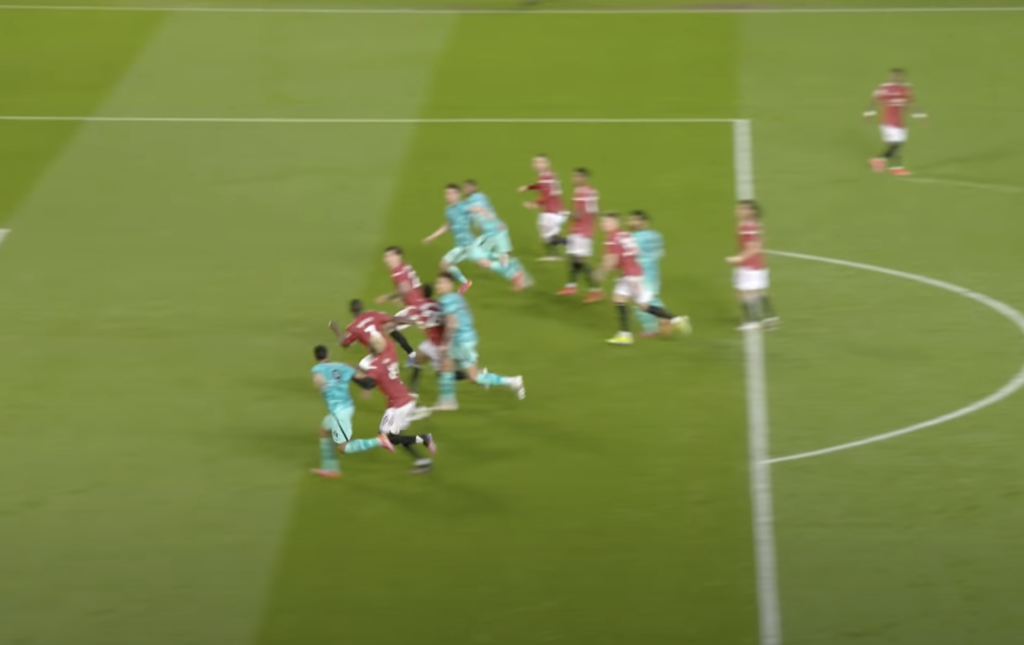
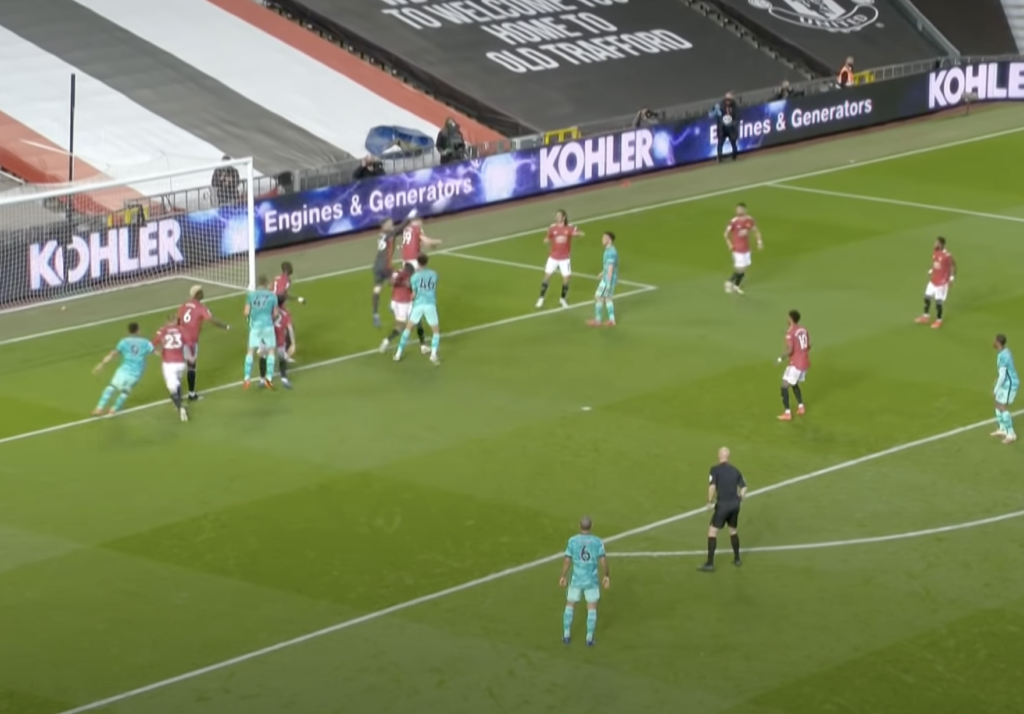
When Firmino headed home the diagonal free-kick against Man United a few weeks ago, Williams was initially standing right next to him, taking up the attention of three tall United players, despite the fact that Williams has no clear aerial ability in terms of heading at goal (as we saw when unmarked this weekend). Three men on (or near) Williams left one player (Paul Pogba) half-marking Firmino at the far post as he stole a march.

Below is Firmino heading home against Spurs, with Williams (ducking) helping him to create a two-on-one.

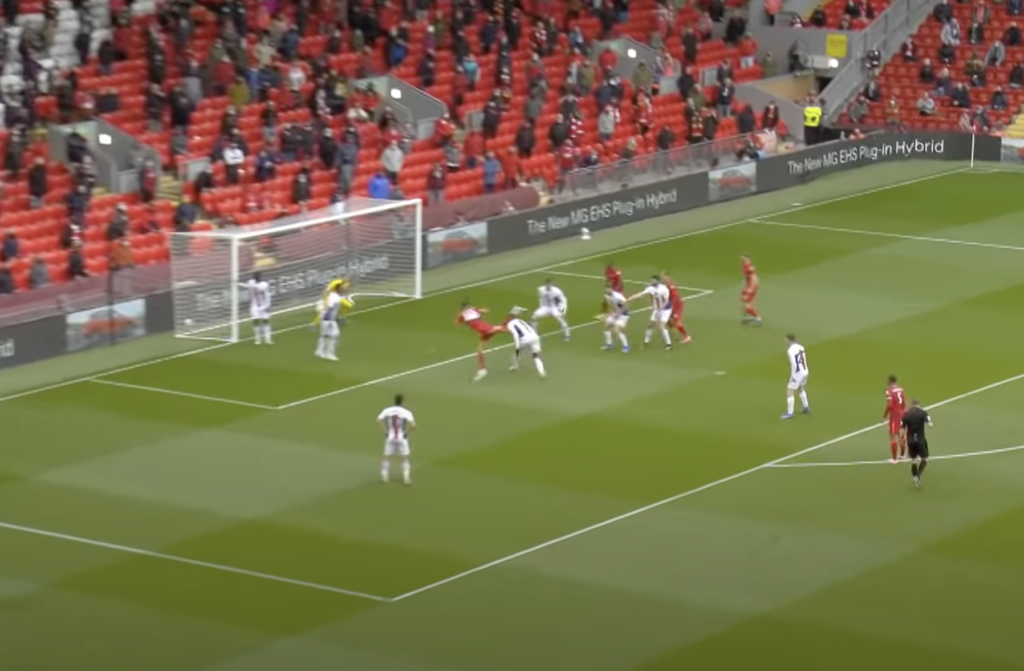
When Liverpool broke through against Palace at the weekend, it was Williams heading the ball on to Firmino after getting above the tall Cheikhou Kouyaté; perhaps by accident, but there they were again, the same pair linking up. Kouyaté failed to jump, and tried to foul Williams, to no avail. He did stop Williams from heading at goal, but the ball fell to Firmino.

Williams was involved in the set-piece goal against United – before Firmino’s – that broke the five-month drought. He was the one who was challenged by David de Gea and not one but two United defenders, which meant space for other players. Three United players against Williams, and the ball fell to Mo Salah in space in the box.

Williams also helped win the penalty from a corner that was bizarrely overruled (yes, Eric Bailly won the ball, but it was not won cleanly, and the follow-through was extreme – far more of a penalty than Fabinho’s challenge outside the box against Sheffield United!).

At 0-0 at Burnley, Williams headed down from a corner and Phillips somehow volleyed over. It was a golden chance. Williams didn’t even need to jump.

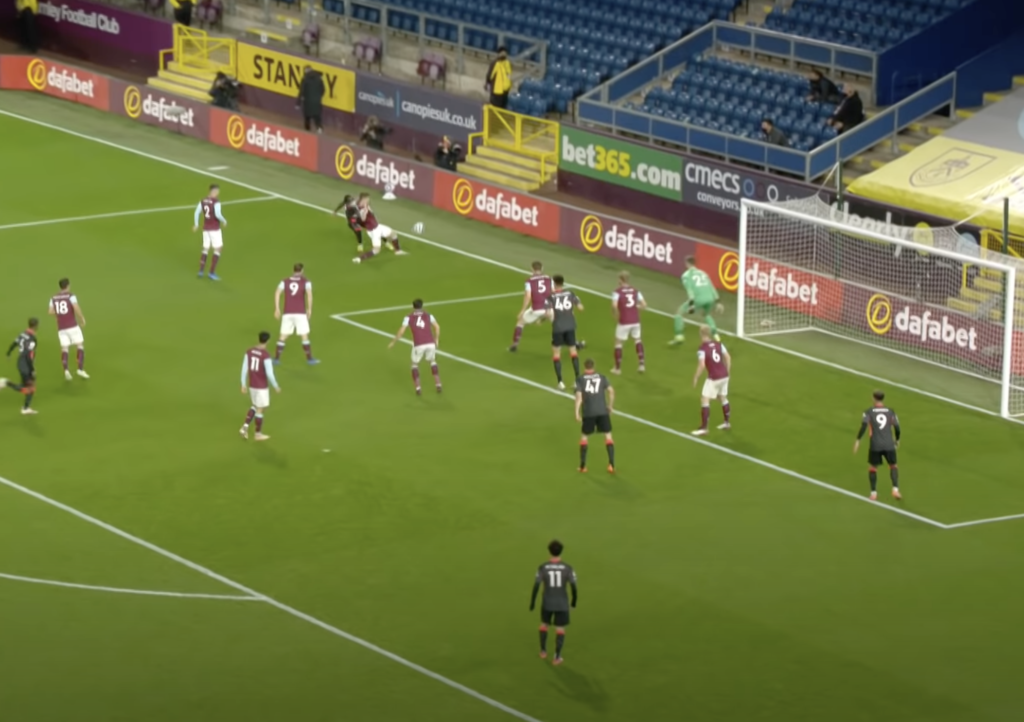
When Mané set up the vital second goal in that game, from a 2nd-phase corner, he lofted the cross directly over Williams’ head at the near post, as the Reds’ no.46 stood surrounded by Burnley players; in snuck an unmarked Phillips to finally show that he can be a threat in the opposition box too, after various wild attempts.

All this is under the radar, with Phillips and Mané getting the plaudits; yet Williams is taking up the attentions of half the home team. You could argue, via the image below, that five players are stationed to deal with Williams, and just one (Ben Mee) has to mark both Phillips and Firmino, as well as being one of the five in a position to challenge Williams (whilst Salah lurks at the back post too).

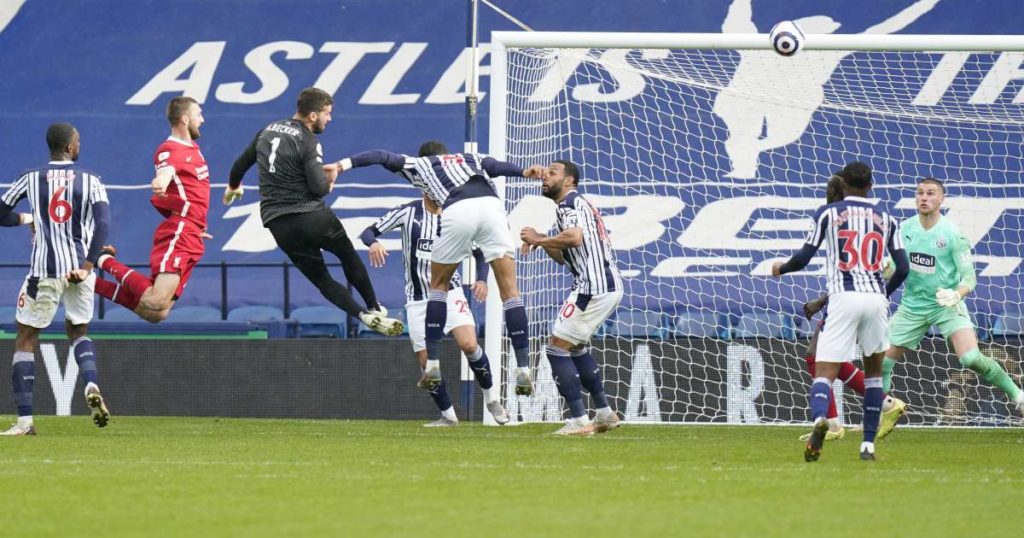
And when Williams went off late-on against West Brom, it was the Reds’ 6’4″ keeper, challenging for the ball along with the aggressive Reds’ 6’3″ heading-machine, that won the game and essentially banished the Black Swans. There was a height overload at the back post, and it turned Liverpool’s fortunes around, and gave us the best moment of the season by far.

While delivery is obviously important, height is absolutely vital at attacking set-pieces – and sometimes it can be the goalkeeper, too. It’s similar to how a quick striker often just needs a half-decent through-ball and he can turn it into a killer pass: a tall player doesn’t necessarily need the perfect cross.

It’s hard to quantify how much better Thiago did with “bodyguards”, but he started the season looking sublime in a team containing van Dijk, Fabinho and Henderson, and then had a slump in a short-arsed midfield, with issues at centre-back.

One other issue during the slump was just how bad the Reds’ finishing was, but this was also partly linked to height and set-pieces. Remember, Firmino gets a lot of his goals as the free man when taller Liverpool players are being marked. He’s the one that finds the space. A lack of set-piece goals put more pressure on the strikers, and for a while they were weighed down. At the other end, the Reds conceded from set-pieces, and conceded penalties that cost a lot of points.

The law of averages suggested Liverpool’s fortunes in front of goal would change, and they did. Sometimes you just have to ride out the storm. Next season, Liverpool should have elite tall players back in the team, as well as (hopefully) other players being fit again. But now, the Reds also have Williams and Phillips, two rookies who helped transform the season. The worst season in a decade turned into one of the best run-ins, and in the absence of up to a dozen players at a time, new heroes were born.

Part Two

Some crazy Black Swan stats, many compiled by Andrew Beasley, often at my request.

Injuries

Defensive Chaos

Penalties Won

Officiating and VAR

Quick Officiating Lowlights Reel via Twitter

(Complete with terrible music)

https://twitter.com/lverpull/status/1396792221559558147?s=21

Summary

The Golden Griffin killed all the Black Swans.

The end.

This is a free article, but The Tomkins Times has existed since 2009 due to paid subscribers who take part in the troll-free paywalled debate (and get access to subscriber-only material), so see details below on how to sign up. Also, we have a free Substack newsletter that sends highlights from TTT to your inbox, which you can register for here.