Monday, September 27, 2010

陳莉珍‧很有常識!

2010-09-24 19:21

最近一位長者與我分享,做人處事,尤其是從政者就該有常識(common sense)。其實,應該有常識的何止是從政者而已,法官在審理案件時,也該如此,尤其在審理牽涉宗教因素的案件時。

印度最高法院最近通過了訴訟一方的申請,暫緩了北印度地庭對它審理的一起案子作出裁決。在該起案子裡,法庭必須裁決被興都教暴徒拆毀的一所回教堂附近的土地是由興都徒或回教徒所擁有。

申請暫緩的一方認為,此事可以通過協商庭外和解。

印度首相也公開承認,這起案件將是印度今年國家安全最大的挑戰。1992年,該地的興都教徒以該回教堂是建立在他們信仰的神明的出生地為理由,拆毀了自16世紀就落成的回教堂。這場暴動,造成了2千人死亡。

庭外和解,或許是避免流血事件,也是最合理的方案。

前幾天,柔佛高庭法官拿督Zakiah Kassim在審理拆毀原住民教堂的訴訟案裡,也展現了應有的專業及智慧。

起訴人是原本居住在Stulang Laut的基督原住民,而答辯人則是柔佛土地局、新山市議會及原住民事務局總監。

1993年,州政府征用起訴人的世俗居住地作為發展用途,並將他們搬遷至Kuala Masai的原住民村。搬遷前,起訴人表示已向當局確認,他們可以在新的村落建立教堂。

答辯人原本計劃在2000年將新的村落在憲報上發佈為原住民保留地,不過,卻遲遲沒有落實。當起訴人在2003年搬遷到新的村落時,發現到當局並沒有替他們建立教堂,便決定自行建立祈禱場所。不過州政府基於該地尚未上憲報上被頒佈為原住民保留地,該地仍屬於州政府所有,因此要求起訴人將教堂拆掉,不過卻遭起訴人拒絕。2005年聖誕節幾天前,有關當局進入該村拆毀起訴人建立的教堂。

審理這次案子的法官認為,有關當局沒有在憲報上頒佈該村落為原住民保留地的疏忽,不能構成他們拆毀教堂的理由,也不能阻止這些原住民居住或使用該地的權利。他們拆毀教堂的舉動是不合法的。答辯人也沒有權利進入起訴人的土地,他們的行為等同侵入,而且選擇在起訴人慶祝聖誕節前夕,如此高調拆毀教堂的手法極度殘忍及不公平。法官因此宣判起訴人獲勝,而答辯人必須作出賠償。

雖然不知道答辯人會否上訴,不過法庭這次的裁決,在一片擾亂人心的種族言論,宗教糾紛中,算是一個人令人欣慰的結果,更可能重新建立公眾對司法失去已久的信心,絕對是一個很有常識的裁決!

星洲日報/言路‧作者:陳莉珍‧《星洲日報》文教部副主任‧2010.09.24

Tuesday, August 24, 2010

What’s next for Malaysia? � Lim Kit Siang

What’s next for Malaysia? � Lim Kit Siang

What’s next for Malaysia?


By Karim Raslan
The Star
Tuesday August 24, 2010

All societies need change and countries that don’t change or can’t change remain ossified and stagnant.

A few weeks ago, I hosted a lunch for a Malaysian politician and an Indonesian businessman.

The politician and I were struck by the tycoon’s steadfast support of his nation’s democratic traditions.

He stressed that he would not be where he was now had it not been for Reformasi and the turbulence of 1998.

Indeed he made a powerful argument that his country wouldn’t be powering ahead were it not for the transformation that took place after Soeharto’s ouster.

Interestingly, I think most Malaysian businessmen, including those dependent on government contracts, would agree with my Indonesian friend.

All societies need change and countries that don’t change or can’t change remain ossified and stagnant.

Malaysia is in danger of experiencing a “lost decade” like Japan – stuck in an unproductive, even destructive, socio-economic and political model.

In the past, I used to praise Malaysia’s slow but steady pace of change. The events of the last decade have changed my mind.

I now see that our evolutionary (as opposed to revolutionary) political process is a formidable barrier to our future growth.

Politics is holding us back and until we resolve two core political challenges, we will remain in limbo.

The first is the role of ethnicity and the second is the civil liberties agenda.

Economic reform cannot happen when race still governs our public life, and where our citizens are not allowed to think and speak independently.

We remain a top-down, illiberal and limited democracy.

We have leaders who do not trust the rakyat.

The rakyat, conversely are increasingly frustrated with what is going on.

They clearly see that in order to maintain the status quo, there is a cynical fanning of racial and religious sentiment that only pushes us closer to some kind of political Armageddon.

So, as Malaysia readies itself for the 13th general election, I have a few points to stress, reflecting some of the developments over the past two years:

1) Public scepticism and distrust is peaking.

Public distrust has risen. We are face to face with too many scandals and legal travesties – ranging from the Teoh Beng Hock inquest to the second Anwar Ibrahim trial.

These unresolved (and unresolvable) cases gnaw away at public confidence.

They impact the entire system.

As a result, there’s less and less confidence in public institutions.

2) We are experiencing a breakdown of the culture of deference in the Malay society.

Malay society has been highly disciplined and hierarchical for many decades.

However, Tun Dr Mahathir’s “Melayu baru” rhetoric has taken root.

Like it or not, the vast expansion of the Malay middle class has changed the dynamics between the ruled and the rulers.

The Malay community is no longer respectful of entrenched authority.

Instead they are critical and asking questions.

Indeed, younger Malaysians of all races are more “transactional” in their approach to politics.

They ask, “What’s in it for me?” Elected officials have to be more humble and service-orientated. MP’s and ministers can no longer expect to command respect.

They have to earn it, step-by-step. The best way to do this is by being honest and humble.

3) Not all political warhorses will deliver the goods.

Sarawak’s Tan Sri Taib Mahmud has been in office for well over 30 years.

Is he liked or disliked by the rakyat?

Can he deliver his state once again into the hands of Barisan Nasional?

Past success is no guarantee for future delivery.

The next state election in Sarawak will be eagerly contested and wat-ched.

4) The role of the media.

What is the truth? The continuing restrictions on Malaysia’s media have proven to be a disaster for Barisan.

On the other hand, certain conservative papers appear to have been given a free hand to engage in race-baiting.

Not only have these double-standards not boosted public sentiment, it robs the Government of a very effective method of understanding what’s happening on the ground.

Without the freedom of expression, journalists can only write what the leaders want to read, not what they need to.

As a result, Malaysia’s elite have become insulated from the rakyat, something the former can ill-afford at this juncture.

5) The age of coalitions is upon us.

The results of the UK and Australian elections show that the Westminster system of democracy, which we practise, tends to produce hung legislatures when voter dissatisfaction is great.

The question then arises: who, Barisan or Pakatan Rakyat, has a sounder alliance?

Who can better bring together our fragmented socio-political sphere?

These factors will become apparent in the upcoming power plays.

Whatever happens, there’s no turning back and Malaysia will never be the same again.

Positively Negative, Negatively Positive | The Tomkins Times | Paul Tomkins' blog about Liverpool Football Club (LFC)

http://tomkinstimes.com/2010/08/positively-negative-negatively-positive/

Recently I’ve been described by a couple of people on Twitter as the most negative Red they’ve ever encountered. While my disposition isn’t quite as sunny as when I was writing for the club’s official site (which required the omission of criticisms), I’ve always just tried to call it as I see it, based on evidence and analysis, with a bit of gut feeling thrown in.

While I foresaw a tough start to the league season, I didn’t expect it to go quite so badly. It could have all been different, of course, but for the late, late Arsenal equaliser. But that still doesn’t really explain the shambolic showing at Man City. It’s 52 seasons since Liverpool started with a home draw and away defeat; the Second Division days, before Shankly.

I’ve long-since accepted the notion that if several key players, and the men in suits, really weren’t happy with Benítez, then replacing him was always going to be more simple than replacing all of them.

Last season’s failure was put down by those suits to the problems with the boss, so a new boss of any identity should at least ride the wave of that relief. While financial problems meant that the squad wasn’t as good as it should have been, there wasn’t an awful lot wrong with the majority of it 12 months earlier.

As an English manager with experience of the Premier League, and given his age, Roy Hodgson was never going to be a long-term solution, but instead, someone who could do a job from the start, with the explicit aim of regaining a place in the top four. With his far more personable approach with players, and the shadows and long faces of last season banished, I expected a better start than this. There’s no shame in losing at City, but the performance was the problem.

I had my misgivings about Hodgson pre-dating his appointment, as noted on this site; I am on record from 2009 as being a massive fan of his work at Fulham (in my book, Red Race), but I am also aware that most managers who’d done similar work in the past did not see that translated to bigger clubs.

The stats showed that he liked to field a very experienced (i.e. old) side, and his style was rooted in the 1970s ideas of English coach Allen Wade, whose work subsequently inspired Sven Goran Eriksson and Gérard Houllier. He was not a club builder, and didn’t look to youth. He was a good man-manager and organiser of defences.

While I’ve warmed to the man based on his press conferences, I am still awaiting evidence to dispel my niggling fears about his suitability to Liverpool. This does not in any way mean that he is the wrong man; simply that I am still looking to see evidence (at this early juncture) that negates my admittedly preconceived notions. He has plenty of time to set that right.

I’d hoped that the home game against Rabotnicki was such a moment, as the Reds dazzled, but the opposition were amateurs on tour who’d spent the day taking pictures of the stadium. Since then, possession football has been totally absent, conceding the lion’s share of the ball against Arsenal, Trabzonspor and now City. This is more like Liverpool 1998-2004.

Liverpool’s average age so far this season in the league is over 27; in any given Premier League season (the good and the bad) it hasn’t exceeded 26.5. Liking experience isn’t a crime, and it’s fine if the players are good enough. But it backed up another belief: Roy prefers older players.

Part of the problem is that it costs a lot more money to buy players at the right age, in their ‘prime of value’ from 21-27, so I have some sympathy here; Roy is working within the awful confines that haunted the previous manager, although last season certain pundits said it was not a valid excuse.

And 4-4-2, with two similar strikers, and trying to hit long balls into the channels, strikes me as archaic. It’s a formation that’s hardly used these days, and almost never by the top clubs. To do so without a recognised winger on either flank, and with only full-back comfortable of getting forward, was worrying.

For the record, I Tweeted well before the game that I didn’t see how Ngog and Torres would work together, seeing as they are not a natural pairing; both have similar assets, although Torres, the superior player, was the one lacking the sharpness going into the game. Beyond the first few minutes, they didn’t exchange a single pass.

Prior to the game, Andy Gray eulogised about Roy’s decision to play Steven Gerrard “where he belongs”, claiming that he never understood why Benítez and Capello used him anywhere but his best position in the centre of midfield. “I don’t know” he blustered, “you’ll have to ask them”, as if it were some crazy foreign notion.

Gray also explained how man-marking will improve Liverpool at set-pieces, and he said that he was delighted for Liverpool fans that the manager was being really positive, with two strikers – making it clear, in a sarcastic tone, that it’s something Benítez would never have dared do.

Gerrard had a couple of bright moments, not least when hitting the post, but on the whole the game passed him by, as did James Milner for the opening goal. Liverpool were beaten from a corner – when having no men on the posts and marking zonally would have rendered Tevez offside. And 4-4-2, contrary to Gray’s bold proclamations, was a disaster. Rather than play between the lines, the Reds are now playing in straight lines.

When will Gray learn the the numerals 4-4-2, even with two out-and-out strikers, does not necessarily make a team attacking? Last season, Liverpool had two attacking full-backs; this season, just half (Johnson, as he’s only done so half the time). So it’s swings and roundabouts as to how many attacking players are in the team.

But losing the midfield in numerical terms five to four, and therefore starving the front two of possession beyond ‘out balls’, is not an attacking move.

Gray said that Gerrard would be happiest playing in the centre of midfield. It ignores his happiness at winning a lot of games and scoring a lot of goals as the semi-striker; a role that garnered him the Footballer of the Year award and, most recently, his best goals for England in a scintillating second half display. His best position is the one that suits the team, not him.

Even though Liverpool lost to Arsenal last season, the Reds bossed the first half by a country mile and should have been 4-0 up at half-time (according to Arsene Wenger). In recent seasons, the Reds have put four past the Gunners on several occasions at Anfield, and actually bossed those games for long parts.

And the draw at City earlier in the year was fairly even stuff, with Liverpool never rattled. Arsenal at home and City away are traditionally good fixtures for the Reds. But this season, Liverpool’s midfield has barely had a touch.

Now, you can do that and still win games by taking your chances; not least by breaking with breathtaking skill and verve, as seen by Germany in the World Cup. But you cannot do it habitually and expect to get very far. At times under Benítez, Liverpool controlled games to a fault, and didn’t make it count. But the opposite – having so little possession – means you run the risk of being overrun.

If Sky, and Gray, are going to go great lengths to tell us how much better things will be under Hodgson than they were under Benítez, then what do they say after a reversal like that? (A game for which Gray said he preferred Roy’s approach.)

I’d rather Liverpool were winning games every week, but if they don’t, I do want to call to account those who spent so long criticising the previous manager last season, and continue to do so this. (Again, they are the ones who keep bringing up his name; any praise of Roy is always couched in a criticism of Rafa.)

Liverpool were losing 3-0 on 68 minutes, and Roy made his first change on 78 minutes, some 15 minutes after the point Rafa would tend to (and get slated by Gray for leaving it too late).

At that point, Roy brought on Babel, who was taken off in midweek at half-time, just seconds after scoring: another Andy Gray no-no.

Babel didn’t start the next game (this one) either, and the previous manager was slaughtered any time he did something like that. Ngog didn’t start the game after he scored against Arsenal, too. Torres went off when we needed goals to win the game. And when Roy changed his team heavily for the Uefa Cup, he wasn’t rotating, merely “making good use of his squad”.

If Roy wants to make these decisions, that’s fine; aside from not being a fan of 4-4-2, I have no great problem with any of these judgement calls. He’s the manager and he’s entitled to do so. But why are the same decisions (or even more extreme versions) being met with a different reaction?

I’m also baffled as to why, with the squad in need of bolstering, a talented defence-splitter like Aquilani is not even going to be considered – no transfer fee this season as it’s a loan, and no player to call upon. While Mascherano was missed last night, Aquilani in the hole would have made more sense than Ngog. I appreciate the Italian’s frailties, and admit that he still had plenty to prove, but he was one of the more talented individuals, in a squad that needed strengthening, not weakening. Time will tell, but I do still find it odd; if we’d got £12m to invest in the side this season, I’d have seen the point.

Similarly, Insua is also being totally frozen out. While he is not the perfect left-back, he is more natural there than Agger, who, in turn, is a better centre-back than Skrtel.

One thing I did expect was early season optimism, and the buzz you get from a new man in charge. But now, it seems, we haven’t even got that. Roy is discovering that Liverpool is an incredibly hard club to manage. Already the press conferences are tetchy (according to Oliver Kay), when at Fulham they were light-hearted.

It’s a club that turns managers into nervy, paranoid stress-heads, and I hope Roy retains his composure, and maybe after that first win – surely against West Brom at Anfield? – he can avoid the problem that befell him at Blackburn: dragged into the bottom three early on, never to escape.

Anything but three points in this game – after a tough, hostile trip to Turkey – and then it’s trips to Birmingham and Manchester United while almost certainly in the relegation zone. And while the fixture list gets easier from then on, the fear becomes the kind of tailspin we saw last season; once things start going wrong, its hard to arrest.

Based on resources, Liverpool are currently equipped to finish about 6th. City are equipped to finish in 1st, but given the newness of the project, in the top 3 at least. But this wasn’t even City at their strongest; several of the major new signings weren’t available.

I do not expect or demand that Roy match Rafa at his best, from just two seasons ago, but I do believe it’s his job to improve on last season: Rafa at his worst. However, I think 5th or 6th would be fine. What he cannot do is slip well below 7th come May.

A tough start to the fixture list means that 17th at this stage is to be taken with a pinch of salt. But it’s vital to not stay down there for too long. All is not lost, but with the upcoming games, in the next few weeks it could get worse before it gets better.

鄭丁賢‧外星人搞鬼 | 評論

鄭丁賢‧外星人搞鬼 | 評論

馬來西亞會爆發大內戰?

這是《馬來西亞前鋒報》的封面大新聞。

我看了,笑感神經失控,忍唆不住,嘴裡的咖啡噴了出來,把報紙弄濕了。

對不起,這份報紙不能看了。

噢,大內戰,Perang Besar?

莫非有外星人潛入大馬,化身成為大馬人,無中生有的在人民之間製造事端,播下仇恨和戰爭的種子?

不能說沒有可能,電影裡看過很多了;

未來的世界大戰,就是這樣發生的。

如果是這樣,問題就嚴重了,不能小覷,必須慎以待之。

於是,我把原本已經不能看的報紙,用吹風筒給吹干,讓模糊的文字重現;然後,帶著高度嚴謹的研究態度,逐字閱讀,要從中找到線索。

一看之下,發覺愈多奧妙,心裡也愈為恐慌。

原來,《馬來西亞前鋒報》引述大戰的肇因,充滿外星人入侵和離間的影子。

根據它的報導,備受爭議的霹靂宗教司哈魯沙尼,某日向群眾公開演講時,收到3份新憲法,據說,這份新憲法刪除了某些重要而敏感的條文,並說是要取代現有的憲法。

由此引證,大內戰可能就此爆發。

種種跡象顯示,這可能就是外星人搞的鬼。

第一,大庭廣眾之下,沒有人發覺是誰把新憲法交給宗教司,形跡太過神秘,似乎是外星人所為;

第二,沒有人承認擬定新憲法,不會是國陣,而民聯也徹底否認;因此,可能是外星霸權第3股勢力;

第三,真正的馬來西亞人沒有反對現有憲法,相反的,國陣和民聯都一再的聲稱要捍衛憲法,也要對方遵守憲法;只有外星人可能不滿意大馬憲法;

第四,沒有人可以通過和實行新憲法。即使要修改憲法,必須由政府推動,內閣通過,交由總檢察署草擬,交給國會辯論,下議院通過之後,還要上議院接納;最後,還得由國家元首卸准。

修改憲法都如此困難,更別說實行新憲法。

除非外星人下手,可能有他們的辦法。

《馬來西亞前鋒報》作為一家神通廣大的媒體,應該成立一支採訪隊,專門負責調查和揭發外星人圖謀不軌的陰謀。

或許,它可以組織一支特工隊,和外星人進行殊死戰。

至於其他馬來西亞人,我們安份守己,還是做一個愛好和平的一等良民。

內戰,去你的吧!

星洲日報/馬荷加尼‧作者:鄭丁賢‧《星洲日報》副總編輯‧2010.08.22

Friday, August 13, 2010

鄭丁賢‧抄牌有理

http://opinions.sinchew-i.com/node/15890?tid=17


2010-08-12 19:09

親愛的馬荷加尼:

你是否支持暗中抄牌?

反對者說,這違反人權;贊同者說,這可以阻止執法人員貪污。

到底何者比較有理?

蘇馬克

親愛的蘇馬克:

其實,我不是很明白,暗中抄牌的目的,究竟是為了取締違規駕駛,還是阻止執法人員貪污。

同樣的,我也不明白,攔路抄牌的用意,究竟是為了充實國庫,還是提昇駕駛人和執法人員議價的能力。

曾經一次,我被攔路抄牌。由於本人對價格欠缺敏感度,不善於討價還價,因此,直截了當表明要充實國庫,以盡良民之責任。

但是,執法人員可能鑑於國庫已經豐滿,或者認為本人所得稅已經過繳,因此一再推拒本人錢繳國庫之善意。

儘管我一再懇請執法人員開罰單,對方卻體恤小市民如我者的處境,指罰款很重,最好選擇其它負擔較輕的方式。

而我竟然枉費他的苦心美意,不為所動;最後,對方無法說服我,連單也不開了,揮了揮手,要我離去。

對這位如此溫情的執法人員,我只好心懷感激,踩油揚長而去。

如果是暗中抄牌,就不會有如此一幕感人的真情交流。

儘管如此,並不表示我支持攔路抄牌。

曾有一次,在幽暗的道路上,我以超過100的時速行車;在一個轉彎處,突然出現幾個執法人員,從路旁殺出,以手電筒示意停車。

說時遲那時快,車子已經停不下來,直衝他們。

在煞車制和輪胎劇烈摩擦的噪音中,我幾乎扭盡駕駛盤,以數寸之距,和他們擦身而過。

電光火石之間,我眼角一掃,好像有人跌進路旁溝裡。

真是對不起。我們的執法人員,竟然冒著生命的危險,以身體作為執法的工具,而且,以大無畏的精神,勇敢的跳進溝裡。

兩次經驗,讓我親身體驗執法人員的溫情和勇敢,對他們肅然起敬。

而今,我們的交通部長反對攔路抄牌,要以暗中抄牌取代,目的要阻止執法人員貪污。

貪污,我沒說過,那是部長說的;我更加關心的是他們執法時的安全。

至於說暗中抄牌違反人權,我想,他們可能弄錯了吧,最近集會點蜡燭上警車的事件,和暗中抄牌並沒有關係。

況且,使用大道時,沿路都有告示牌,上面寫著:“前方設有隱藏攝影機,請駕駛人不要超速,遵守交通規則”。

這怎能叫“暗中”抄牌?應該改稱為“溫情提醒,抄牌有理”。

如此美意,怎能反對!

星洲日報/馬荷加尼‧作者:鄭丁賢‧《星洲日報》副總編輯‧2010.08.12

Wednesday, July 21, 2010

Joe Cole, Gerrard, Hodgson & Being English

http://tomkinstimes.com/2010/07/joe-cole-gerrard-hodgson-being-english/
Posted on July 20th, 2010 Written by Paul Tomkins


It’s been a weird few days. First, the hard-to-fathom sale of promising, albeit rough diamond, Emiliano Insua – all the more strange as he was the third and final left-back out of the club in six months – followed shortly after by the signing of a player who wanted wages Liverpool could not match, Champions League football the club couldn’t offer and a locale that was not in, or near, London.
Other than that, it was business as usual.
This led me to write two articles, although so inter-linked were they, I’ve merged them into one; albeit split into two distinct sections.
Part II: Going English
‘Going English’ has been the theme of this summer. In some ways I still fear it is the usual 180º-turn/backlash against the (incorrectly) perceived problems that clubs like Newcastle and, of course, the English national side, end up making.
Signing Joe Cole is an excellent move; however, it seems part of a move to a more English set-up throughout the club. There’s nothing wrong with that, so long as it’s not simply to be different from what went before.
Apparently senior players at Liverpool wanted an English manager. If true, it’s not hard to guess who they were; it’s not as if Torres, Reina, Mascherano, Agger and Kuyt would be making such demands. They’d surely just want the best man for the job, irrespective of where he hailed from.
It’s also the usual line trotted out by the older ex-Reds, who predate the mid-‘90s continental enlightenment of the game. ‘Old-fashioned’ seems to be the byword at Liverpool right now; the brilliant Jonathan Wilson described Roy Hodgson as such in this informative piece.
It doesn’t have to be only negative in connotation; Wilson’s piece was fairly complimentary, and he prefaced ‘old-fashioned’ with ‘endearingly’. Hodgson, as shown by his success at Fulham, is not out of touch; but he is in many ways old school. And it remains to be seen if that will work at a club, beyond the short-term, where more is expected.
(Of course, the appointment can be viewed as getting back to basics: perhaps there’s the notion that if Hodgson won’t be as inspired as Benítez at his best, he won’t be as ‘over-complicating’ as Benítez at his worst. “Good old-fashioned ideas”, and so on.)
Part of the problem I’ve had getting my head around things this summer has been that I prefer managers who are one step ahead of the game; as outdated as some of his ideas now seem, Bill Shankly was certainly that (at least as far as football in England was concerned; he learned from the Europeans while his peers remained insular, introducing ball-playing centre-backs in the early ‘70s).
I made it clear a few weeks back that I was no longer sure if Kenny Dalglish would be forward-thinking as a manager; but he was 25 years ago. I felt Benítez was, too. Mourinho, Wenger and Ancelloti are similarly inventive.
And Alex Ferguson has remained at the cutting edge for so long because he surrounds himself with people who don’t hark back to the methods of his first successes at United, almost 20 years ago: he moves with the game, replacing coaches on a regular basis; using more rotation than anyone else; experimenting with modern formations (the ‘false-9’ as Wilson describes it, when two years ago United had no ‘real’ centre-forward); and not buying Brits for the sake of it.
I remain to be convinced that Hodgson is the best man for the Liverpool job before a season of steadying, but he is certainly not a bad manager, and is definitely one of this country’s finest.
Of course, that’s partly the problem; it’s not an especially big pool. Lest we forget, many pundits felt that Alan Curbishley should have got the job in 2004, rather than Benítez.
And although England tanked at the World Cup with an Italian manager, at least they got there, as they had with the Swede in 2006; with the Englishman in between, they failed to even qualify for the major tournament. (Although again, Steve McLaren – like Hodgson, with a Uefa Cup final and a foreign league title to his name – is one of the better English managers.)
While I’m definitely a fan of forward-thinking and innovation, some long-held (ergo old-fashioned) values in football remain constant: the need to care about the team before the self; the importance of not being a total arsehole off the pitch as it can come back to bite you on it; keeping the ego in check at all times; giving 100% on as many occasions as is physically possible in a season; and so on.
If you can guarantee most of those – and that’s something that Hodgson seems to have the maturity and wisdom to command (at least until he ‘loses the dressing room’) – then, allied to good organisation on the pitch, Liverpool shouldn’t do too badly at all next season. Often, any new approach can be positive, for a while at least.
But I’d like to think that the club are not pandering to the views of those hoary old pundits and rent-a-quotes who see the world through a sepia lens. Roy is now the manager, and although he has to earn his right to be revered, even his doubters will be give him time to win them over. So far he has spoken a good game, signed one very good player, and managed to keep a world-class one.
However, filling the squad with Premier League journeymen – if he (or Purslow) is planning such a move – is not going to help his cause. One thing Joe Cole’s arrival has done is ease some of those fears, but with several further exits lined up, and no left-back on the books, more than one ticks-all-the-boxes signing is required.
It just seems a little odd – if it is indeed the path Liverpool are taking – to dilute the Spanish and South American influence, given the healthy state of these regions with regard to developing technically gifted players who are winners. Maybe it’s just coincidental.
In truth, Joe Cole will add little new to the squad, simply replace what had just departed; albeit two years younger and, perhaps, with greater untapped potential, than Yossi Benayoun. While arguably no better than the Chelsea-bound Benayoun (worse goalscoring ratio, better assist rate), he is at least of the required quality to appease the fans.
Some other names being linked – Paul Scharner, Paul Konchesky, and, heaven forbid, James Beattie – are not. (In fairness, these are currently just names in the press.)
But Cole was a free transfer; otherwise, English players in particular are usually horribly overpriced. (Cole’s wages aren’t cheap – almost £5m a season – but in this case, they’re probably worth it.)
Brits also often come with cultural flaws, such as the desire to chase every ball like it’s playground football; an immature attitude to getting drunk; a fear of keeping possession when the going gets tough; and a distrust of ‘thinkers’. (Get a GCSE and you’ll probably be nicknamed ‘the Professor’.)
Despite the impending rule changes relating to the amount of home-grown players needed for Premier League games, it’s vital to get the best players irrespective of nationality. We were here before in 1991 when Souness offloaded Houghton and Staunton and bought inferior Englishmen, on one of the prior occasions when the rules for European competition were changed (before being changed back). You need your quota, but not at the expense of common sense.
If there’s this tired notion that Liverpool need more ‘English steel’ because it’s best (and not merely to fit the 6+5 ruling) then you only need look at the World Cup for a total lack of heart and technique and overabundance of egos. John Terry, Mr Lionheart personified, will throw himself in the way of a flying ball or take six studs in the head out on the pitch, but it’s not much good if he’s diddling someone else’s wife and trying to undermine the manager away from it.
For me, bottle is about never hiding when the going gets tough; Insua showed bottle. Lucas has more bottle than almost any Liverpool player I’ve ever seen; he’s more ‘English’ in that sense than plenty of my fellow countrymen. (Bottle isn’t going around kicking people off the ball, ala Vinnie Jones, or diving into tackles without thinking, like the gutsy but tactically suspect Stephen Warnock.)
It doesn’t stop there. Reina is the best captain Liverpool have never had. Torres is a fighter (who admittedly needs to sulk a bit less). Foreigners don’t have to be scared of wet Wednesday nights in Wigan.
As for the ‘they don’t understand the club’ rot, I’d rather have overseas professionals (Reina, Alonso, Torres, Kuyt, Hyypia, and so on) who give their all every game than some Brit with major character flaws who, all the same, ‘understands the club’.
After all, it doesn’t take long to play for (or manage) Liverpool to get what it ‘means’. Or were Hyypia, Hamann, Dudek, Alonso, Riise and Garcia all passengers in Istanbul? Did Torres, from Spain, understand what Liverpool FC is about as much as fan-as-a-boy Robbie Keane? Did it matter one jot?
Maybe xenophobes also forget the antics of the ‘Spice Boys’ under Roy Evans, and how English players like Neil Ruddock devised drinking games while out on the pitch, and Stan Collymore only did his best when it came to staying away from training. I don’t miss that.
It took some pesky foreigners to change that crass approach. Yes, English players are generally much more professional these days; but they’re not without their faults. If you can find those who fit the bill, great; but I object to the notion of English-for-English-sake.
Right now, Liverpool have four first XI players who are English, plus three or four youngsters who, as things currently stand, won’t let anyone down if included in the squad. There are also overseas kids who now qualify as ‘home grown’. There’s no need to panic. And there’s no need to abandon the continental approach – making wholesale changes (which lead to longer bedding-in times) – just because of dinosaurs like Ian St John don’t think Johnny Foreigner likes it up ‘im. And to suggest that Rafa Benítez didn’t understand Liverpool or the club itself is equally disingenuous; he and his wife did far more in the community than some home-grown players. He was from Spain; not outer space.
While each and every player needs to be judged as an individual case (you will get good and bad buys from both home and abroad), Liverpool’s British signings have too often underwhelmed in the past couple of decades: Collymore, Heskey, Bellamy, Pennant, Barmby, Ince, Stewart, Saunders, Babb, Ruddock, Walters and Keane, to name just a few who arrived with full English top division experience (and in most cases, a hefty fee), but were average at best, terrible at worst.
Harry Kewell, Oyvind Leonhardsen, Bolo Zenden and Christian Ziege can be added to that list, if including overseas players who were used to English football, but a fat lot of good it did them.
When signing from the Premier League since its inception, only Steve Finnan, Yossi Benayoun, Didi Hamann, Gary McAllister and Peter Crouch stand out as definite successes, and two of those were truly outstanding. Glen Johnson is busy adding himself to that list.
So I don’t see English league experience, or British nationality, as a simple solution; there’s no evidence to suggest you’ll have greater success. If you had to pick a team of Liverpool’s best British signings since 1992 to play their overseas counterparts, there’d only be one winner. And that applies to value for money, too.
Equally, it’s daft to suggest that Cole will go the same way as Robbie Keane simply because they both moved from an English club and wear the number seven shirt (if Cole is confirmed as such).
Cole looks to be an excellent signing, but in many ways a simple one: a free agent, and proven quality. He required no scouting; no great vision or imagination. He will have needed persuading – and well done to those responsible in that sense. But he was on the open market and destined for a good club.
And that’s where some of my doubts remain; it doesn’t really answer the questions I have about Hodgson in terms of spotting untapped talent. (Or indeed, about just who is behind the buying and selling policy at Liverpool right now, and if that policy is far-sighted enough.)
So far, so good; but if going English is to be more widespread, it’s hard to see who the club could find of sufficient quality on the current budget. Hopefully Hodgson will realise that he has the bones of an excellent team, and that whatever their nationality, the quality – so long as injuries don’t force him too deep into the squad – is there.
Ultimately, if Cole’s arrival helps keep players like Gerrard (and as I write, Gerrard has confirmed he will stay) and Torres at Liverpool – with their hearts fully in it – then that’d be ideal. It’s certainly got to be more persuasive than James Beattie trundling into Melwood.
But if it doesn’t, the departures – especially if it’s Torres late in the summer window with no real time to adjust – could throw us all back into darkness.

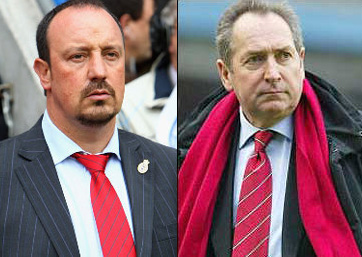
Houllier Vs Benítez: Who “Won”?


Whilst I lost faith with Gérard Houllier before he was sacked in 2004, I do think he did a fine job up until 2002. However, his incredible attack on Benítez cannot mask the fact that Houllier left a pretty dire squad low on value and morale, and that in almost every way you look at it, the Spaniard did better than the Frenchman.
Houllier told Mihir Bose of the Evening Standard:
“After Rafa Benitez left this summer, one of the players sent me a message. He said, ‘Boss, he hasn’t beaten you.’”
I’m not quite sure what Houllier, or the player, means by this. Were they playing against each other?
Houllier won more ‘proper’ trophies than Benítez; but the Spaniard won the one that mattered most, and came close a further two times. Like Houllier, he also won an FA Cup; Rafa faced inferior opposition in the final, but far superior opposition on the way to it. He also took a title challenge into May, later than Houllier.
Benítez won 56% of games, to Houllier’s 50%.
Benítez averaged 72 points a season, the 4th-highest in Premier League history out of those who have managed for more than two seasons; Houllier averaged 65, ranking 9th, behind Roy Evans, his predecessor. Benítez easily has the highest Liverpool average since Kenny Dalglish, and unlike Houllier, improved on his predecessor’s tally.
Houllier’s best season was 2nd, with 80 points; Benítez’s 2nd, with 86 points. (Houllier’s best season also happened to be the one of which he missed almost half, due to a serious heart complaint; results picked up as soon as he fell ill, perhaps due to a “do it for the boss” reaction, which gradually wore off. In fairness, it was his team, but Phil Thompson was doing the legwork.)
Benítez made it to three Champions League semi-finals and two finals, to Houllier’s none. But Houllier did win more League Cups.
Is that what he meant?
“When I came into the changing room in Istanbul some of the players said: ‘Boss it’s your team.’“ …
First of all, what the hell were you doing there, as ex-manager? What kind of egotist walks in like that, even if at the game in an official capacity? Did Roy Evans start wandering into the changing rooms in Cardiff and Dortmund?
… “Twelve out of 14 in Istanbul were players I had signed or developed. I left Liverpool with a team in the Champions League. But when you finish seventh with Torres [er - wasn’t he injured for a lot of 2009/10?] and Gerrard [ditto]. . .” His voice tails off. Houllier does not need to spell out the very different legacy Benitez has left Hodgson.
What, one with 12 players at the World Cup, and four – all signed by Benítez – in the squads for the final? Rafa leaves an excellent team, but one which cannot cope with many injuries and dips in form; as seen last season. It’s not the deepest of squads, as the Spaniard himself acknowledged last season.
Also, Liverpool finished with more points (63 to 60) in Benítez’s final season, and made a semi-final. The team Houllier left won just 16 of their 38 games, compared with the 18 won last season. Neither season was great; but come on, let’s not pretend that was a good Liverpool side six years ago, just as it wasn’t seven years ago.
Liverpool finished 23 points behind the Champions last season; but 30 points behind in 2004. Incredibly, Liverpool lost five league games at Anfield in 2003/04, and did poorly in all three cup competitions.
The problem of one bad season last year – but not as bad as 2003/04 in many respects – was exacerbated by better teams now existing to take advantage. (And while it was one bad season, I’ve said since before 2004 that two poor ones in the row is the true mark of a manager having lost his way.)
Liverpool were also a stable, fairly well-run club back then; no American owners pillaging and plundering. Yes, there was a lack of visionaries at the club, but that’s better than what we’ve had to put up with since 2007.
There was also no Chelsea as we’d know it from 2004 onwards, nor Man City; both clubs have spent millions more than Liverpool. Indeed, in the last three years, Aston Villa, Birmingham, Spurs and even Sunderland have spent more (net) than the Reds. (Maybe Houllier could ask himself why his good friend Arsene Wenger has failed to even finish 2nd since 2004, when up until then his sides finished either as Champions or runners-up.)
Houllier is happily taking credit for Istanbul; but none of the blame for a lame squad that Benítez struggled to get 58 league points with in his first season (more-or-less what Houllier ended with).
He takes credit for Gerrard and Carragher, and yet while he played a big part in their careers, both were at the club when he arrived in 1998, and also further developed by Benítez in his first season; Carragher as a centre-back, Gerrard in a more attacking role (his average goal ratio was 6 a season in Houllier’s time, with a maximum of 10; he averaged around 20 a season under Benítez, with a maximum of 24 and a Footballer of the Year award).
Houllier left Harry Kewell, who was never fully fit after halfway through his debut season (a bit like leaving a written-off Ferrari in pieces in the garage). He left Vladimir Smicer, who was talented but also rarely fit. And Chris Kirkland, who made Kewell and Smicer look indestructible.
He left Djibril Cissé, who, like Emile Heskey, cost in excess of £25m in today’s money (source: TPI), but who lacked guile to go with his pace. He left Jerzy Dudek, whose excellent debut season and sublime performance in Istanbul were great bookends for the three nervy, error-strewn years in between. And as much as I loved Igor Biscan, he was, like Smicer, a hugely inconsistent and relatively expensive player entering the final year of his contract when Benítez took over.
He also left Djimi Traore, a player whose attributes (height, pace) were outweighed by his headless chicken act. Milan Baros was another headless chicken, although at least one with some talent.
He did leave Hyypia and Hamann – two fantastic players – but both were entering the final stages of their careers. Steve Finnan also had a limited time left, but it was only after Benítez arrived that he showed his true worth. And John Arne Riise was a good all-rounder.
But then there’s Salif Diao, El Hadji Diouf, Bruno Cheyrou, Anthony Le Tallec and Carl Medjani. What a waste of time they were.
Getting any kind of money for Houllier’s flops was a challenge. Indeed, making a profit on any of his successes was rare; only Hyypia, if sold at his peak, would have added greatly to his value and brought in enough money to reinvest. (The costly Hamann would have surely got his money back.)
Of course, Traore left for £2m, four times what he cost. Milan Baros was sold for roughly twice what he cost. Alou Diarra, who spent three years at Liverpool out on loan, also raised £2m, having been a free transfer. And the lively, likeable but often ineffective Sinama-Pongolle left for more-or-less what he cost. All told, about £12m raised on £6m of spending.
But Heskey, Cissé and Diouf left for less than half of their considerable original fees, at a time when high football inflation meant that they were sold for even less, in relative terms. Owen left for half of his actual value, too, with his contract in its final 12 months (having refused to sign a new deal under Houllier). Diao left for nothing, as did Cheyrou.
Stephen Warnock was also part of Benítez’s inheritance. But at 22, he’d never been given a single game by Houllier.
As far as I can tell, during his time in charge Houllier didn’t sell for a profit a single player he himself had signed; essential to rebuild without having to force the club to stump up cash it doesn’t possess. And in total, only three players signed between 1998 and 2004 ended up making the club a profit, none of them hugely significant.
Now let’s look at Benítez. Like Houllier, he signed some duds. Unlike Houllier, he regularly sold them for profit to make money to reinvest (making for a high gross spend, but a relatively low net one; essentially the money was recycled).
Following Benítez’s exit, the £1m paid for Insua seems to have turned into £5m. Yossi Benayoun, despite now being 30, left for what he cost; a great deal for a player at that age. San Jose, signed for a negligible fee, recently left for £2.6m; in other words, paying for Danny Wilson.
If the club wanted, it could get £30m for Javier Mascherano and up to £70m for Fernando Torres. Pepe Reina and Daniel Agger are both worth far more now than when purchased; easily £30m combined. These were all excellent investments, both in terms of playing ability and resale value. None is yet at his peak.
Liverpool received £30m for Xabi Alonso, after five seasons (two of them excellent) following a £10.5m (£20m TPI) transfer. Despite only having a year left on his deal, Alvaro Arbeloa also left for a profit, heading to the mighty Madrid.
Flops like Gonzalez, Voronin, Leto and Paletta (due to a sell-on clause) all left for profits (yes, they required wages while here, but then so did all Houllier’s flops.) Nunez, Josemi and Kromkamp all left for more-or-less what they cost. And players like Keane, Dossena and Morientes, though offloaded at a loss, still left for more than half what they cost; only Jermaine Pennant was a complete write-off.
And if sold now, El Zhar, Degen and various other ‘free’ fringe players would lead to a profit, while Maxi – who is in no way a flop – could easily bring in £4m (if Benayoun is worth £6m). Kyrgiakos, a desperate but essential signing when funds were too tight to go beyond £1.5m, would leave for at least what he cost.
Hit-and-miss players like Bellamy, Crouch, Carson (including £2m received by Aston Villa to take him on loan) and Sissoko all raised a lot of money through sales for profit; money that was usually spent on better players, and then disingenuously used against Benítez to make out he’d spent more than he had.
So far, eleven of Benítez’s signings have left for a healthy profit (over £42m in total), compared with Houllier’s three (worth around £6m).
And even if Torres, Reina, Agger and Mascherano weren’t sold until 2013, then unless injured they’d still conceivably raise a profit of over £50m that a future manager could benefit from.
The fact is, if you add every pound spent by Benítez to every pound players have either been sold for or are now worth, he’d be well in profit. Not bad for a manager whose Champions League runs raised much of the cash in the first place, at a time when David Moores was running out of dough, and Gillett and Hicks were looking to run away with the money.
For more on the spending comparison, there is this article I wrote a couple of months ago.
Back to Houllier’s interview:
By then the Frenchman was in sole charge and he still believes his pioneering tenure made it easy for Benitez to follow. “One, the pattern of getting a foreign coach was already accepted. Two, he had a Champions League-winning team.”…
Woah woah woah. Back up. Two of the most important players in 2005 were Xabi Alonso and Luis Garcia. And I don’t recall Liverpool winning the Champions League until a year after Houllier was sacked, following consecutive dire seasons. How can he claim such a thing?
He laid some of the foundations, clearly, but if Roy Hodgson wins the league in 2011 (however unlikely), will Houllier come out and say that it wasn’t down to his good friend, but rather Rafa Benítez? Of course not.
…“Three, the team were already in the Champions League. Four, we had built new facilities. And five, it was a different training routine, different attitude and mentality.”
Maybe these are true. But Liverpool were not Champions League regulars by any stretch of the imagination. And Benítez could not get the boost of introducing basic, continental techniques (fitness, anti-alcohol, etc) because Houllier already had. That one cuts both ways.
Above all else, it strikes me that the miracle of Istanbul was not due to the fact that the Reds came from 3-0 down at half-time against the mighty AC Milan, but how such a collection of players could even get near the final, let alone win it.
And for that reason, Benítez deserves far more respect than his bitter predecessor seems capable of affording him.